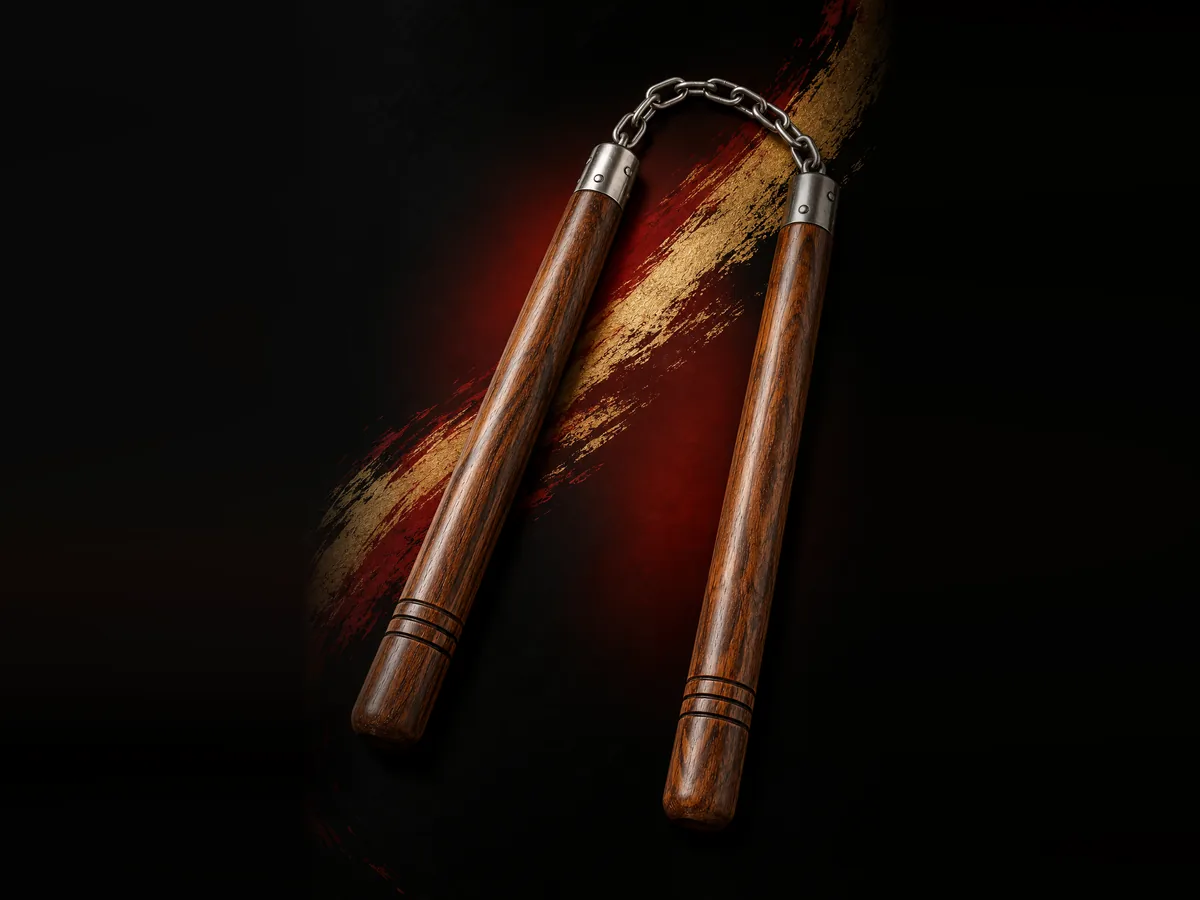
O nunchaku faz parte do kobudō de Okinawa; a origem é discutida (um mangual para cereais ou o freio de um cavalo são teorias comuns) e tem parentes na China. Os filmes de Bruce Lee no início dos anos 1970 tornaram-no famoso no mundo inteiro, e alguns países passaram a restringi-lo.
Dois paus de cerca de 30 cm, redondos ou octogonais, unidos numa ponta por um cordão (himo) ou corrente. As versões de treino são de espuma ou plástico.
Técnicas básicas
furi (balanço)
uchi (golpe)
kaeshi (apanhar e trocar de mão)
shime (estrangulamento/chave)
kata de nunchaku
Treino
As armas flexíveis aprendem-se devagar, com versões de espuma, corda ou borracha: primeiro os balanços e voltas à volta do corpo, depois as trocas de mão e as paragens, e só mais tarde os golpes num alvo. Os erros castigam primeiro quem a usa, por isso a velocidade vem no fim.
Segurança
Comece com versões macias, use proteção para os olhos e mantenha um círculo livre largo à sua volta. Verifique correntes, cordas e uniões antes de cada sessão: uma peça que parte a meio do balanço torna-se um projétil.
Legalidade (informação geral)
Paus, bastões e outras armas de impacto ou flexíveis são objetos comuns em alguns países e armas proibidas ou limitadas noutros (vários países europeus, por exemplo, regulam nunchaku, bastões extensíveis ou correntes com peso). Andar com uma na rua sem motivo pode ser infração mesmo onde é legal tê-la. Transporte-a num saco e use-a no local de treino. Isto é informação geral, não aconselhamento jurídico: confirme a lei local.
Curiosidades
Existe uma versão desportiva moderna com nunchaku almofadados, com federações internacionais e combate por pontos.
The nunchaku is part of Okinawan kobudō; its origin is debated (a flail for grain or a horse bit are common theories) and it has relatives in China. Bruce Lee’s films in the early 1970s made it world famous, and some countries then restricted it.
Two sticks of about 30 cm, round or octagonal, joined at one end by a cord (himo) or chain. Training versions are made of foam or plastic.
Basic techniques
furi (swing)
uchi (strike)
kaeshi (catch and switch)
shime (choke/lock)
nunchaku kata
Training
Flexible weapons are learned slowly with foam, rope or rubber versions: first the swings and wraps around the body, then changes of hand and stops, and only later strikes at a target. They punish mistakes on the user first, so speed comes last.
Safety
Start with soft versions, wear eye protection and keep a wide empty circle around you. Check chains, cords and joints before each session: a part that breaks mid-swing becomes a projectile.
Legality (general information)
Sticks, staffs and other impact or flexible weapons are ordinary objects in some countries and restricted weapons in others (several European countries, for example, regulate nunchaku, batons or weighted chains). Carrying one in public without a good reason can be an offence even where owning it is legal. Transport it in a bag and use it in the training hall. This is general information, not legal advice: check local law.
Did you know?
There is a modern sport version with padded nunchaku, with its own international federations and point fighting.
El nunchaku forma parte del kobudō de Okinawa; su origen se discute (un mayal para el grano o el bocado de un caballo son teorías comunes) y tiene parientes en China. Las películas de Bruce Lee a principios de los años 1970 lo hicieron mundialmente famoso, y algunos países pasaron a restringirlo.
Dos palos de unos 30 cm, redondos u octogonales, unidos en un extremo por un cordón (himo) o cadena. Las versiones de práctica son de espuma o plástico.
Técnicas básicas
furi (balanceo)
uchi (golpe)
kaeshi (atrapar y cambiar de mano)
shime (estrangulación/luxación)
kata de nunchaku
Entrenamiento
Las armas flexibles se aprenden despacio, con versiones de espuma, cuerda o goma: primero los giros y vueltas alrededor del cuerpo, luego los cambios de mano y las paradas, y solo más tarde los golpes a un objetivo. Los errores castigan primero a quien la usa, por eso la velocidad llega al final.
Seguridad
Empiece con versiones blandas, use protección ocular y mantenga un círculo libre amplio a su alrededor. Revise cadenas, cuerdas y uniones antes de cada sesión: una pieza que se rompe en pleno giro se convierte en un proyectil.
Legalidad (información general)
Palos, bastones y otras armas de impacto o flexibles son objetos corrientes en algunos países y armas restringidas en otros (varios países europeos, por ejemplo, regulan el nunchaku, las porras o las cadenas con peso). Llevar una en público sin motivo puede ser infracción aunque poseerla sea legal. Transpórtela en una bolsa y úsela en la sala de entrenamiento. Es información general, no asesoramiento jurídico: consulte la ley local.
Curiosidades
Existe una versión deportiva moderna con nunchaku acolchados, con federaciones internacionales y combate por puntos.
Le nunchaku fait partie du kobudō d’Okinawa ; son origine est débattue (fléau à grain ou mors de cheval sont des hypothèses courantes) et il a des cousins en Chine. Les films de Bruce Lee au début des années 1970 le rendent célèbre dans le monde entier, et certains pays le restreignent ensuite.
Deux bâtons d’environ 30 cm, ronds ou octogonaux, reliés à une extrémité par une cordelette (himo) ou une chaîne. Les versions d’entraînement sont en mousse ou en plastique.
Techniques de base
furi (balancement)
uchi (frappe)
kaeshi (rattraper et changer de main)
shime (étranglement/clé)
kata de nunchaku
Entraînement
Les armes souples s’apprennent lentement avec des versions en mousse, corde ou caoutchouc : d’abord les moulinets et enroulements autour du corps, puis les changements de main et les arrêts, et seulement ensuite les frappes sur cible. Les erreurs punissent d’abord l’utilisateur ; la vitesse vient en dernier.
Sécurité
Commencez avec des versions souples, portez une protection des yeux et gardez un large cercle libre autour de vous. Vérifiez chaînes, cordes et jonctions avant chaque séance : une pièce qui casse en plein mouvement devient un projectile.
Légalité (information générale)
Bâtons, cannes et autres armes contondantes ou souples sont des objets ordinaires dans certains pays et des armes réglementées dans d’autres (plusieurs pays européens encadrent par exemple le nunchaku, la matraque ou les chaînes lestées). Les porter en public sans motif peut constituer une infraction même là où leur détention est légale. Transportez-les dans un sac et utilisez-les en salle. Ceci est une information générale, pas un conseil juridique : vérifiez la loi locale.
Le saviez-vous ?
Il existe une version sportive moderne avec nunchaku rembourrés, avec ses fédérations internationales et son combat aux points.