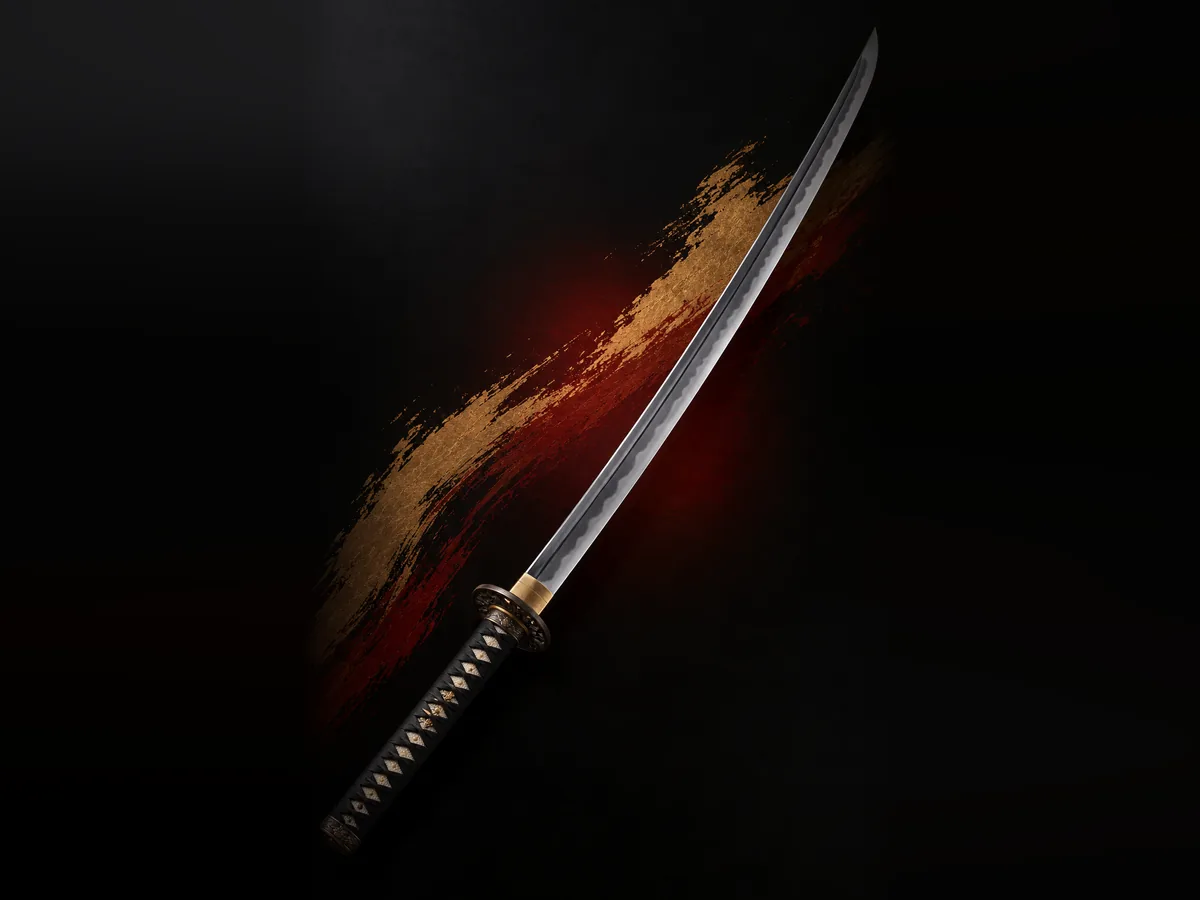
A espada curva de um só gume dos samurais, usada com o gume para cima, enfiada no cinto. A lâmina é dura no gume e mais macia nas costas, o que deixa a linha ondulada da têmpera (hamon).
Katana Ilustração WABUKAN
Outros nomes
刀 · uchigatana; daitō; nihontō
Origem e história
A katana surgiu no período Muromachi (séc. XIV–XV), quando o combate a pé tornou mais prático usar a espada enfiada no cinto com o gume para cima do que a longa tachi suspensa. Tornou-se a arma principal dos samurais e, depois do édito Haitōrei de 1876, que proibiu andar armado, um símbolo mantido vivo pelo kenjutsu, pelo iaido e pelo kendo.
Lâmina de cerca de 60–80 cm, ligeiramente curva, forjada em aço dobrado (tradicionalmente tamahagane do forno tatara). O gume é temperado sob argila, o que cria o hamon; o punho (tsuka) é forrado a pele de raia e entrançado, e a guarda chama-se tsuba.
Sword Guard (Tsuba) with Fence and Flower, c. 1615–1868. Foto: Cleveland Museum of Art, domínio público (CC0) · Ficha do museuSword Guard (Tsuba) with Elephant in Pine, c. 1800. Foto: Cleveland Museum of Art, domínio público (CC0) · Ficha do museuSword Guard (Tsuba) with Plovers in Waves, c. 1615–1868. Foto: Cleveland Museum of Art, domínio público (CC0) · Ficha do museu
Técnicas básicas
kiri-oroshi
kesa-giri
yoko-giri
tsuki
nukitsuke
chiburi
nōtō
Treino
Os principiantes aprendem primeiro a pega, a postura e o trabalho de pés; depois as linhas de corte e de estocada em formas a solo ou exercícios, normalmente com uma réplica de madeira ou sem fio. Seguem-se exercícios a pares, devagar, antes de qualquer combate livre com proteções.
Segurança
Treine com réplicas de madeira, sem fio ou aprovadas pelo clube; lâminas verdadeiras só para praticantes experientes e com supervisão. Verifique lâmina, cabo e montagens antes de cada sessão, mantenha um espaço livre de pelo menos dois comprimentos da arma e nunca corte na direção de pessoas.
Legalidade (informação geral)
Espadas, facas e outras armas de lâmina são reguladas de forma muito diferente de país para país (e por vezes de região para região): ter uma em casa é muitas vezes permitido, mas trazê-la na via pública, comprá-la abaixo de certa idade ou importá-la pode estar limitado ou proibido. Os praticantes costumam transportá-las em estojo fechado, fora de alcance e diretamente entre casa e dojo. Isto é informação geral, não aconselhamento jurídico: confirme a lei onde vive.
Curiosidades
As espadas antigas classificam-se pelo comprimento: mais de 2 shaku (cerca de 60,6 cm) é katana, entre 1 e 2 shaku é wakizashi, menos de 1 shaku é tantō.
The curved, single-edged sword of the samurai, worn edge-up through the belt. Its blade is hardened along the edge and softer in the spine, which leaves the wavy temper line (hamon).
Katana WABUKAN illustration
Also known as
刀 · uchigatana; daitō; nihontō
Origin and history
The katana appeared in the Muromachi period (14th–15th c.), when fighting on foot made a sword worn edge-up through the belt more practical than the long slung tachi. It became the main sidearm of the samurai and, after the 1876 Haitōrei edict banned swords in public, a symbol kept alive by kenjutsu, iaido and kendo.
A blade of about 60–80 cm, slightly curved, forged from folded steel (traditionally tamahagane from the tatara furnace). The edge is clay-hardened, which gives the hamon; the hilt (tsuka) is wrapped over rayskin and the guard is the tsuba.
Sword Guard (Tsuba) with Fence and Flower, c. 1615–1868. Photo: Cleveland Museum of Art, public domain (CC0) · Museum recordSword Guard (Tsuba) with Elephant in Pine, c. 1800. Photo: Cleveland Museum of Art, public domain (CC0) · Museum recordSword Guard (Tsuba) with Plovers in Waves, c. 1615–1868. Photo: Cleveland Museum of Art, public domain (CC0) · Museum record
Basic techniques
kiri-oroshi
kesa-giri
yoko-giri
tsuki
nukitsuke
chiburi
nōtō
Training
Beginners learn grip, posture and footwork first, then cutting and thrusting lines in solo forms or drills, usually with a wooden or blunt trainer. Paired drills with a partner come next, at slow speed, before any free sparring with protective gear.
Safety
Train with wooden, blunt or club-approved trainers; keep live blades for experienced practitioners under supervision. Check the blade, handle and fittings before every session, keep a clear space of at least two weapon lengths and never cut towards people.
Legality (general information)
Swords, knives and other edged weapons are regulated very differently from country to country (and sometimes from region to region): owning one at home is often allowed, while carrying it in public, buying it under a certain age or importing it may be restricted or banned. Practitioners usually transport them cased, out of reach and straight between home and dojo. This is general information, not legal advice: check the law where you live.
Did you know?
Old swords are graded by length: over 2 shaku (about 60.6 cm) is a katana, between 1 and 2 shaku a wakizashi, under 1 shaku a tantō.
La espada curva de un solo filo de los samuráis, llevada con el filo hacia arriba en el cinturón.
Katana Ilustración WABUKAN
Otros nombres
刀 · uchigatana; daitō; nihontō
Origen e historia
La katana apareció en el periodo Muromachi (s. XIV–XV), cuando el combate a pie hizo más práctico llevar la espada metida en el cinturón con el filo hacia arriba que la larga tachi colgada. Se convirtió en el arma principal de los samuráis y, tras el edicto Haitōrei de 1876, que prohibió ir armado, en un símbolo que mantienen vivo el kenjutsu, el iaido y el kendo.
Hoja de unos 60–80 cm, ligeramente curva, forjada en acero plegado (tradicionalmente tamahagane del horno tatara). El filo se templa bajo arcilla, lo que crea el hamon; la empuñadura (tsuka) va forrada de piel de raya y trenzada, y la guarda es la tsuba.
Sword Guard (Tsuba) with Fence and Flower, c. 1615–1868. Foto: Cleveland Museum of Art, dominio público (CC0) · Ficha del museoSword Guard (Tsuba) with Elephant in Pine, c. 1800. Foto: Cleveland Museum of Art, dominio público (CC0) · Ficha del museoSword Guard (Tsuba) with Plovers in Waves, c. 1615–1868. Foto: Cleveland Museum of Art, dominio público (CC0) · Ficha del museo
Técnicas básicas
kiri-oroshi
kesa-giri
yoko-giri
tsuki
nukitsuke
chiburi
nōtō
Entrenamiento
Los principiantes aprenden primero el agarre, la postura y el juego de pies; después las líneas de corte y de estocada en formas en solitario o ejercicios, normalmente con una réplica de madera o roma. Luego vienen los ejercicios por parejas, despacio, antes de cualquier combate libre con protecciones.
Seguridad
Entrene con réplicas de madera, romas o aprobadas por el club; las hojas reales solo para practicantes expertos y bajo supervisión. Revise hoja, empuñadura y montura antes de cada sesión, mantenga un espacio libre de al menos dos largos del arma y nunca corte hacia personas.
Legalidad (información general)
Las espadas, cuchillos y demás armas blancas se regulan de forma muy distinta según el país (y a veces según la región): tener una en casa suele estar permitido, pero llevarla en la vía pública, comprarla por debajo de cierta edad o importarla puede estar limitado o prohibido. Los practicantes suelen transportarlas en funda cerrada, fuera de alcance y directamente entre casa y dojo. Es información general, no asesoramiento jurídico: consulte la ley donde vive.
Curiosidades
Las espadas antiguas se clasifican por longitud: más de 2 shaku (unos 60,6 cm) es katana, entre 1 y 2 shaku wakizashi, menos de 1 shaku tantō.
Le sabre courbe à un seul tranchant des samouraïs, porté tranchant vers le haut dans la ceinture.
Katana Illustration WABUKAN
Autres noms
刀 · uchigatana; daitō; nihontō
Origine et histoire
Le katana apparaît à l’époque Muromachi (XIVe–XVe s.), quand le combat à pied rend plus pratique un sabre glissé dans la ceinture, tranchant vers le haut, que le long tachi suspendu. Il devient l’arme principale des samouraïs puis, après l’édit Haitōrei de 1876 qui interdit le port du sabre, un symbole entretenu par le kenjutsu, l’iaido et le kendo.
Lame d’environ 60–80 cm, légèrement courbe, forgée en acier replié (traditionnellement du tamahagane issu du four tatara). Le tranchant est trempé sous argile, d’où le hamon ; la poignée (tsuka) est recouverte de peau de raie et tressée, la garde s’appelle tsuba.
Sword Guard (Tsuba) with Fence and Flower, c. 1615–1868. Photo : Cleveland Museum of Art, domaine public (CC0) · Fiche du muséeSword Guard (Tsuba) with Elephant in Pine, c. 1800. Photo : Cleveland Museum of Art, domaine public (CC0) · Fiche du muséeSword Guard (Tsuba) with Plovers in Waves, c. 1615–1868. Photo : Cleveland Museum of Art, domaine public (CC0) · Fiche du musée
Techniques de base
kiri-oroshi
kesa-giri
yoko-giri
tsuki
nukitsuke
chiburi
nōtō
Entraînement
Les débutants apprennent d’abord la prise, la posture et le jeu de jambes, puis les lignes de coupe et d’estoc en formes solo ou en exercices, généralement avec une arme d’entraînement en bois ou émoussée. Viennent ensuite les exercices à deux, lentement, avant tout assaut libre avec protections.
Sécurité
Entraînez-vous avec des répliques en bois, émoussées ou homologuées par le club ; les lames vives sont réservées aux pratiquants confirmés et encadrés. Vérifiez lame, poignée et montures avant chaque séance, gardez un espace libre d’au moins deux longueurs d’arme et ne coupez jamais vers quelqu’un.
Légalité (information générale)
Les épées, couteaux et autres armes blanches sont réglementés très différemment d’un pays à l’autre (parfois d’une région à l’autre) : en posséder une chez soi est souvent permis, mais la porter dans la rue, l’acheter avant un certain âge ou l’importer peut être limité ou interdit. Les pratiquants la transportent en général dans un étui fermé, hors de portée et directement entre domicile et dojo. Ceci est une information générale, pas un conseil juridique : vérifiez la loi là où vous vivez.
Le saviez-vous ?
Les sabres anciens se classent par longueur : plus de 2 shaku (environ 60,6 cm) c’est un katana, entre 1 et 2 shaku un wakizashi, moins de 1 shaku un tantō.