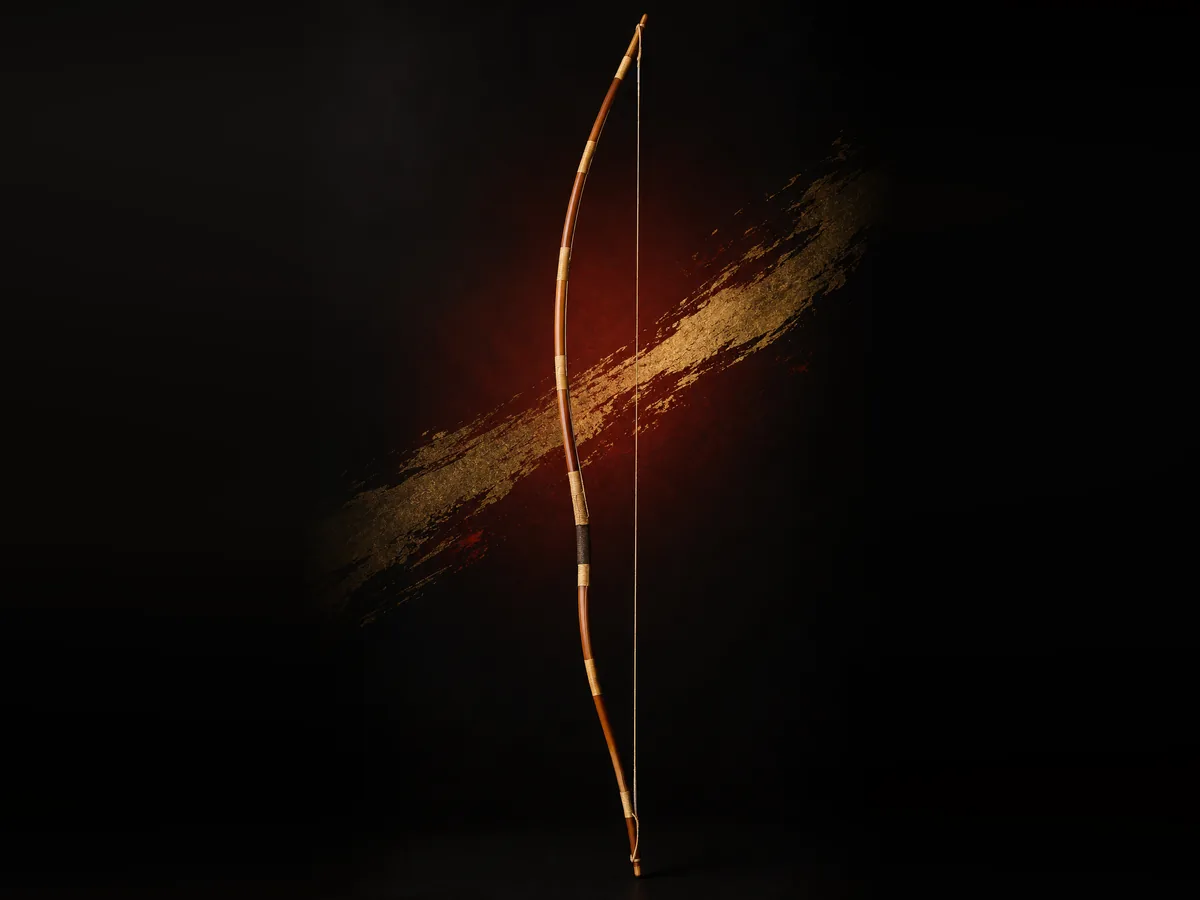
O arco longo japonês, com mais de dois metros e assimétrico: a pega fica abaixo do meio. Ainda hoje mestres artesãos o fazem de bambu e madeira.
Yumi Ilustração WABUKAN
Outros nomes
弓 · daikyū; hankyū (short bow)
Origem e história
O arco japonês aparece em artefactos da idade do bronze e foi durante séculos a principal arma dos samurais; o código guerreiro antigo chamava-se “caminho do cavalo e do arco” (kyūba no michi). Hoje usa-se no kyūdō e no tiro a cavalo (yabusame) nos santuários.
Arco longo assimétrico com mais de 2 m, com a pega a cerca de um terço da base, tradicionalmente feito de bambu e madeira colados em camadas. As flechas (ya) são de bambu com penas; o arqueiro usa uma luva (yugake).
Técnicas básicas
ashibumi
dōzukuri
yugamae
uchiokoshi
hikiwake
kai
hanare
zanshin (hassetsu)
Treino
As armas de distância treinam-se numa carreira com anteparo seguro: postura, pega, largada e respiração repetem-se até o movimento ser igual em todas as vezes. A distância só aumenta quando a forma está estável.
Segurança
Só atire ou lance numa carreira supervisionada com anteparo seguro, nunca na direção de algo que não queira atingir, e nunca vá buscar setas ou lâminas enquanto outros estão a atirar.
Legalidade (informação geral)
Arcos, lâminas de arremesso e armas semelhantes são muitas vezes legais de ter, mas só podem ser usados em carreiras de tiro aprovadas ou segundo as regras do clube; algumas armas de arremesso (como shuriken ou estrelas de lançamento) são proibidas em vários países. Isto é informação geral, não aconselhamento jurídico: confirme a lei local e as regras da sua federação.
Curiosidades
Por causa da assimetria e da torção do pulso na largada (tenouchi), o arco roda na mão depois do tiro e a corda acaba do lado de fora do braço.
The Japanese longbow, over two metres long and asymmetric: the grip sits below the centre. It is still made of bamboo and wood by master bowmakers.
Yumi WABUKAN illustration
Also known as
弓 · daikyū; hankyū (short bow)
Origin and history
The Japanese bow is shown on bronze-age artefacts and was the samurai’s chief weapon for centuries; the early warrior code was called “the way of horse and bow” (kyūba no michi). Today it is used in kyūdō and in mounted archery (yabusame) at shrines.
An asymmetric longbow over 2 m long, with the grip about one third from the bottom, traditionally laminated from bamboo and wood glued together. Arrows (ya) are bamboo with feather fletching; the archer wears a glove (yugake).
Basic techniques
ashibumi
dōzukuri
yugamae
uchiokoshi
hikiwake
kai
hanare
zanshin (hassetsu)
Training
Ranged weapons are trained on a range with a safe backstop: stance, grip, release and breathing are repeated until the movement is identical every time. Distance increases only after the form is stable.
Safety
Only shoot or throw on a supervised range with a safe backstop, never towards anything you would not want to hit, and never retrieve while others are shooting or throwing.
Legality (general information)
Bows, throwing blades and similar weapons are often legal to own but may only be used on approved ranges or under club rules; some throwing weapons (such as shuriken or throwing stars) are banned outright in several countries. This is general information, not legal advice: check local law and your federation’s rules.
Did you know?
Because of the asymmetry and the twist of the wrist on release (tenouchi), the bow rotates in the hand after the shot so the string ends outside the arm.
El arco japonés aparece en objetos de la edad del bronce y fue durante siglos la principal arma de los samuráis; el antiguo código guerrero se llamaba «camino del caballo y del arco» (kyūba no michi). Hoy se usa en el kyūdō y en el tiro a caballo (yabusame) en los santuarios.
Arco largo asimétrico de más de 2 m, con la empuñadura a un tercio de la base, hecho tradicionalmente de bambú y madera laminados. Las flechas (ya) son de bambú con plumas; el arquero usa un guante (yugake).
Técnicas básicas
ashibumi
dōzukuri
yugamae
uchiokoshi
hikiwake
kai
hanare
zanshin (hassetsu)
Entrenamiento
Las armas de distancia se practican en un campo con parapeto seguro: postura, agarre, suelta y respiración se repiten hasta que el movimiento sea idéntico cada vez. La distancia solo aumenta cuando la forma es estable.
Seguridad
Dispare o lance solo en un campo supervisado con parapeto seguro, nunca hacia algo que no quiera alcanzar, y nunca recoja mientras otros están tirando.
Legalidad (información general)
Arcos, armas arrojadizas y similares suelen ser legales de poseer, pero solo pueden usarse en campos autorizados o según las normas del club; algunas armas arrojadizas (como los shuriken o estrellas) están prohibidas en varios países. Es información general, no asesoramiento jurídico: consulte la ley local y las normas de su federación.
Curiosidades
Por la asimetría y el giro de muñeca en la suelta (tenouchi), el arco gira en la mano tras el disparo y la cuerda acaba por fuera del brazo.
L’arc japonais apparaît sur des objets de l’âge du bronze et fut pendant des siècles l’arme principale des samouraïs ; l’ancien code guerrier s’appelait « la voie du cheval et de l’arc » (kyūba no michi). On l’utilise aujourd’hui en kyūdō et au tir à cheval (yabusame) dans les sanctuaires.
Arc long asymétrique de plus de 2 m, la poignée au tiers inférieur, traditionnellement en bambou et bois laminés. Les flèches (ya) sont en bambou empenné ; l’archer porte un gant (yugake).
Techniques de base
ashibumi
dōzukuri
yugamae
uchiokoshi
hikiwake
kai
hanare
zanshin (hassetsu)
Entraînement
Les armes à distance se travaillent sur un pas de tir avec une butte sûre : posture, prise, lâcher et respiration se répètent jusqu’à ce que le geste soit identique à chaque fois. La distance n’augmente qu’une fois la forme stabilisée.
Sécurité
Ne tirez ou ne lancez que sur un pas de tir encadré avec une butte sûre, jamais vers ce que vous ne voulez pas atteindre, et n’allez jamais récupérer pendant que d’autres tirent.
Légalité (information générale)
Arcs, lames de lancer et armes similaires sont souvent légaux à détenir mais ne peuvent être utilisés que sur des pas de tir agréés ou selon les règles du club ; certaines armes de lancer (comme les shuriken ou étoiles) sont interdites dans plusieurs pays. Ceci est une information générale, pas un conseil juridique : vérifiez la loi locale et les règles de votre fédération.
Le saviez-vous ?
Avec l’asymétrie et la torsion du poignet au lâcher (tenouchi), l’arc tourne dans la main après le tir et la corde finit à l’extérieur du bras.