Karaté ou taekwondo? Origens, técnicas, regras e treino lado a lado
· 4 min de leitura
O karaté e o taekwondo são duas das artes marciais mais praticadas do mundo. Ambas usam socos e pontapés, ambas têm formas, cinturões e uma história olímpica, e ambas são muitas vezes confundidas por quem está a começar. Mas vêm de lugares diferentes, treinam-se de forma diferente e, em competição, premeiam coisas diferentes. Eis uma comparação lado a lado.
Origens
O karaté nasceu em Okinawa, no antigo reino das ilhas Ryūkyū, a partir de métodos de combate locais (te) misturados com influências chinesas. Em 1922, Gichin Funakoshi fez uma demonstração em Tóquio e ficou a ensiná-lo no Japão continental. O nome escrevia-se primeiro 唐手, «mão chinesa»; em 1936, os mestres de Okinawa adotaram a escrita 空手, «mão vazia». Saiba mais no nosso artigo sobre o Okinawa-te.
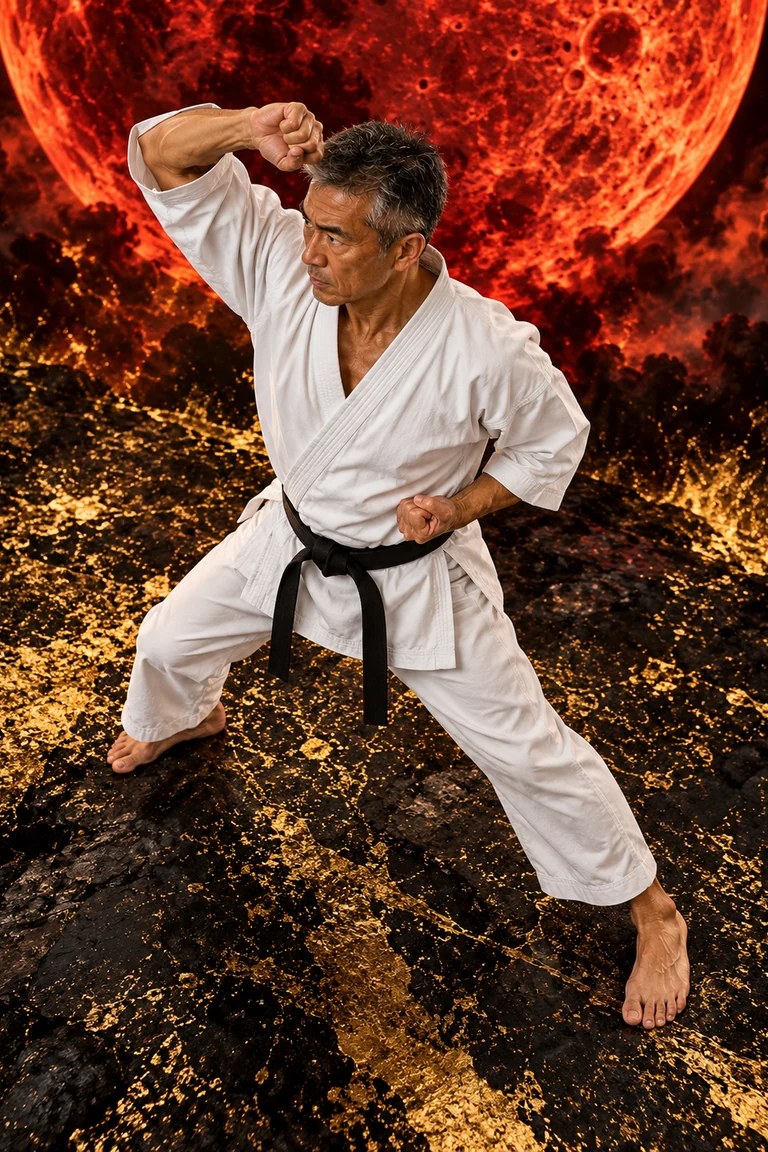
Karaté: posições baixas e técnicas de braço e perna equilibradas. Ilustração WABUKAN
O taekwondo nasceu na Coreia depois de 1945. Vários dos seus fundadores tinham treinado karaté no Japão durante a ocupação japonesa da Coreia e, de regresso, abriram escolas (kwan) que misturavam esse karaté com tradições coreanas como o taekkyeon. Em 1955 adotou-se o nome taekwondo, «o caminho do pé e do punho», sob a liderança do general Choi Hong-hi. Seguiram-se duas grandes organizações: a ITF (1966), fundada por Choi, e a WTF, hoje World Taekwondo (1973), ligada ao Kukkiwon de Seul.
Técnicas
É a diferença mais visível. O karaté procura um equilíbrio entre braços e pernas: socos diretos, defesas, golpes de cotovelo e joelho, e pontapés geralmente dirigidos ao tronco. As posições são mais baixas e estáveis, e muitos estilos ensinam também projeções, varrimentos e chaves dentro dos kata.
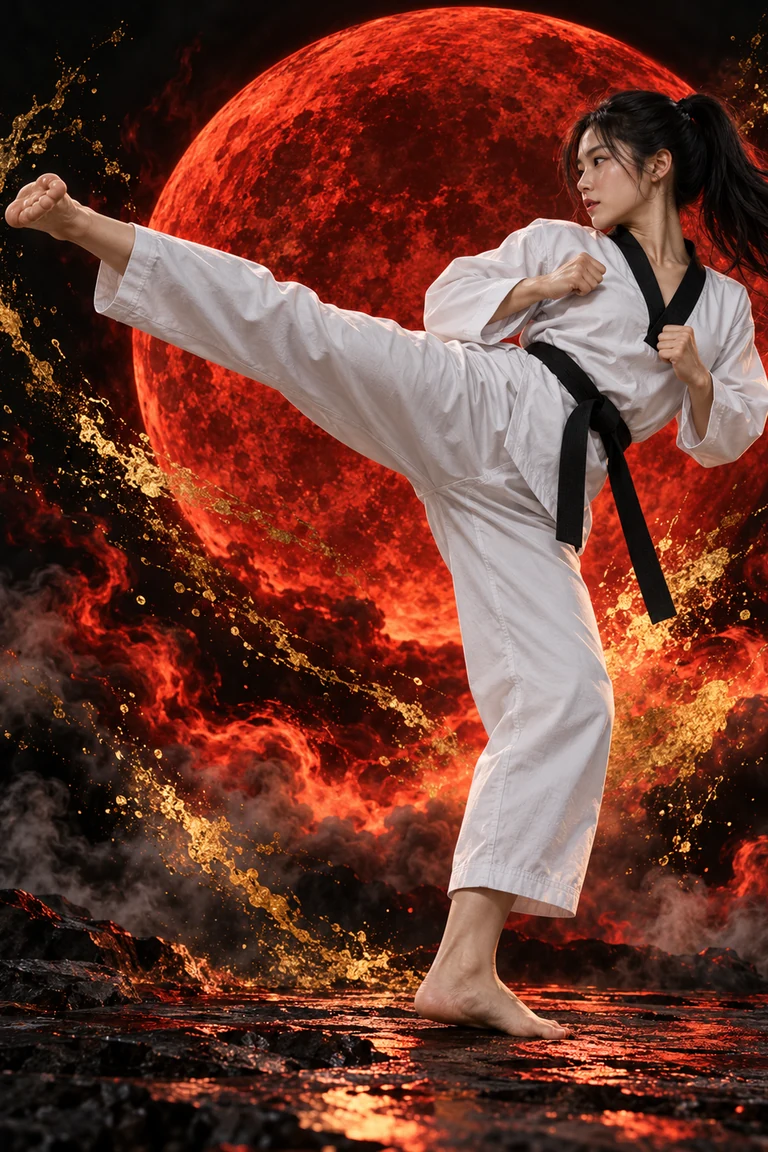
O taekwondo é famoso pelos pontapés: altos, em salto e rotativos, muitas vezes dirigidos à cabeça. As posições são mais leves e móveis, com trabalho de pés constante para gerir a distância. Os braços usam-se, mas no taekwondo desportivo têm um papel muito menor.
As duas artes partilham também a tradição da quebra de tábuas, telhas ou tijolos para testar a potência e a precisão de uma técnica: tameshiwari no karaté, gyeokpa no taekwondo. No taekwondo faz parte de muitos exames de graduação e demonstrações; no karaté está mais associada a certos estilos, como o kyokushin.
Taekwondo: a arte coreana é conhecida pelos pontapés altos e rotativos. Ilustração WABUKAN
Formas
Ambas as artes conservam sequências coreografadas de técnicas. No karaté chamam-se kata (Heian, Bassai, Kankū e muitos outros, conforme o estilo). No taekwondo, as primeiras formas inspiraram-se nos kata do karaté; mais tarde, a ITF criou os seus tul e o Kukkiwon os poomsae (Taegeuk e outros). Hoje ambas as artes têm também competições de formas.
Uniforme, local e língua
O karaté pratica-se num dojo, com um karategi, um casaco branco fechado pelo cinturão. O taekwondo pratica-se num dojang, com um dobok: no World Taekwondo tem decote em V e veste-se pela cabeça, enquanto a ITF mantém o casaco cruzado. Ambas as artes começam e acabam as aulas com uma saudação, mas a língua muda: no karaté, a contagem e os nomes das técnicas são em japonês (ichi, ni, san); no taekwondo, em coreano (hana, dul, set). O professor chama-se sensei no karaté e sabeomnim no taekwondo.
Competição
No karaté WKF (a federação reconhecida pelo COI), o kumite disputa-se com contacto ligeiro e técnicas controladas. Os pontos dependem da técnica: um soco vale menos do que um pontapé à cabeça ou uma projeção seguida de golpe. O objetivo é mostrar uma técnica limpa e controlada, à distância certa. Outras formas de karaté, como o kyokushin, usam contacto pleno, sem socos à cabeça.
No World Taekwondo, os atletas usam colete e capacete, e desde os Jogos Olímpicos de 2012 os pontos são registados por sensores eletrónicos. Os pontapés à cabeça e os rotativos valem mais do que as técnicas simples, o que explica o estilo que se vê nos Jogos: muitos pontapés, poucos socos e um jogo constante com a perna da frente.
Os Jogos Olímpicos
O taekwondo foi desporto de demonstração em 1988 e 1992 e passou a modalidade olímpica oficial em Sydney 2000; faz parte do programa desde então. O karaté só se estreou em Tóquio 2020, realizado em 2021, e não foi incluído nos Jogos seguintes. Ambos continuam a ter campeonatos do mundo e provas continentais todos os anos.
Treino e para quem
As duas artes servem para crianças e adultos e desenvolvem coordenação, flexibilidade, disciplina e condição física. Uma aula de karaté inclui normalmente kihon (base), kata e kumite; uma aula de taekwondo dá mais tempo a exercícios de pontapé, flexibilidade e mobilidade. Quem gosta de técnicas precisas, bem assentes, e de um leque largo de ferramentas pode preferir o karaté; quem aprecia velocidade, agilidade e pontapés espetaculares sentir-se-á em casa no taekwondo. No fim, a qualidade do professor e do clube conta mais do que o nome da arte.
Karate or taekwondo? Origins, techniques, rules and training side by side
· 4 min read
Karate and taekwondo are two of the most practised martial arts in the world. Both use punches and kicks, both have forms, belts and an Olympic history, and both are often confused by those who are just starting. But they come from different places, train differently and, in competition, reward different things. Here is a side-by-side comparison.
Origins
Karate was born in Okinawa, in the old kingdom of the Ryūkyū islands, from local fighting methods (te) mixed with Chinese influences. In 1922, Gichin Funakoshi gave a demonstration in Tokyo and stayed to teach it on the Japanese mainland. The name was first written 唐手, "Chinese hand"; in 1936 Okinawan masters adopted the writing 空手, "empty hand". Read more in our article on Okinawa-te.
Karate: low stances and a balance of hand and leg techniques. WABUKAN illustration
Taekwondo was born in Korea after 1945. Several of its founders had trained karate in Japan during the Japanese occupation of Korea and, back home, opened schools (kwan) that mixed this karate with Korean traditions such as taekkyeon. In 1955 the name taekwondo, "the way of the foot and the fist", was adopted, under the leadership of General Choi Hong-hi. Two major organisations followed: the ITF (1966), founded by Choi, and the WTF, now World Taekwondo (1973), linked to the Kukkiwon in Seoul.
Techniques
This is the most visible difference. Karate seeks a balance between hands and legs: straight punches, blocks, elbow and knee strikes, and kicks generally aimed at the body. Stances are lower and more stable, and many styles also teach throws, sweeps and joint locks inside the kata.
Taekwondo is famous for its kicks: high kicks, jumping kicks and spinning kicks, often thrown at the head. Stances are lighter and more mobile, with constant footwork to manage distance. The hands are used, but in sport taekwondo they play a much smaller role.
Both arts also share a tradition of breaking boards, tiles or bricks to test the power and precision of a technique: tameshiwari in karate, gyeokpa in taekwondo. In taekwondo it is part of many grading exams and demonstrations; in karate it is more associated with certain styles, such as kyokushin.
Taekwondo: the Korean art is known for high and spinning kicks. WABUKAN illustration
Forms
Both arts preserve choreographed sequences of techniques. In karate they are called kata (Heian, Bassai, Kankū and many others, depending on the style). In taekwondo, the first forms were inspired by karate kata; later, the ITF created its own tul and the Kukkiwon the poomsae (Taegeuk and others). Today both arts also hold competitions in forms.
Uniform, place and language
Karate is practised in a dojo wearing a karategi, a white jacket closed by the belt. Taekwondo is practised in a dojang wearing a dobok: in World Taekwondo it has a V-neck and is pulled over the head, while the ITF keeps a wrap-around jacket. Both arts begin and end classes with a bow, but the language changes: in karate the counting and the names of techniques are in Japanese (ichi, ni, san), in taekwondo in Korean (hana, dul, set). The teacher is called sensei in karate and sabeomnim in taekwondo.
Competition
In WKF karate (the federation recognised by the IOC), kumite is fought with light contact and controlled techniques. Points depend on the technique: a punch is worth less than a kick to the head or a takedown followed by a strike. The aim is to show a clean, controlled technique at the right distance. Other forms of karate, such as kyokushin, use full contact, without punches to the head.
In World Taekwondo, athletes wear a chest protector and helmet, and since the 2012 Olympic Games points have been recorded by electronic sensors. Kicks to the head and spinning kicks are worth more than simple techniques, which explains the style seen at the Olympics: many kicks, few punches, and constant play with the front leg.
The Olympic Games
Taekwondo was a demonstration sport in 1988 and 1992 and became an official Olympic sport in Sydney 2000; it has been part of the programme ever since. Karate made its debut only at Tokyo 2020, held in 2021, and was not included in the following Games. Both continue to have world championships and continental events every year.
Training and who it suits
Both arts are suitable for children and adults and develop coordination, flexibility, discipline and fitness. A karate class usually includes kihon (basics), kata and kumite; a taekwondo class gives more time to kicking drills, flexibility and mobility. Those who like precise, rooted techniques and a broad range of tools may prefer karate; those who enjoy speed, agility and spectacular kicks will feel at home in taekwondo. In the end, the quality of the teacher and the club matters more than the name of the art.
Summary
Origin: karate, Okinawa (Japan); taekwondo, Korea.
Emphasis: karate, hands and legs in balance; taekwondo, kicks.
Forms: kata; tul or poomsae.
Olympics: karate only in Tokyo 2020; taekwondo since 2000.
Discover both in detail on the pages for karate and taekwondo, and read our article on taekwondo.
Timeline
1922Funakoshi demonstrates karate in Tokyo.
1936Okinawan masters adopt the writing 空手, 'empty hand'.
1955The name taekwondo is adopted in South Korea.
1966 / 1973ITF and WTF (now World Taekwondo) are founded.
2000Taekwondo debuts as an Olympic sport in Sydney.
2021Karate at the Tokyo 2020 Games (held in 2021).
¿Karate o taekwondo? Orígenes, técnicas, reglas y entrenamiento cara a cara
· 4 min de lectura
El karate y el taekwondo son dos de las artes marciales más practicadas del mundo. Ambas usan puñetazos y patadas, ambas tienen formas, cinturones e historia olímpica, y ambas se confunden a menudo cuando se empieza. Pero vienen de lugares distintos, se entrenan de forma diferente y, en competición, premian cosas diferentes. Aquí va una comparación cara a cara.
Orígenes
El karate nació en Okinawa, en el antiguo reino de las islas Ryūkyū, a partir de métodos de combate locales (te) mezclados con influencias chinas. En 1922, Gichin Funakoshi hizo una demostración en Tokio y se quedó a enseñarlo en el Japón continental. El nombre se escribía primero 唐手, «mano china»; en 1936 los maestros de Okinawa adoptaron la escritura 空手, «mano vacía». Más información en nuestro artículo sobre el Okinawa-te.
Karate: posiciones bajas y equilibrio entre brazos y piernas. Ilustración WABUKAN
El taekwondo nació en Corea después de 1945. Varios de sus fundadores habían entrenado karate en Japón durante la ocupación japonesa de Corea y, a su regreso, abrieron escuelas (kwan) que mezclaban ese karate con tradiciones coreanas como el taekkyeon. En 1955 se adoptó el nombre taekwondo, «el camino del pie y el puño», bajo el liderazgo del general Choi Hong-hi. Siguieron dos grandes organizaciones: la ITF (1966), fundada por Choi, y la WTF, hoy World Taekwondo (1973), vinculada al Kukkiwon de Seúl.
Técnicas
Es la diferencia más visible. El karate busca un equilibrio entre brazos y piernas: puñetazos rectos, bloqueos, golpes de codo y rodilla, y patadas dirigidas sobre todo al tronco. Las posiciones son más bajas y estables, y muchos estilos enseñan también proyecciones, barridos y luxaciones dentro de los kata.
El taekwondo es famoso por sus patadas: altas, en salto y giratorias, a menudo dirigidas a la cabeza. Las posiciones son más ligeras y móviles, con un juego de pies constante para controlar la distancia. Los brazos se usan, pero en el taekwondo deportivo tienen un papel mucho menor.
Ambas artes comparten también la tradición de la rotura de tablas, tejas o ladrillos para comprobar la potencia y la precisión de una técnica: tameshiwari en karate, gyeokpa en taekwondo. En taekwondo forma parte de muchos exámenes de grado y exhibiciones; en karate se asocia más a ciertos estilos, como el kyokushin.
Taekwondo: el arte coreano es conocido por sus patadas altas y giratorias. Ilustración WABUKAN
Formas
Las dos artes conservan secuencias coreografiadas de técnicas. En karate se llaman kata (Heian, Bassai, Kankū y muchos otros, según el estilo). En taekwondo, las primeras formas se inspiraron en los kata del karate; más tarde la ITF creó sus tul y el Kukkiwon los poomsae (Taegeuk y otros). Hoy ambas artes tienen también competiciones de formas.
Uniforme, lugar e idioma
El karate se practica en un dojo, con un karategi, una chaqueta blanca cerrada por el cinturón. El taekwondo se practica en un dojang, con un dobok: en World Taekwondo tiene cuello de pico y se pone por la cabeza, mientras que la ITF mantiene la chaqueta cruzada. Ambas artes empiezan y terminan las clases con un saludo, pero cambia el idioma: en karate el conteo y los nombres de las técnicas son en japonés (ichi, ni, san); en taekwondo, en coreano (hana, dul, set). Al profesor se le llama sensei en karate y sabeomnim en taekwondo.
Competición
En el karate WKF (la federación reconocida por el COI), el kumite se disputa con contacto ligero y técnicas controladas. Los puntos dependen de la técnica: un puñetazo vale menos que una patada a la cabeza o un derribo seguido de golpe. Se trata de mostrar una técnica limpia y controlada a la distancia justa. Otras formas de karate, como el kyokushin, usan contacto pleno, sin puñetazos a la cabeza.
En World Taekwondo, los deportistas llevan peto y casco, y desde los Juegos Olímpicos de 2012 los puntos se registran con sensores electrónicos. Las patadas a la cabeza y las giratorias valen más que las técnicas simples, lo que explica el estilo que se ve en los Juegos: muchas patadas, pocos puñetazos y un juego constante con la pierna adelantada.
Los Juegos Olímpicos
El taekwondo fue deporte de exhibición en 1988 y 1992 y pasó a ser deporte olímpico oficial en Sídney 2000; forma parte del programa desde entonces. El karate solo debutó en Tokio 2020, celebrado en 2021, y no se incluyó en los Juegos siguientes. Ambos siguen teniendo campeonatos del mundo y pruebas continentales cada año.
Entrenamiento y para quién
Las dos artes son aptas para niños y adultos y desarrollan coordinación, flexibilidad, disciplina y forma física. Una clase de karate suele incluir kihon (básicos), kata y kumite; una de taekwondo dedica más tiempo a ejercicios de patada, flexibilidad y movilidad. A quien le gusten las técnicas precisas, bien asentadas, y un abanico amplio de herramientas quizá prefiera el karate; quien disfrute con la velocidad, la agilidad y las patadas espectaculares se sentirá en casa en el taekwondo. Al final, la calidad del profesor y del club importa más que el nombre del arte.
Karaté ou taekwondo ? Origines, techniques, règles et entraînement côte à côte
· 4 min de lecture
Le karaté et le taekwondo sont deux des arts martiaux les plus pratiqués au monde. Tous deux utilisent poings et pieds, tous deux ont des formes, des ceintures et une histoire olympique, et les débutants les confondent souvent. Pourtant, ils viennent de lieux différents, s’entraînent différemment et, en compétition, récompensent des choses différentes. Voici une comparaison côte à côte.
Origines
Le karaté est né à Okinawa, dans l’ancien royaume des îles Ryūkyū, de méthodes de combat locales (te) mêlées d’influences chinoises. En 1922, Gichin Funakoshi fait une démonstration à Tokyo et reste l’enseigner au Japon continental. Le nom s’écrivait d’abord 唐手, « main chinoise » ; en 1936, les maîtres d’Okinawa adoptent l’écriture 空手, « main vide ». Pour en savoir plus, lisez notre article sur l’Okinawa-te.
Karaté : positions basses et équilibre entre bras et jambes. Illustration WABUKAN
Le taekwondo est né en Corée après 1945. Plusieurs de ses fondateurs avaient pratiqué le karaté au Japon pendant l’occupation japonaise de la Corée et, à leur retour, ont ouvert des écoles (kwan) mêlant ce karaté à des traditions coréennes comme le taekkyeon. En 1955 est adopté le nom taekwondo, « la voie du pied et du poing », sous l’impulsion du général Choi Hong-hi. Deux grandes organisations suivent : l’ITF (1966), fondée par Choi, et la WTF, aujourd’hui World Taekwondo (1973), liée au Kukkiwon de Séoul.
Techniques
C’est la différence la plus visible. Le karaté recherche un équilibre entre bras et jambes : coups de poing directs, blocages, coudes et genoux, et coups de pied visant surtout le tronc. Les positions sont plus basses et plus stables, et beaucoup de styles enseignent aussi des projections, des balayages et des clés au sein des kata.
Le taekwondo est célèbre pour ses coups de pied : hauts, sautés et retournés, souvent dirigés vers la tête. Les positions sont plus légères et mobiles, avec un jeu de jambes permanent pour gérer la distance. Les poings servent, mais en taekwondo sportif leur rôle est bien moindre.
Les deux arts partagent aussi la tradition de la casse de planches, tuiles ou briques pour éprouver la puissance et la précision d’une technique : tameshiwari en karaté, gyeokpa en taekwondo. En taekwondo, elle fait partie de nombreux passages de grade et démonstrations ; en karaté, elle est surtout associée à certains styles, comme le kyokushin.
Taekwondo : l’art coréen est connu pour ses coups de pied hauts et retournés. Illustration WABUKAN
Les formes
Les deux arts conservent des enchaînements codifiés de techniques. En karaté, on les appelle kata (Heian, Bassai, Kankū et bien d’autres, selon le style). En taekwondo, les premières formes s’inspiraient des kata du karaté ; plus tard, l’ITF a créé ses tul et le Kukkiwon ses poomsae (Taegeuk et autres). Aujourd’hui, les deux arts ont aussi des compétitions de formes.
Tenue, lieu et langue
Le karaté se pratique dans un dojo, en karategi, une veste blanche fermée par la ceinture. Le taekwondo se pratique dans un dojang, en dobok : à World Taekwondo il a un col en V et s’enfile par la tête, tandis que l’ITF garde la veste croisée. Les deux arts commencent et finissent les cours par un salut, mais la langue change : en karaté, le compte et les noms des techniques sont en japonais (ichi, ni, san) ; en taekwondo, en coréen (hana, dul, set). Le professeur s’appelle sensei en karaté et sabeomnim en taekwondo.
La compétition
En karaté WKF (la fédération reconnue par le CIO), le kumite se dispute au contact léger, avec des techniques contrôlées. Les points dépendent de la technique : un coup de poing vaut moins qu’un coup de pied à la tête ou qu’une amenée au sol suivie d’une frappe. Il s’agit de montrer une technique nette et maîtrisée, à la bonne distance. D’autres formes de karaté, comme le kyokushin, se pratiquent au contact plein, sans coups de poing au visage.
À World Taekwondo, les athlètes portent plastron et casque et, depuis les Jeux olympiques de 2012, les points sont enregistrés par des capteurs électroniques. Les coups de pied à la tête et les techniques retournées valent plus que les techniques simples, d’où le style visible aux Jeux : beaucoup de coups de pied, peu de coups de poing et un jeu permanent de la jambe avant.
Les Jeux olympiques
Le taekwondo a été sport de démonstration en 1988 et 1992, puis sport olympique officiel à Sydney 2000 ; il est au programme depuis. Le karaté n’a fait ses débuts qu’à Tokyo 2020, tenu en 2021, et n’a pas été retenu pour les Jeux suivants. Les deux ont toujours des championnats du monde et des épreuves continentales chaque année.
Entraînement et pour qui
Les deux arts conviennent aux enfants comme aux adultes et développent coordination, souplesse, discipline et condition physique. Un cours de karaté comprend en général kihon (bases), kata et kumite ; un cours de taekwondo consacre plus de temps aux exercices de jambes, à la souplesse et à la mobilité. Qui aime les techniques précises, bien ancrées, et une large palette d’outils préférera peut-être le karaté ; qui apprécie la vitesse, l’agilité et les coups de pied spectaculaires se sentira chez lui en taekwondo. Au final, la qualité du professeur et du club compte davantage que le nom de l’art.
En résumé
Origine : karaté, Okinawa (Japon) ; taekwondo, Corée.
Accent : karaté, bras et jambes en équilibre ; taekwondo, coups de pied.
Formes : kata ; tul ou poomsae.
Jeux olympiques : karaté seulement à Tokyo 2020 ; taekwondo depuis 2000.
Découvrez les deux en détail sur les pages du karaté et du taekwondo, et lisez notre article sur le taekwondo.
Chronologie
1922Funakoshi fait une démonstration de karaté à Tokyo.
1936Les maîtres d’Okinawa adoptent l’écriture 空手, « main vide ».
1955Adoption du nom taekwondo en Corée du Sud.
1966 / 1973Fondation de l’ITF et de la WTF (aujourd’hui World Taekwondo).
2000Le taekwondo devient olympique à Sydney.
2021Le karaté aux Jeux de Tokyo 2020 (tenus en 2021).