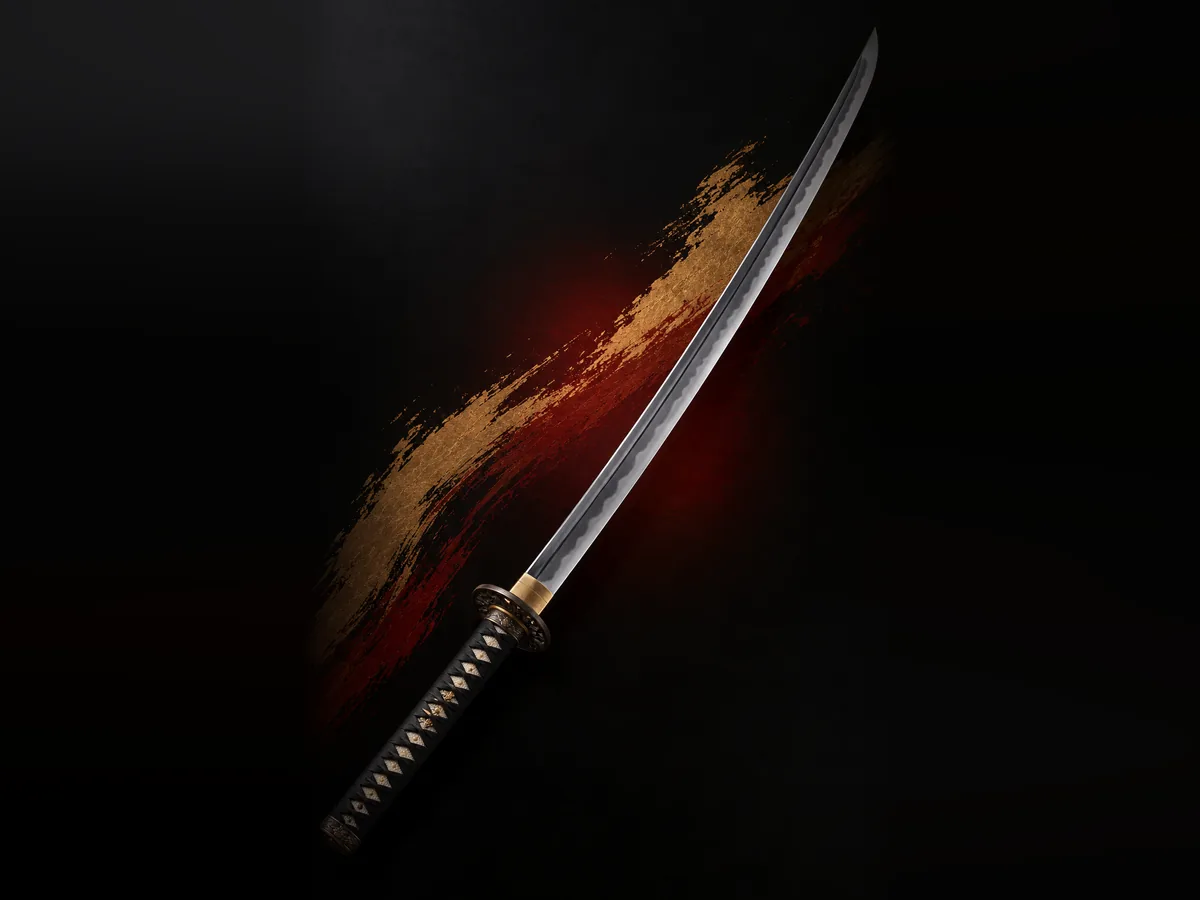
A katana é provavelmente a espada mais reconhecível do mundo. Por trás da silhueta há uma tecnologia precisa: um aço especial, um método de forja que junta metal duro e macio, e uma têmpera com barro que dá à lâmina o gume e a curvatura.
A katana na coleção de armas da WABUKAN. Ilustração WABUKAN
Da tachi à katana
As primeiras espadas curvas japonesas surgiram entre os séculos X e XII. Essas lâminas antigas, chamadas tachi, eram longas e muito curvas, feitas para guerreiros a cavalo e penduradas do cinto com o gume para baixo. A partir do século XV, com a guerra a depender mais da infantaria, generalizou-se uma espada mais curta, enfiada na faixa com o gume para cima. É a katana: desembainhada e cortante num só movimento, base das artes do iaido e do battodo. Junto com a mais curta wakizashi, formava o daishō, o «longo e curto» que distinguia a classe samurai no período Edo.
Por convenção, uma katana tem uma lâmina (nagasa) com mais de dois shaku, cerca de 60,6 cm; a maioria mede entre 65 e 75 cm.
O aço: tamahagane
As espadas tradicionais começam no tatara, um grande forno de barro alimentado durante cerca de três dias e três noites com areia ferrosa (satetsu) e carvão vegetal. No fim, parte-se o forno e retira-se um grande bloco, o kera. As melhores partes são o tamahagane, o «aço joia»: um material irregular, com teor de carbono variável e inclusões de escória.
Pedaços de tamahagane, o aço obtido no forno tatara. Autor: Loulasedna · Licença: CC BY 3.0 · Wikimedia Commons
O ferreiro separa os pedaços pela dureza, achata-os, empilha-os e solda-os num bloco. Vem depois a famosa dobragem: o bloco é aquecido, estendido à martelada, cortado e dobrado sobre si mesmo, em regra entre dez e quinze vezes. O objetivo não é místico: a dobragem expulsa a escória e uniformiza o carbono. Quinze dobras já produzem dezenas de milhares de camadas finas, que aparecem como um grão fino (hada) na lâmina polida.
Pele dura, coração macio
Muitas lâminas tradicionais juntam dois aços: um invólucro mais duro e com mais carbono (kawagane) à volta de um núcleo mais macio e com menos carbono (shingane). O aço duro segura um gume afiado; o núcleo macio absorve choques e reduz o risco de a lâmina partir. Escolas e épocas usaram montagens diferentes, algumas mais complexas, com peças separadas para o gume e para os lados.
A têmpera: curva e hamon
Depois de dar forma à lâmina, o ferreiro cobre-a com uma pasta de barro, carvão e pó de pedra, grossa nas costas e fina no gume. A lâmina é aquecida até à cor certa, avaliada a olho numa forja escurecida, e mergulhada em água. O barro fino deixa o gume arrefecer muito depressa e tornar-se martensite, duríssima; as costas arrefecem mais devagar e ficam mais resistentes.
A martensite ocupa um pouco mais de volume, por isso o gume expande e a lâmina dobra para trás: grande parte da curvatura da katana (sori) nasce na têmpera. A fronteira entre as duas estruturas é o hamon, a linha de têmpera, que cada ferreiro desenha com o barro: reta, ondulada, em botões de cravinho ou em ondas. Os colecionadores estudam-na como uma assinatura.
Lâmina de katana com sulco (hi) e linha de têmpera (hamon). Autor: Samuraiantiqueworld · Licença: CC BY-SA 3.0 · Wikimedia Commons
Polimento e montagem
Uma lâmina acabada ainda é baça e cinzenta. Um polidor especializado, o togishi, trabalha-a durante dias ou semanas com uma sequência de pedras cada vez mais finas. O polimento revela o hamon, o grão e a geometria; um mau polimento pode estragar uma boa espada. A assinatura do ferreiro (mei) é gravada no espigão (nakago), a parte escondida no punho.
Outros artesãos fazem as guarnições: o colar (habaki), a guarda (tsuba), o punho (tsuka) coberto com pele de raia e enrolado em fita, e a bainha lacada (saya). Uma pequena cavilha de bambu (mekugi) prende a lâmina ao punho, para que a espada possa ser desmontada para manutenção.
Montagem completa (koshirae) de uma katana: bainha, guarda e punho. Autor: 国立文化財機構 · Licença: CC BY 4.0 · Wikimedia Commons
Mitos a esquecer
«Dobrada um milhão de vezes.» Não. Dobrar além de certo ponto não traz vantagem e queima carbono. As camadas multiplicam-se depressa, mas o número de dobras é modesto.
«Corta tudo.» A katana é uma excelente ferramenta de corte contra alvos macios, mas o gume duro pode lascar contra objetos duros. Bloquear gume contra gume, como nos filmes, estraga-a; as escolas antigas preferem desviar com o lado ou as costas.
«A melhor espada de sempre.» Cada espada é um compromisso entre corte, estocada, peso, proteção e modo de uso. Uma espada longa europeia ou uma jian chinesa respondiam a outras necessidades.
A katana hoje
Em 1876 o édito Haitōrei proibiu o uso de espadas em público, pondo fim ao papel visível dos samurais. Depois da Segunda Guerra Mundial, as espadas foram confiscadas pelas autoridades de ocupação, e o Japão criou mais tarde um sistema de registo: as lâminas tradicionais são registadas como objetos de arte por comissões locais de educação, e só ferreiros licenciados as podem fazer, com limites apertados. No dojo, pratica-se com ferramentas adaptadas a cada arte: o shinai de bambu no kendo, o bokken de madeira nas formas a dois, o iaitō sem fio no iaido, e lâminas verdadeiras a cortar esteiras enroladas (tatami omote) só para praticantes avançados de battodo.
Para ver a katana nas mãos do espadachim mais famoso da história, leia o nosso artigo sobre Miyamoto Musashi.
Linha do tempo
séc. X–XIISurgem as primeiras espadas curvas japonesas (tachi).
séc. XIVMasamune trabalha em Sagami; idade de ouro da forja.
séc. XV–XVIA katana, usada de gume para cima, substitui a tachi.
1876Édito Haitōrei proíbe usar espada em público.
1958Lei japonesa de controlo de armas e espadas: registo obrigatório.
The katana is probably the most recognisable sword in the world. Behind the silhouette there is a precise technology: a special steel, a forging method that combines hard and soft metal, and a clay-coated quench that gives the blade both its edge and its curve.
The katana in the WABUKAN weapons collection. WABUKAN illustration
From tachi to katana
The first curved Japanese swords appeared between the 10th and 12th centuries. These early blades, called tachi, were long and strongly curved, made for mounted warriors and hung from the belt with the edge facing down. From the 15th century onwards, as warfare relied more on infantry, a shorter sword worn thrust through the sash with the edge facing up became the norm. This is the katana: drawn and cut in a single movement, the basis of the arts of iaido and battodo. Paired with the shorter wakizashi, it formed the daishō, the "long and short" that marked the samurai class in the Edo period.
By convention, a katana has a blade (nagasa) longer than two shaku, about 60.6 cm; most measure between 65 and 75 cm.
The steel: tamahagane
Traditional swords start in the tatara, a large clay furnace fed for about three days and nights with iron sand (satetsu) and charcoal. At the end the furnace is broken open and a large bloom, the kera, is extracted. Its best parts are tamahagane, "jewel steel": an irregular material with varying carbon content and inclusions of slag.
Pieces of tamahagane, the steel produced in the tatara furnace. Author: Loulasedna · Licence: CC BY 3.0 · Wikimedia Commons
The smith sorts the pieces by hardness, flattens them, stacks them and welds them into a block. Then comes the famous folding: the block is heated, hammered out, cut and folded back on itself, usually around ten to fifteen times. The goal is not mystical: folding expels slag and evens out the carbon. Fifteen folds already produce tens of thousands of thin layers, which appear as a fine grain (hada) on the polished blade.
Hard skin, soft core
Many traditional blades combine two steels: a harder, higher-carbon jacket (kawagane) wrapped around a softer, lower-carbon core (shingane). The hard steel holds a sharp edge; the soft core absorbs shocks and reduces the risk of the blade snapping. Schools and periods used different arrangements, some more complex, with separate pieces for the edge and the sides.
The quench: curve and hamon
Once the blade is shaped, the smith covers it with a paste of clay, charcoal and stone powder, thick on the spine and thin on the edge. The blade is heated to the right colour, judged by eye in a darkened forge, and plunged into water. The thin clay lets the edge cool very quickly and become martensite, very hard; the spine cools more slowly and stays tougher.
Martensite takes up slightly more volume, so the edge expands and the blade bends backwards: a large part of the katana's curve (sori) is born in the quench. The boundary between the two structures is the hamon, the temper line, which each smith shapes with the clay: straight, wavy, like clove buds or rolling waves. Collectors study it as a signature.
Katana blade showing the groove (hi) and the temper line (hamon). Author: Samuraiantiqueworld · Licence: CC BY-SA 3.0 · Wikimedia Commons
Polish and mounting
A finished blade is still dull and grey. A specialist polisher, the togishi, works it for days or weeks with a sequence of ever finer stones. Polishing reveals the hamon, the grain and the geometry; a bad polish can ruin a good sword. The smith's signature (mei) is chiselled on the tang (nakago), the part hidden in the hilt.
Other craftsmen make the fittings: the collar (habaki), the guard (tsuba), the hilt (tsuka) covered in ray skin and wrapped in braid, and the lacquered scabbard (saya). A small bamboo peg (mekugi) holds blade and hilt together, so that the sword can be dismantled for maintenance.
Full katana mounting (koshirae): scabbard, guard and hilt. Author: 国立文化財機構 · Licence: CC BY 4.0 · Wikimedia Commons
Myths worth forgetting
"Folded a million times." No. Folding beyond a certain point brings no benefit and burns away carbon. Layers multiply quickly, but the number of folds is modest.
"It cuts through anything." A katana is an excellent cutting tool against soft targets, but its hard edge can chip against hard objects. Blocking edge-to-edge, as in films, damages it; old schools prefer to deflect with the side or the back.
"The best sword ever made." Every sword is a compromise between cutting, thrusting, weight, protection and the way it is used. A European longsword or a Chinese jian answered other needs.
The katana today
In 1876 the Haitōrei edict banned the wearing of swords in public, ending the visible role of the samurai. After the Second World War, swords were confiscated by the occupation authorities, and Japan later created a registration system: traditional blades are registered as art objects by local education boards, and only licensed smiths may make them, under strict limits. In the dojo, practice is done with tools adapted to each art: the bamboo shinai in kendo, the wooden bokken in partner forms, the unsharpened iaitō in iaido, and real blades cutting rolled mats (tatami omote) only for advanced battodo practitioners.
To see the katana in the hands of history's most famous swordsman, read our article on Miyamoto Musashi.
Timeline
10th–12th c.First curved Japanese swords (tachi) appear.
14th c.Masamune works in Sagami; golden age of forging.
15th–16th c.The katana, worn edge-up, replaces the tachi.
1876Haitōrei edict bans wearing swords in public.
1958Japanese firearms and swords control law: registration required.
La katana es probablemente la espada más reconocible del mundo. Detrás de la silueta hay una tecnología precisa: un acero especial, un método de forja que combina metal duro y blando, y un temple con arcilla que da a la hoja su filo y su curvatura.
La katana en la colección de armas de WABUKAN. Ilustración WABUKAN
De la tachi a la katana
Las primeras espadas curvas japonesas aparecieron entre los siglos X y XII. Esas hojas antiguas, llamadas tachi, eran largas y muy curvas, hechas para guerreros a caballo y colgadas del cinturón con el filo hacia abajo. A partir del siglo XV, cuando la guerra pasó a depender más de la infantería, se generalizó una espada más corta, metida en la faja con el filo hacia arriba. Es la katana: se desenvaina y corta en un solo movimiento, base de las artes del iaido y del battodo. Junto con la más corta wakizashi, formaba el daishō, el «largo y corto» que distinguía a la clase samurái en el período Edo.
Por convención, una katana tiene una hoja (nagasa) de más de dos shaku, unos 60,6 cm; la mayoría mide entre 65 y 75 cm.
El acero: tamahagane
Las espadas tradicionales empiezan en el tatara, un gran horno de arcilla alimentado durante unos tres días y tres noches con arena ferrosa (satetsu) y carbón vegetal. Al final se rompe el horno y se extrae un gran bloque, el kera. Sus mejores partes son el tamahagane, el «acero joya»: un material irregular, con un contenido de carbono variable e inclusiones de escoria.
Trozos de tamahagane, el acero obtenido en el horno tatara. Autor: Loulasedna · Licencia: CC BY 3.0 · Wikimedia Commons
El herrero separa los trozos por dureza, los aplana, los apila y los suelda en un bloque. Llega entonces el famoso plegado: el bloque se calienta, se estira a martillazos, se corta y se dobla sobre sí mismo, normalmente entre diez y quince veces. El objetivo no es místico: el plegado expulsa la escoria e iguala el carbono. Quince pliegues ya producen decenas de miles de capas finas, que aparecen como un grano fino (hada) en la hoja pulida.
Piel dura, corazón blando
Muchas hojas tradicionales combinan dos aceros: una envoltura más dura y con más carbono (kawagane) alrededor de un núcleo más blando y con menos carbono (shingane). El acero duro mantiene un filo agudo; el núcleo blando absorbe golpes y reduce el riesgo de que la hoja se rompa. Escuelas y épocas usaron disposiciones distintas, algunas más complejas, con piezas separadas para el filo y los lados.
El temple: curva y hamon
Una vez formada la hoja, el herrero la cubre con una pasta de arcilla, carbón y polvo de piedra, gruesa en el lomo y fina en el filo. La hoja se calienta hasta el color justo, juzgado a ojo en una forja a oscuras, y se sumerge en agua. La arcilla fina deja que el filo se enfríe muy deprisa y se convierta en martensita, durísima; el lomo se enfría más despacio y queda más tenaz.
La martensita ocupa algo más de volumen, así que el filo se dilata y la hoja se curva hacia atrás: buena parte de la curvatura de la katana (sori) nace en el temple. La frontera entre las dos estructuras es el hamon, la línea de temple, que cada herrero dibuja con la arcilla: recta, ondulada, en capullos de clavo o en olas. Los coleccionistas la estudian como una firma.
Hoja de katana con acanaladura (hi) y línea de temple (hamon). Autor: Samuraiantiqueworld · Licencia: CC BY-SA 3.0 · Wikimedia Commons
Pulido y montura
Una hoja terminada sigue siendo mate y gris. Un pulidor especializado, el togishi, la trabaja durante días o semanas con una secuencia de piedras cada vez más finas. El pulido revela el hamon, el grano y la geometría; un mal pulido puede arruinar una buena espada. La firma del herrero (mei) se graba en la espiga (nakago), la parte oculta en la empuñadura.
Otros artesanos hacen las guarniciones: el collar (habaki), la guarda (tsuba), la empuñadura (tsuka) cubierta de piel de raya y envuelta en cordón, y la vaina lacada (saya). Una pequeña clavija de bambú (mekugi) une hoja y empuñadura, de modo que la espada puede desmontarse para su mantenimiento.
Montura completa (koshirae) de una katana: vaina, guarda y empuñadura. Autor: 国立文化財機構 · Licencia: CC BY 4.0 · Wikimedia Commons
Mitos que conviene olvidar
«Plegada un millón de veces.» No. Plegar más allá de cierto punto no aporta nada y quema carbono. Las capas se multiplican deprisa, pero el número de pliegues es modesto.
«Lo corta todo.» La katana es una excelente herramienta de corte contra blancos blandos, pero su filo duro puede mellarse contra objetos duros. Bloquear filo contra filo, como en las películas, la daña; las escuelas antiguas prefieren desviar con el plano o el lomo.
«La mejor espada de la historia.» Cada espada es un compromiso entre corte, estocada, peso, protección y forma de uso. Una espada larga europea o una jian china respondían a otras necesidades.
La katana hoy
En 1876 el edicto Haitōrei prohibió llevar espada en público y acabó con el papel visible de los samuráis. Tras la Segunda Guerra Mundial, las espadas fueron confiscadas por las autoridades de ocupación, y Japón creó después un sistema de registro: las hojas tradicionales se registran como objetos de arte ante comisiones locales de educación, y solo herreros con licencia pueden fabricarlas, con límites estrictos. En el dojo se practica con herramientas adaptadas a cada arte: el shinai de bambú en el kendo, el bokken de madera en las formas por parejas, el iaitō sin filo en el iaido, y hojas reales cortando esteras enrolladas (tatami omote) solo para practicantes avanzados de battodo.
Para ver la katana en manos del espadachín más famoso de la historia, lea nuestro artículo sobre Miyamoto Musashi.
Cronología
s. X–XIIAparecen las primeras espadas curvas japonesas (tachi).
s. XIVMasamune trabaja en Sagami; edad de oro de la forja.
s. XV–XVILa katana, llevada con el filo hacia arriba, sustituye a la tachi.
1876El edicto Haitōrei prohíbe llevar espada en público.
1958Ley japonesa de control de armas y espadas: registro obligatorio.
Le katana est sans doute le sabre le plus reconnaissable au monde. Derrière la silhouette se cache une technologie précise : un acier particulier, une méthode de forge qui associe métal dur et métal doux, et une trempe à l’argile qui donne à la lame son tranchant et sa courbure.
Le katana dans la collection d’armes de WABUKAN. Illustration WABUKAN
Du tachi au katana
Les premiers sabres courbes japonais apparaissent entre le Xe et le XIIe siècle. Ces lames anciennes, appelées tachi, sont longues et très courbes, faites pour des guerriers à cheval et suspendues à la ceinture, tranchant vers le bas. À partir du XVe siècle, quand la guerre repose davantage sur l’infanterie, un sabre plus court, glissé dans la ceinture tranchant vers le haut, se généralise. C’est le katana : dégainé et tranchant en un seul geste, base de l’iaido et du battodo. Avec le plus court wakizashi, il forme le daishō, le « long et court » qui distingue la classe des samouraïs à l’époque d’Edo.
Par convention, un katana a une lame (nagasa) de plus de deux shaku, environ 60,6 cm ; la plupart mesurent entre 65 et 75 cm.
L’acier : le tamahagane
Les sabres traditionnels commencent dans le tatara, un grand four d’argile alimenté pendant environ trois jours et trois nuits en sable ferrugineux (satetsu) et en charbon de bois. À la fin, on casse le four pour en extraire une grande loupe, le kera. Ses meilleures parties sont le tamahagane, « l’acier joyau » : un matériau irrégulier, à teneur en carbone variable, avec des inclusions de laitier.
Morceaux de tamahagane, l’acier produit dans le four tatara. Auteur: Loulasedna · Licence: CC BY 3.0 · Wikimedia Commons
Le forgeron trie les morceaux selon leur dureté, les aplatit, les empile et les soude en un bloc. Vient ensuite le fameux repliage : le bloc est chauffé, étiré au marteau, entaillé et replié sur lui-même, en général dix à quinze fois. Le but n’a rien de mystique : le repliage chasse le laitier et homogénéise le carbone. Quinze replis donnent déjà des dizaines de milliers de couches fines, visibles comme un grain fin (hada) sur la lame polie.
Peau dure, cœur souple
Beaucoup de lames traditionnelles associent deux aciers : une enveloppe plus dure et plus carburée (kawagane) autour d’un cœur plus doux et moins carburé (shingane). L’acier dur tient un tranchant affûté ; le cœur souple absorbe les chocs et réduit le risque de rupture. Écoles et époques ont utilisé des assemblages différents, parfois plus complexes, avec des pièces distinctes pour le tranchant et les flancs.
La trempe : courbure et hamon
Une fois la lame mise en forme, le forgeron la couvre d’une pâte d’argile, de charbon et de poudre de pierre, épaisse sur le dos et fine sur le tranchant. La lame est chauffée jusqu’à la bonne couleur, jugée à l’œil dans une forge obscure, puis plongée dans l’eau. L’argile fine laisse le tranchant refroidir très vite et devenir de la martensite, très dure ; le dos refroidit plus lentement et reste plus tenace.
La martensite occupe un peu plus de volume : le tranchant se dilate et la lame se cambre vers l’arrière. Une grande partie de la courbure du katana (sori) naît ainsi de la trempe. La frontière entre les deux structures est le hamon, la ligne de trempe, que chaque forgeron dessine avec l’argile : droite, ondulée, en boutons de girofle ou en vagues. Les collectionneurs l’étudient comme une signature.
Lame de katana avec gorge (hi) et ligne de trempe (hamon). Auteur: Samuraiantiqueworld · Licence: CC BY-SA 3.0 · Wikimedia Commons
Polissage et monture
Une lame terminée reste terne et grise. Un polisseur spécialisé, le togishi, la travaille pendant des jours ou des semaines avec une série de pierres de plus en plus fines. Le polissage révèle le hamon, le grain et la géométrie ; un mauvais polissage peut ruiner un bon sabre. La signature du forgeron (mei) est gravée sur la soie (nakago), la partie cachée dans la poignée.
D’autres artisans réalisent les garnitures : la bague (habaki), la garde (tsuba), la poignée (tsuka) couverte de peau de raie et tressée, et le fourreau laqué (saya). Une petite cheville de bambou (mekugi) fixe la lame à la poignée, ce qui permet de démonter le sabre pour l’entretien.
Monture complète (koshirae) d’un katana : fourreau, garde et poignée. Auteur: 国立文化財機構 · Licence: CC BY 4.0 · Wikimedia Commons
Des mythes à oublier
« Replié un million de fois. » Non. Replier au-delà d’un certain point n’apporte rien et brûle le carbone. Les couches se multiplient vite, mais le nombre de replis reste modeste.
« Il coupe tout. » Le katana est un excellent outil de coupe contre des cibles souples, mais son tranchant dur peut s’ébrécher sur des objets durs. Parer tranchant contre tranchant, comme au cinéma, l’abîme ; les écoles anciennes préfèrent dévier avec le plat ou le dos.
« Le meilleur sabre de tous les temps. » Chaque arme est un compromis entre coupe, estoc, poids, protection et manière de s’en servir. Une épée longue européenne ou un jian chinois répondaient à d’autres besoins.
Le katana aujourd’hui
En 1876, l’édit Haitōrei interdit le port du sabre en public et met fin au rôle visible des samouraïs. Après la Seconde Guerre mondiale, les sabres sont confisqués par les autorités d’occupation ; le Japon crée ensuite un système d’enregistrement : les lames traditionnelles sont déclarées comme objets d’art auprès de commissions locales de l’éducation, et seuls des forgerons agréés peuvent en fabriquer, dans des limites strictes. Au dojo, on s’entraîne avec des outils adaptés à chaque art : le shinai en bambou au kendo, le bokken en bois dans les formes à deux, l’iaitō non affûté en iaido, et de vraies lames coupant des nattes roulées (tatami omote) seulement pour les pratiquants avancés de battodo.
Pour voir le katana entre les mains du sabreur le plus célèbre de l’histoire, lisez notre article sur Miyamoto Musashi.
Chronologie
Xe–XIIe s.Apparition des premiers sabres courbes japonais (tachi).
XIVe s.Masamune travaille à Sagami ; âge d’or de la forge.
XVe–XVIe s.Le katana, porté tranchant vers le haut, remplace le tachi.
1876L’édit Haitōrei interdit le port du sabre en public.
1958Loi japonaise sur les armes et les sabres : enregistrement obligatoire.