Kobudo de Okinawa: as armas que vieram do campo (e as que não vieram)
· 4 min de leitura
Kobudo quer dizer «antigo caminho marcial». Em Okinawa, a palavra designa uma família de artes com armas que cresceu ao lado do karaté: o bastão, o sai, a tonfa, o nunchaku, a foice e algumas ferramentas menos conhecidas. A história costuma contar-se numa frase: «camponeses proibidos de ter espadas transformaram as ferramentas do campo em armas». A verdade é mais interessante.
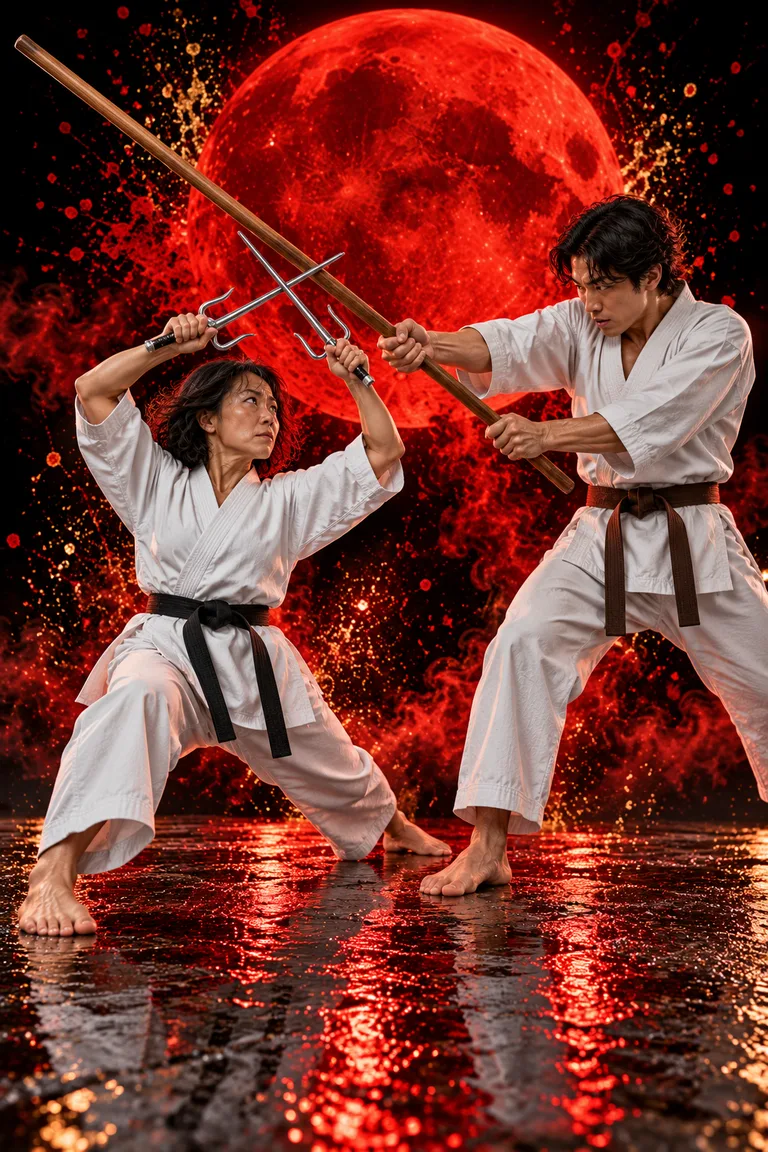
Kobudo de Okinawa: as armas tradicionais treinam-se em kata. Ilustração WABUKAN
Um reino entre dois impérios
Okinawa era o coração do Reino de Ryūkyū, unificado em 1429 e enriquecido pelo comércio marítimo entre a China, o Japão e o Sudeste Asiático. Enviados chineses, mercadores e militares passaram pelas ilhas durante séculos, e muitas técnicas de Okinawa mostram influência chinesa. Em 1609 o domínio japonês de Satsuma invadiu as ilhas e, a partir daí, o reino viveu com dupla lealdade: tributário da China e controlado por Satsuma.
Houve de facto restrições às armas, tanto com reis de Ryūkyū anteriores como sob Satsuma, e elas favoreceram o treino em privado e com material modesto. Mas os historiadores avisam contra a versão simples. A prática era sobretudo mantida pelos shizoku, a pequena nobreza de Okinawa, e não pelos camponeses, e várias armas não têm origem agrícola evidente.
As armas principais
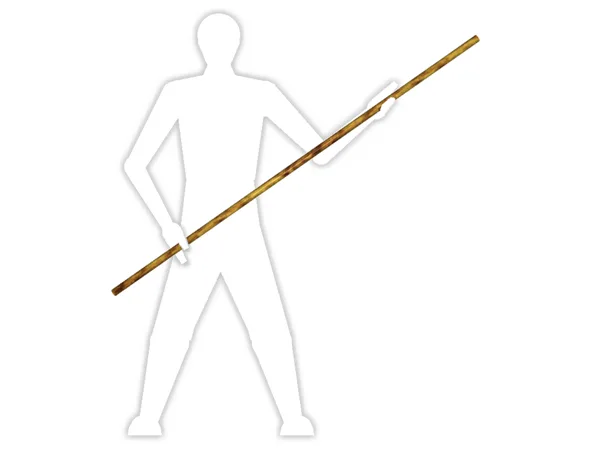
Bo — o bastão longo, normalmente de seis shaku (cerca de 1,8 m), o «rokushakubo». É a espinha dorsal do kobudo: quase todas as escolas começam por ele, e partilha os princípios do bojutsu japonês. Uma vara de carregar baldes é um antepassado plausível, mas o bastão é também uma das armas mais antigas em todo o mundo.
O bo, bastão de seis shaku (cerca de 1,8 m). Ilustração WABUKAN
Sai — um bastão de metal com duas pontas laterais curvas (yoku), usado aos pares. É o contraexemplo mais claro da história dos camponeses: é um objeto de metal forjado, próximo de ferramentas usadas por agentes da autoridade em Ryūkyū e de armas semelhantes na China e no Sudeste Asiático. Serve para golpear, bloquear, prender e estocar; as pontas laterais apanham um bastão ou uma lâmina.
Kata com sai num campeonato mundial de kobudo em Okinawa, 2019. Autor: Мирутенко · Licença: CC BY 4.0 · Wikimedia Commons
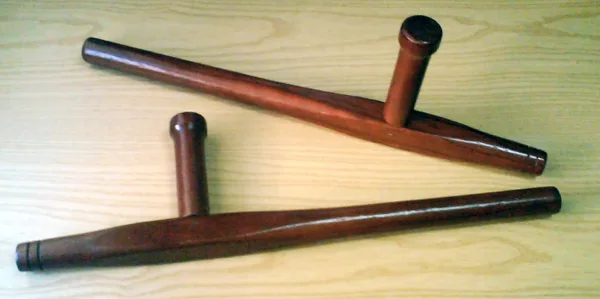
Tonfa (tuifa em okinawano) — uma barra de madeira com pega lateral, muitas vezes apontada como derivada do cabo de uma mó. Segura pela pega, fica ao longo do antebraço para o proteger e pode rodar para golpear. Nos anos 1970 a sua forma inspirou os bastões policiais de pega lateral usados em todo o mundo.
A tonfa, com a pega lateral que inspirou bastões policiais modernos. Ilustração WABUKAN
Nunchaku — dois paus curtos unidos por um cordão ou corrente. Fala-se muitas vezes de uma ligação aos manguais de debulhar cereal ou a um freio de cavalo, mas nada está provado. Era uma arma menor no kobudo tradicional até os filmes dos anos 1970 a tornarem famosa no mundo inteiro.
Kama — a foice, claramente uma ferramenta agrícola, usada sozinha ou aos pares. Treinar com kama verdadeiras é perigoso; a maior parte da prática usa versões rombas ou de madeira.
Entre as armas menos conhecidas estão o eku (um remo de barco), o tekko (um protetor de nós dos dedos, talvez derivado de um estribo), o tinbe e o rochin (escudo com lança curta) e o surujin (corda com pesos).
Os mestres que o salvaram
Depois da anexação de Ryūkyū pelo Japão em 1879 e das convulsões do século XX, incluindo a destruição da Batalha de Okinawa em 1945, perdeu-se muito. A figura mais associada ao salvamento é Taira Shinken (1897–1970). Aluno de Yabiku Mōden, percorreu as ilhas a recolher kata de armas junto de velhos mestres e, em 1955, fundou uma associação para a preservação do kobujutsu de Ryūkyū. Muitos kata ensinados hoje têm nomes de mestres ou de lugares: Shūshi no kon e Sakugawa no kon para o bo; Tsuken Shitahaku no sai; Hamahiga no tonfa.
Outras linhas, como a da família Matayoshi, preservaram armas e formas diferentes. Hoje o kobudo ensina-se como arte independente e como complemento dentro de escolas de karaté; vários estilos de karaté consideram o trabalho com armas uma continuação natural do treino de mãos vazias.
Como se treina
O treino segue o modelo do karaté: movimentos básicos repetidos em linha, kata a solo e depois formas a dois (kumite ou bunkai) em que um ataca com o bo e o outro defende com sai ou tonfa. Os principiantes usam armas de madeira ou almofadadas e trabalham devagar; a velocidade só chega quando o controlo é fiável. Pulsos e antebraços precisam de condicionamento paciente, sobretudo com sai e tonfa.
Como com qualquer arma, o praticante tem de conhecer as regras locais: alguns objetos, como o nunchaku, são restringidos em vários países. Os clubes costumam aconselhar a transportar o material coberto e apenas entre casa e o dojo.
Cada arma ensina também uma distância diferente. O bo trabalha a longa distância e obriga o corpo inteiro a mover-se como uma só peça; o sai e a tonfa trabalham perto, com o antebraço, muito como os bloqueios de mãos vazias; o nunchaku e a kama exigem sentido de tempo e mudanças de pega precisas. É por isso que muitos mestres aconselham aprender primeiro o bo e acrescentar depois as armas curtas, uma de cada vez.
Porque importa
O kobudo é um arquivo vivo da história de Okinawa: de um pequeno reino que negociava com todos, adaptou influências estrangeiras e manteve os seus métodos através da ocupação e da guerra. Explica também muito do movimento do karaté: os bloqueios, as posições e a rotação da anca fazem mais sentido com uma arma nas mãos.
Linha do tempo
1429Unificação do Reino de Ryūkyū.
1609Invasão de Okinawa pelo domínio de Satsuma.
1879Ryūkyū é anexado pelo Japão (prefeitura de Okinawa).
1955Taira Shinken funda a associação de preservação do kobujutsu.
1970sO nunchaku torna-se mundialmente famoso pelo cinema.
Okinawan kobudo: the weapons from the farm (and the ones that were not)
· 4 min read
Kobudo means "old martial way". In Okinawa the word names a family of weapon arts that grew up beside karate: the staff, the sai, the tonfa, the nunchaku, the sickle and a few less known tools. Their story is usually told in one sentence: "peasants forbidden to carry swords turned their farm tools into weapons". The truth is more interesting.
Okinawan kobudo: traditional weapons are trained through kata. WABUKAN illustration
A kingdom between two empires
Okinawa was the heart of the Ryūkyū Kingdom, unified in 1429 and rich from sea trade between China, Japan and South-East Asia. Chinese envoys, merchants and military officers passed through the islands for centuries, and many Okinawan techniques show Chinese influence. In 1609 the Japanese domain of Satsuma invaded, and from then on the kingdom lived under a double loyalty: tributary to China, controlled by Satsuma.
Restrictions on weapons did exist, both under earlier Ryūkyūan kings and under Satsuma, and they encouraged training in private and with modest equipment. But historians warn against the simple version. Practice was mostly kept by the shizoku, the Okinawan gentry, not by farmers, and several weapons have no obvious farm origin.
The main weapons
Bo — the long staff, typically six shaku (about 1.8 m), the "rokushakubo". It is the backbone of kobudo: almost every school starts with it, and it shares its principles with the Japanese bojutsu. A carrying pole for buckets is a plausible ancestor, but a staff is also one of the oldest weapons anywhere.
The bo, a six-shaku staff (about 1.8 m). WABUKAN illustration
Sai — a metal baton with two curved side prongs (yoku), used in pairs. It is the clearest counter-example to the farmer story: it is a forged metal object, closely related to tools carried by law-enforcement officials in Ryūkyū and to similar weapons in China and South-East Asia. It is used to strike, block, trap and thrust; the prongs catch a staff or a blade.
Sai kata at a world kobudo tournament in Okinawa, 2019. Author: Мирутенко · Licence: CC BY 4.0 · Wikimedia Commons
Tonfa (tuifa in Okinawan) — a wooden bar with a side handle, often said to come from the handle of a millstone. Held by the handle, it lies along the forearm to protect it and can be spun to strike. In the 1970s its shape inspired side-handle police batons used around the world.
The tonfa, whose side handle inspired modern police batons. WABUKAN illustration
Nunchaku — two short sticks joined by a cord or chain. A link with flails used for threshing grain or with a horse bit is often suggested, but not proved. It was a minor weapon in traditional kobudo until films of the 1970s made it world-famous.
Kama — the sickle, clearly a farm tool, used single or in pairs. Real kama are dangerous to train with; most practice uses blunt or wooden versions.
Lesser known weapons include the eku (a boat oar), the tekko (a knuckle guard, perhaps from a horse stirrup), the tinbe and rochin (a shield with a short spear) and the surujin (a weighted rope).
The masters who saved it
After the annexation of Ryūkyū by Japan in 1879 and the upheavals of the 20th century, including the destruction of the Battle of Okinawa in 1945, much was lost. The figure most associated with saving it is Taira Shinken (1897–1970). A student of Yabiku Mōden, he travelled around the islands collecting weapon kata from old teachers and, in 1955, founded a society for the preservation of Ryūkyū kobujutsu. Many of the kata taught today bear the names of masters or places: Shūshi no kon, Sakugawa no kon for the bo; Tsuken Shitahaku no sai; Hamahiga no tonfa.
Other lines, such as that of the Matayoshi family, preserved different weapons and forms. Today kobudo is taught both as an independent art and as a complement inside karate schools; several karate styles consider weapon work a natural continuation of empty-hand training.
How it is trained
Training follows the karate model: basic movements repeated in lines, kata alone, then forms with a partner (kumite or bunkai) in which one person attacks with a bo and the other defends with sai or tonfa. Beginners use wooden or padded weapons and work slowly; speed comes only when control is reliable. Wrists and forearms need patient conditioning, especially with sai and tonfa.
As with any weapon, the practitioner also has to know the local rules: some objects, such as the nunchaku, are restricted in several countries. Clubs usually advise carrying equipment covered and only between home and the dojo.
Each weapon also teaches a different distance. The bo works at long range and forces the whole body to move as one unit; the sai and the tonfa work close, with the forearm, much like empty-hand blocks; the nunchaku and the kama demand timing and precise grip changes. That is why many teachers recommend learning the bo first and adding the short weapons later, one at a time.
Why it matters
Kobudo is a living archive of Okinawan history: of a small kingdom that traded with everyone, adapted foreign influences and kept its own methods through occupation and war. It also explains much of karate's movement: the blocks, the stances and the turning of the hips make more sense when a weapon is in the hands.
Timeline
1429Unification of the Ryūkyū Kingdom.
1609Satsuma domain invades Okinawa.
1879Ryūkyū annexed by Japan (Okinawa Prefecture).
1955Taira Shinken founds the kobujutsu preservation society.
Kobudo de Okinawa: las armas que vinieron del campo (y las que no)
· 4 min de lectura
Kobudo significa «antiguo camino marcial». En Okinawa, la palabra designa una familia de artes con armas que creció junto al karate: el bastón, el sai, la tonfa, el nunchaku, la hoz y algunas herramientas menos conocidas. Su historia suele contarse en una frase: «campesinos a los que se prohibían las espadas convirtieron sus aperos en armas». La verdad es más interesante.
Kobudo de Okinawa: las armas tradicionales se entrenan con kata. Ilustración WABUKAN
Un reino entre dos imperios
Okinawa era el corazón del Reino de Ryūkyū, unificado en 1429 y enriquecido por el comercio marítimo entre China, Japón y el Sudeste Asiático. Enviados chinos, mercaderes y militares pasaron por las islas durante siglos, y muchas técnicas de Okinawa muestran influencia china. En 1609 el dominio japonés de Satsuma invadió las islas y, desde entonces, el reino vivió con una doble lealtad: tributario de China y controlado por Satsuma.
Las restricciones de armas existieron, tanto con reyes de Ryūkyū anteriores como bajo Satsuma, y favorecieron el entrenamiento en privado y con material modesto. Pero los historiadores advierten contra la versión simple. La práctica la mantenían sobre todo los shizoku, la pequeña nobleza de Okinawa, y no los campesinos, y varias armas no tienen un origen agrícola evidente.
Las armas principales
Bo — el bastón largo, normalmente de seis shaku (unos 1,8 m), el «rokushakubo». Es la columna vertebral del kobudo: casi todas las escuelas empiezan por él, y comparte principios con el bojutsu japonés. Una pértiga para cargar cubos es un antepasado plausible, pero el bastón es también una de las armas más antiguas del mundo.
El bo, bastón de seis shaku (unos 1,8 m). Ilustración WABUKAN
Sai — una barra de metal con dos puntas laterales curvas (yoku), usada por parejas. Es el contraejemplo más claro del relato campesino: es un objeto de metal forjado, cercano a herramientas que llevaban agentes de la autoridad en Ryūkyū y a armas parecidas de China y el Sudeste Asiático. Sirve para golpear, bloquear, atrapar y pinchar; las puntas laterales atrapan un bastón o una hoja.
Kata con sai en un campeonato mundial de kobudo en Okinawa, 2019. Autor: Мирутенко · Licencia: CC BY 4.0 · Wikimedia Commons
Tonfa (tuifa en okinawense) — una barra de madera con empuñadura lateral, que a menudo se dice derivada del mango de una muela de molino. Agarrada por la empuñadura, queda a lo largo del antebrazo para protegerlo y puede girar para golpear. En los años setenta su forma inspiró las porras policiales de empuñadura lateral usadas en todo el mundo.
Nunchaku — dos palos cortos unidos por un cordón o una cadena. Se habla a menudo de una relación con los mayales para trillar o con un bocado de caballo, pero no está probada. Era un arma menor en el kobudo tradicional hasta que las películas de los años setenta la hicieron famosa en todo el mundo.
Kama — la hoz, claramente un apero agrícola, usada sola o por parejas. Entrenar con kama reales es peligroso; casi toda la práctica usa versiones romas o de madera.
Entre las armas menos conocidas están el eku (un remo), el tekko (un protector de nudillos, quizá derivado de un estribo), el tinbe y el rochin (escudo con lanza corta) y el surujin (cuerda con pesos).
Los maestros que lo salvaron
Tras la anexión de Ryūkyū por Japón en 1879 y las convulsiones del siglo XX, incluida la destrucción de la Batalla de Okinawa en 1945, se perdió mucho. La figura más asociada a su rescate es Taira Shinken (1897–1970). Alumno de Yabiku Mōden, recorrió las islas recogiendo kata de armas de viejos maestros y, en 1955, fundó una asociación para la preservación del kobujutsu de Ryūkyū. Muchos kata que se enseñan hoy llevan nombres de maestros o de lugares: Shūshi no kon y Sakugawa no kon para el bo; Tsuken Shitahaku no sai; Hamahiga no tonfa.
Otras líneas, como la de la familia Matayoshi, preservaron armas y formas distintas. Hoy el kobudo se enseña como arte independiente y como complemento dentro de escuelas de karate; varios estilos de karate consideran el trabajo con armas una continuación natural del entrenamiento a mano vacía.
Cómo se entrena
El entrenamiento sigue el modelo del karate: movimientos básicos repetidos en línea, kata en solitario y después formas por parejas (kumite o bunkai) en las que uno ataca con el bo y el otro defiende con sai o tonfa. Los principiantes usan armas de madera o acolchadas y trabajan despacio; la velocidad llega solo cuando el control es fiable. Muñecas y antebrazos necesitan un acondicionamiento paciente, sobre todo con sai y tonfa.
Como con cualquier arma, el practicante debe conocer las normas locales: algunos objetos, como el nunchaku, están restringidos en varios países. Los clubes suelen aconsejar transportar el material cubierto y solo entre casa y el dojo.
Cada arma enseña además una distancia distinta. El bo trabaja a larga distancia y obliga a todo el cuerpo a moverse como una sola pieza; el sai y la tonfa trabajan cerca, con el antebrazo, muy parecido a los bloqueos a mano vacía; el nunchaku y la kama exigen sentido del tiempo y cambios de agarre precisos. Por eso muchos maestros aconsejan aprender primero el bo y añadir después las armas cortas, una a una.
Por qué importa
El kobudo es un archivo vivo de la historia de Okinawa: la de un pequeño reino que comerciaba con todos, adaptó influencias extranjeras y mantuvo sus métodos a través de la ocupación y la guerra. También explica mucho del movimiento del karate: los bloqueos, las posiciones y el giro de cadera cobran sentido con un arma en las manos.
Cronología
1429Unificación del Reino de Ryūkyū.
1609El dominio de Satsuma invade Okinawa.
1879Ryūkyū es anexionado por Japón (prefectura de Okinawa).
1955Taira Shinken funda la asociación de preservación del kobujutsu.
1970sEl cine hace mundialmente famoso el nunchaku.
Le kobudo d’Okinawa : les armes venues des champs (et les autres)
· 4 min de lecture
Kobudo signifie « ancienne voie martiale ». À Okinawa, le mot désigne une famille d’arts armés qui a grandi à côté du karaté : le bâton, le sai, le tonfa, le nunchaku, la faucille et quelques outils moins connus. On résume souvent leur histoire en une phrase : « des paysans privés de sabres ont transformé leurs outils agricoles en armes ». La vérité est plus intéressante.
Kobudo d’Okinawa : les armes traditionnelles s’entraînent par les kata. Illustration WABUKAN
Un royaume entre deux empires
Okinawa était le cœur du royaume des Ryūkyū, unifié en 1429 et enrichi par le commerce maritime entre la Chine, le Japon et l’Asie du Sud-Est. Envoyés chinois, marchands et militaires ont traversé les îles pendant des siècles, et beaucoup de techniques d’Okinawa portent une influence chinoise. En 1609, le domaine japonais de Satsuma envahit l’archipel ; dès lors, le royaume vit sous une double allégeance : tributaire de la Chine, contrôlé par Satsuma.
Des restrictions sur les armes ont bien existé, sous des rois des Ryūkyū antérieurs comme sous Satsuma, et elles ont favorisé un entraînement discret avec un matériel modeste. Mais les historiens mettent en garde contre la version simpliste. La pratique était surtout entretenue par les shizoku, la petite noblesse d’Okinawa, et non par les paysans, et plusieurs armes n’ont aucune origine agricole évidente.
Les armes principales
Bo — le bâton long, en général de six shaku (environ 1,8 m), le « rokushakubo ». C’est la colonne vertébrale du kobudo : presque toutes les écoles commencent par lui, et il partage ses principes avec le bōjutsu japonais. Une palanche pour porter des seaux est un ancêtre plausible, mais le bâton est aussi l’une des plus vieilles armes du monde.
Le bo, bâton de six shaku (environ 1,8 m). Illustration WABUKAN
Sai — une barre de métal munie de deux branches latérales recourbées (yoku), utilisée par paire. C’est le contre-exemple le plus net au récit paysan : c’est un objet en métal forgé, proche d’outils portés par des agents de l’autorité aux Ryūkyū et d’armes semblables en Chine et en Asie du Sud-Est. Il sert à frapper, bloquer, piéger et piquer ; les branches accrochent un bâton ou une lame.
Kata au sai lors d’un tournoi mondial de kobudo à Okinawa, 2019. Auteur: Мирутенко · Licence: CC BY 4.0 · Wikimedia Commons
Tonfa (tuifa en okinawaïen) — une barre de bois à poignée latérale, souvent présentée comme issue du manche d’une meule. Tenu par la poignée, il longe l’avant-bras pour le protéger et peut tourner pour frapper. Dans les années 1970, sa forme a inspiré les matraques à poignée latérale utilisées par des polices du monde entier.
Le tonfa, dont la poignée latérale a inspiré des matraques modernes. Illustration WABUKAN
Nunchaku — deux bâtons courts reliés par une corde ou une chaîne. On évoque souvent un lien avec le fléau à battre le grain ou avec un mors de cheval, sans preuve. C’était une arme mineure du kobudo traditionnel jusqu’à ce que les films des années 1970 la rendent célèbre dans le monde entier.
Kama — la faucille, clairement un outil agricole, utilisée seule ou par paire. S’entraîner avec de vraies kama est dangereux ; l’essentiel de la pratique se fait avec des modèles émoussés ou en bois.
Parmi les armes moins connues figurent l’eku (une rame), le tekko (un protège-phalanges, peut-être dérivé d’un étrier), le tinbe et le rochin (bouclier et lance courte) et le surujin (corde lestée).
Les maîtres qui l’ont sauvé
Après l’annexion des Ryūkyū par le Japon en 1879 et les bouleversements du XXe siècle, dont les destructions de la bataille d’Okinawa en 1945, beaucoup a été perdu. La figure la plus associée à son sauvetage est Taira Shinken (1897–1970). Élève de Yabiku Mōden, il a parcouru les îles pour recueillir les kata d’armes auprès de vieux maîtres et, en 1955, il a fondé une association pour la préservation du kobujutsu des Ryūkyū. Beaucoup de kata enseignés aujourd’hui portent des noms de maîtres ou de lieux : Shūshi no kon et Sakugawa no kon au bo ; Tsuken Shitahaku no sai ; Hamahiga no tonfa.
D’autres lignées, comme celle de la famille Matayoshi, ont préservé d’autres armes et d’autres formes. Aujourd’hui le kobudo s’enseigne comme art indépendant et comme complément dans des écoles de karaté ; plusieurs styles considèrent le travail des armes comme le prolongement naturel de l’entraînement à mains nues.
Comment on s’entraîne
L’entraînement suit le modèle du karaté : mouvements de base répétés en ligne, kata en solo, puis formes à deux (kumite ou bunkai) où l’un attaque au bo et l’autre se défend au sai ou au tonfa. Les débutants utilisent des armes en bois ou rembourrées et travaillent lentement ; la vitesse ne vient que lorsque le contrôle est sûr. Poignets et avant-bras demandent un renforcement patient, surtout avec le sai et le tonfa.
Comme pour toute arme, le pratiquant doit connaître les règles locales : certains objets, comme le nunchaku, sont restreints dans plusieurs pays. Les clubs conseillent en général de transporter le matériel couvert et seulement entre le domicile et le dojo.
Chaque arme enseigne aussi une distance différente. Le bo travaille à longue distance et oblige tout le corps à bouger d’un seul bloc ; le sai et le tonfa travaillent de près, avec l’avant-bras, comme les blocages à mains nues ; le nunchaku et la kama exigent un sens du rythme et des changements de prise précis. C’est pourquoi beaucoup d’enseignants conseillent d’apprendre d’abord le bo, puis d’ajouter les armes courtes une à une.
Pourquoi c’est important
Le kobudo est une archive vivante de l’histoire d’Okinawa : celle d’un petit royaume qui commerçait avec tous, adaptait les influences étrangères et gardait ses méthodes à travers l’occupation et la guerre. Il éclaire aussi le karaté : les blocages, les positions et la rotation des hanches prennent tout leur sens avec une arme en main.
Chronologie
1429Unification du royaume des Ryūkyū.
1609Le domaine de Satsuma envahit Okinawa.
1879Les Ryūkyū sont annexées par le Japon (préfecture d’Okinawa).
1955Taira Shinken fonde l’association de préservation du kobujutsu.
1970sLe cinéma rend le nunchaku mondialement célèbre.