Mata-leão (hadaka-jime): como funciona e como se treina em segurança
· 4 min de leitura
No Brasil chama-se mata-leão. No judo é o hadaka-jime, o «estrangulamento nu», porque não precisa do casaco. Em inglês é o rear naked choke. Seja qual for o nome, é uma das técnicas mais eficazes e mais estudadas da luta agarrada e, precisamente por isso, uma das que pedem mais cuidado no treino.
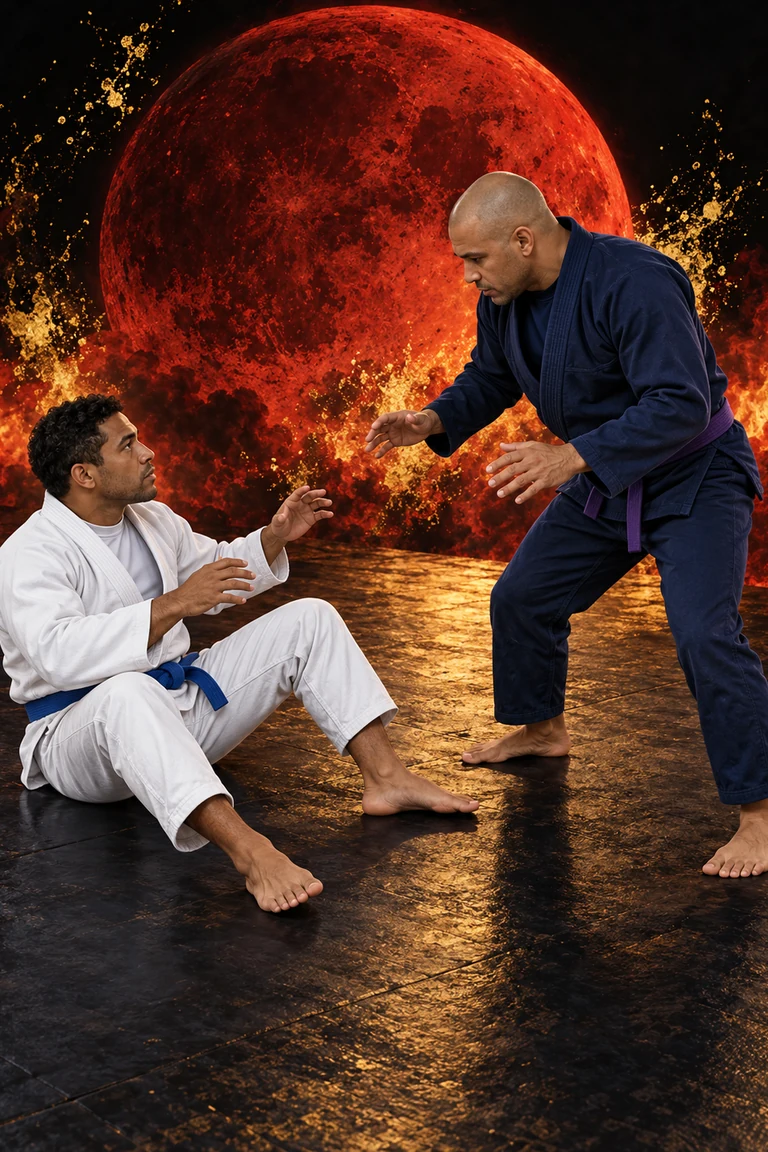
No jiu-jitsu brasileiro, o controlo das costas é a porta para o mata-leão. Ilustração WABUKAN
Uma técnica antiga com muitos nomes
Estrangular um adversário por trás é tão antigo como a própria luta. Obras de arte antigas já o mostram, como este relevo khmer do Camboja. No Japão, as velhas escolas de jujutsu ensinavam-no, e quando Jigorō Kanō organizou o judo do Kodokan a partir de 1882, o hadaka-jime tornou-se um dos shime-waza, as técnicas de estrangulamento, e uma das formas demonstradas no Katame-no-kata.
Baixo-relevo khmer (Camboja) com um estrangulamento por trás: a técnica é muito antiga. Autor: Thunder n lightning · Licença: CC BY-SA 4.0 · Wikimedia Commons
No Brasil, a família Gracie e os seus alunos fizeram do controlo das costas uma posição central do jiu-jitsu brasileiro, com o mata-leão como finalização natural. Quando os primeiros UFC, a partir de 1993, puseram frente a frente lutadores de estilos diferentes, a técnica tornou-se famosa no mundo inteiro, e continua a ser uma das finalizações mais frequentes no MMA.
Como funciona
O mata-leão é um estrangulamento sanguíneo, não respiratório. O objetivo não é esmagar a traqueia, mas comprimir as artérias carótidas dos dois lados do pescoço, entre o antebraço e o bíceps do braço que estrangula. Com menos sangue a chegar ao cérebro, uma pessoa pode perder os sentidos numa questão de segundos. É por isso que é tão eficaz, e tão perigoso se for mantido tempo demais.
A posição clássica tem quatro elementos:
Controlo das costas. O atacante está atrás do adversário, peito contra costas, normalmente com as pernas enganchadas por dentro das coxas do outro («ganchos») para o impedir de rodar.
O braço que estrangula. Passa por baixo do queixo, com o cotovelo centrado à frente da garganta, de modo que o antebraço fica de um lado do pescoço e o bíceps do outro.
O fecho. A mão do braço que estrangula agarra o bíceps do outro braço; a outra mão vai para trás da cabeça ou do ombro do adversário.
O aperto. Mais do que puxar com os braços, o atacante junta os cotovelos, expande o peito e mantém a cabeça colada à do adversário, fechando todos os espaços.
Demonstração de instrutores: braço sob o queixo, mão no bíceps, a outra atrás da cabeça. Autor: Unknown author · Licença: Domínio público / Public domain · Wikimedia Commons
Se o antebraço apertar a frente da garganta em vez dos lados, a técnica passa a ser um estrangulamento respiratório: mais lento, doloroso e mais arriscado para a laringe. No treino, a colocação correta é também uma questão de segurança.
Há variantes. Alguns praticantes juntam as mãos palma contra palma em vez de agarrar o bíceps; com o casaco, o judo e o jiu-jitsu acrescentam estrangulamentos por trás aparentados, como o okuri-eri-jime, que usa a gola do adversário. O princípio é o mesmo: primeiro controlar, depois fechar o espaço à volta do pescoço.
Defesas
A melhor defesa chega cedo: não dar as costas. Se as costas forem tomadas, quem defende protege o pescoço com as mãos e baixa o queixo, luta contra a mão que estrangula com as duas mãos e procura levar as costas ao chão e rodar para fora da posição. Sair do controlo das costas é um capítulo inteiro do jiu-jitsu, treinado devagar e, no início, com um parceiro que colabora.
Segurança: as regras que não se negociam
Bater e largar. Quem é estrangulado bate no parceiro ou no tapete, ou diz «bati»; quem estrangula larga imediatamente. Sem exceções, nem em competição.
Aplicar devagar no treino. A pressão sobe aos poucos, para o parceiro ter tempo de bater. Estrangulamentos bruscos e explosivos não têm lugar numa aula normal.
Nunca sem supervisão. Os estrangulamentos treinam-se só no clube, com um instrutor qualificado presente. Nunca a brincar, nunca em quem não está a treinar.
Se alguém perder os sentidos, largue de imediato, deite a pessoa de costas ou de lado e chame o instrutor. Normalmente acorda depressa, mas qualquer perda de consciência deve ser comunicada e avaliada.
Idade e saúde. Muitas federações não permitem estrangulamentos a crianças, e quem tem problemas de pescoço, coração ou circulação deve falar com um médico antes de os treinar.
Estudos sobre os estrangulamentos do judo, como a revisão de Koiwai de 1987, concluíram que na prática desportiva, aplicadas corretamente e largadas a tempo, estas técnicas têm um bom historial de segurança. Fora do desporto a história é outra: imobilizações prolongadas do pescoço já causaram mortes em detenções, e muitas polícias restringiram-nas ou proibiram-nas. Um estrangulamento é uma técnica de controlo, não de castigo.
Porque se ensina
O mata-leão ensina algumas das lições mais profundas da luta agarrada: a posição antes da finalização, o uso do corpo inteiro em vez dos braços, a paciência e o controlo. No judo mostra que um combate no chão pode ser decidido de forma limpa; no jiu-jitsu resume a lógica da arte; na defesa pessoal lembra que a responsabilidade cresce com a eficácia.
Para ler como o jiu-jitsu dos Gracie se cruzou com outros estilos, veja BJJ e vale-tudo.
Linha do tempo
1882Kodokan: o hadaka-jime entra no judo como shime-waza.
1920sNo Brasil, os Gracie desenvolvem o jogo de chão e o controlo das costas.
1993Primeiro UFC: os estrangulamentos ganham fama mundial.
Rear naked choke (hadaka-jime): how it works and how to train it safely
· 4 min read
In Brazil it is called mata-leão, "lion killer". In judo it is hadaka-jime, the "naked strangle", because it does not need the jacket. In English it is the rear naked choke. Whatever the name, it is one of the most effective and most studied techniques in grappling, and precisely for that reason one that demands the most care in training.
In Brazilian jiu-jitsu, back control is the door to the rear naked choke. WABUKAN illustration
An old technique with many names
Strangling an opponent from behind is as old as fighting itself. Old works of art already show it, like this Khmer relief from Cambodia. In Japan, the old jujutsu schools taught it, and when Jigorō Kanō organised Kodokan judo from 1882, hadaka-jime became one of the shime-waza, the strangling techniques, and one of the forms demonstrated in the Katame-no-kata.
Khmer bas-relief (Cambodia) showing a rear choke: the technique is very old. Author: Thunder n lightning · Licence: CC BY-SA 4.0 · Wikimedia Commons
In Brazil, the Gracie family and their students turned control of the back into a central position in Brazilian jiu-jitsu, with the rear naked choke as its natural finish. When the first UFC events from 1993 showed fighters of different styles against each other, the technique became world-famous, and it is still one of the most common submission finishes in MMA.
How it works
The mata-leão is a blood choke, not an air choke. The goal is not to crush the windpipe, but to compress the carotid arteries on both sides of the neck, between the forearm and the biceps of the choking arm. With blood flow to the brain reduced, a person can lose consciousness in a matter of seconds. That is why it is so effective, and why it is so dangerous if held too long.
The classic position has four elements:
Back control. The attacker is behind the opponent, chest to back, usually with the legs hooked inside the opponent's thighs ("hooks") to stop them turning.
The choking arm. It passes under the chin, with the elbow centred in front of the throat, so that the forearm is on one side of the neck and the biceps on the other.
The lock. The hand of the choking arm grips the biceps of the other arm; the other hand goes behind the opponent's head or shoulder.
The squeeze. More than pulling with the arms, the attacker brings the elbows together, expands the chest and keeps the head close to the opponent's head, closing every space.
Instructors' demonstration: arm under the chin, hand on the biceps, the other behind the head. Author: Unknown author · Licence: Domínio público / Public domain · Wikimedia Commons
If the forearm presses on the front of the throat instead of the sides, the technique becomes an air choke: slower, painful and riskier for the larynx. In training, correct placement is therefore also a safety question.
There are variants. Some practitioners join the hands palm to palm instead of gripping the biceps; with the jacket, judo and jiu-jitsu add related rear chokes such as okuri-eri-jime, which uses the opponent's lapel. The principle stays the same: control first, then close the space around the neck.
Defences
The best defence comes early: do not give up the back. Once the back is taken, the defender protects the neck with the hands and lowers the chin, fights the choking hand with both hands, and tries to bring the back to the mat and turn out of the position. Escaping from back control is a whole chapter of jiu-jitsu, trained slowly and with a partner who cooperates at first.
Safety: the rules that are not negotiable
Tap and release. Whoever is choked taps the partner or the mat, or says "tap"; whoever chokes releases immediately. No exceptions, not even in competition.
Apply slowly in training. Pressure is built up gradually, so that the partner has time to tap. Sudden, explosive chokes have no place in a normal class.
Never outside supervision. Chokes are trained only in a club, with a qualified instructor present. Never as a game, never on someone who is not training.
If someone goes unconscious, release at once, place the person on their back or side and call the instructor. People usually wake up quickly, but any loss of consciousness must be reported and assessed.
Age and health. Many federations do not allow chokes for children, and people with neck, heart or circulation problems should talk to a doctor before training them.
Studies of judo chokes, such as Koiwai's review of 1987, concluded that in sport practice, applied correctly and released in time, these techniques have a good safety record. Outside sport the story is different: prolonged neck holds have caused deaths in arrests, and many police forces have restricted or banned them. A choke is a technique of control, not of punishment.
Why it is taught
The mata-leão teaches some of the deepest lessons of grappling: position before submission, the use of the whole body instead of the arms, patience and control. In judo it shows that a fight on the ground can be decided cleanly; in jiu-jitsu it summarises the logic of the art; in self-defence it reminds us that responsibility grows with effectiveness.
To read how the jiu-jitsu of the Gracies met other styles, see BJJ and vale tudo.
Timeline
1882Kodokan: hadaka-jime enters judo as a shime-waza.
1920sIn Brazil, the Gracies develop groundwork and back control.
Mata león (hadaka-jime): cómo funciona y cómo se entrena con seguridad
· 4 min de lectura
En Brasil se llama mata-leão, «mata león». En judo es el hadaka-jime, la «estrangulación desnuda», porque no necesita la chaqueta. En inglés es el rear naked choke. Sea cual sea el nombre, es una de las técnicas más eficaces y estudiadas de la lucha cuerpo a cuerpo y, precisamente por eso, una de las que exigen más cuidado al entrenar.
En el jiu-jitsu brasileño, el control de espalda es la puerta al mata león. Ilustración WABUKAN
Una técnica antigua con muchos nombres
Estrangular a un rival por detrás es tan antiguo como la propia lucha. Obras de arte antiguas ya lo muestran, como este relieve jemer de Camboya. En Japón, las viejas escuelas de jujutsu lo enseñaban, y cuando Jigorō Kanō organizó el judo del Kodokan a partir de 1882, el hadaka-jime pasó a ser uno de los shime-waza, las técnicas de estrangulación, y una de las formas del Katame-no-kata.
Bajorrelieve jemer (Camboya) con una estrangulación por detrás: la técnica es muy antigua. Autor: Thunder n lightning · Licencia: CC BY-SA 4.0 · Wikimedia Commons
En Brasil, la familia Gracie y sus alumnos hicieron del control de espalda una posición central del jiu-jitsu brasileño, con el mata león como finalización natural. Cuando los primeros UFC, desde 1993, enfrentaron a luchadores de estilos distintos, la técnica se hizo famosa en todo el mundo, y sigue siendo una de las finalizaciones más frecuentes del MMA.
Cómo funciona
El mata león es una estrangulación sanguínea, no respiratoria. El objetivo no es aplastar la tráquea, sino comprimir las arterias carótidas a ambos lados del cuello, entre el antebrazo y el bíceps del brazo que estrangula. Con menos sangre llegando al cerebro, una persona puede perder el conocimiento en cuestión de segundos. Por eso es tan eficaz, y tan peligrosa si se mantiene demasiado.
La posición clásica tiene cuatro elementos:
Control de espalda. El atacante está detrás del rival, pecho contra espalda, normalmente con las piernas enganchadas por dentro de sus muslos («ganchos») para impedir que gire.
El brazo que estrangula. Pasa bajo la barbilla, con el codo centrado delante de la garganta, de modo que el antebrazo queda a un lado del cuello y el bíceps al otro.
El cierre. La mano del brazo que estrangula agarra el bíceps del otro brazo; la otra mano va detrás de la cabeza o del hombro del rival.
El apriete. Más que tirar con los brazos, el atacante junta los codos, expande el pecho y mantiene la cabeza pegada a la del rival, cerrando todos los espacios.
Demostración de instructores: brazo bajo la barbilla, mano en el bíceps, la otra detrás de la cabeza. Autor: Unknown author · Licencia: Domínio público / Public domain · Wikimedia Commons
Si el antebrazo presiona la parte delantera de la garganta en lugar de los lados, la técnica se convierte en una estrangulación respiratoria: más lenta, dolorosa y más arriesgada para la laringe. En el entrenamiento, la colocación correcta es también una cuestión de seguridad.
Hay variantes. Algunos practicantes unen las manos palma con palma en lugar de agarrar el bíceps; con chaqueta, el judo y el jiu-jitsu añaden estrangulaciones por detrás emparentadas, como el okuri-eri-jime, que usa la solapa del rival. El principio es el mismo: primero controlar, después cerrar el espacio alrededor del cuello.
Defensas
La mejor defensa llega pronto: no dar la espalda. Si la espalda ya está tomada, quien defiende protege el cuello con las manos y baja la barbilla, lucha contra la mano que estrangula con ambas manos e intenta llevar la espalda al suelo y girar para salir de la posición. Escapar del control de espalda es un capítulo entero del jiu-jitsu, que se entrena despacio y, al principio, con un compañero que colabora.
Seguridad: reglas innegociables
Palmear y soltar. Quien es estrangulado palmea al compañero o el tapiz, o lo dice en voz alta; quien estrangula suelta inmediatamente. Sin excepciones, tampoco en competición.
Aplicar despacio al entrenar. La presión sube poco a poco, para que el compañero tenga tiempo de palmear. Las estrangulaciones bruscas no tienen sitio en una clase normal.
Nunca sin supervisión. Las estrangulaciones se entrenan solo en el club, con un instructor cualificado presente. Nunca como juego, nunca con alguien que no está entrenando.
Si alguien pierde el conocimiento, suelte de inmediato, coloque a la persona boca arriba o de lado y avise al instructor. Normalmente despierta enseguida, pero toda pérdida de conocimiento debe comunicarse y evaluarse.
Edad y salud. Muchas federaciones no permiten estrangulaciones a niños, y quien tenga problemas de cuello, corazón o circulación debe consultar a un médico antes de entrenarlas.
Estudios sobre las estrangulaciones del judo, como la revisión de Koiwai de 1987, concluyeron que en la práctica deportiva, bien aplicadas y soltadas a tiempo, estas técnicas tienen un buen historial de seguridad. Fuera del deporte la historia es otra: las sujeciones prolongadas del cuello han causado muertes en detenciones, y muchas policías las han restringido o prohibido. Una estrangulación es una técnica de control, no de castigo.
Por qué se enseña
El mata león enseña algunas de las lecciones más profundas de la lucha: la posición antes de la finalización, el uso de todo el cuerpo en lugar de los brazos, la paciencia y el control. En judo muestra que un combate en el suelo puede decidirse limpiamente; en jiu-jitsu resume la lógica del arte; en defensa personal recuerda que la responsabilidad crece con la eficacia.
Para leer cómo el jiu-jitsu de los Gracie se cruzó con otros estilos, vea BJJ y vale tudo.
Cronología
1882Kodokan: el hadaka-jime entra en el judo como shime-waza.
1920sEn Brasil, los Gracie desarrollan el suelo y el control de espalda.
1993Primer UFC: las estrangulaciones se hacen famosas.
L’étranglement arrière (hadaka-jime) : comment il fonctionne et comment s’entraîner en sécurité
· 4 min de lecture
Au Brésil, on l’appelle mata-leão, « tueur de lion ». En judo, c’est le hadaka-jime, « l’étranglement nu », car il n’a pas besoin de la veste. En anglais, c’est le rear naked choke. Quel que soit son nom, c’est l’une des techniques les plus efficaces et les plus étudiées de la lutte au corps à corps, et c’est justement pour cela qu’elle exige le plus de prudence à l’entraînement.
En jiu-jitsu brésilien, le contrôle du dos ouvre la voie à l’étranglement arrière. Illustration WABUKAN
Une technique ancienne aux nombreux noms
Étrangler un adversaire par derrière est aussi ancien que le combat lui-même. Des œuvres anciennes le montrent déjà, comme ce relief khmer du Cambodge. Au Japon, les anciennes écoles de jujutsu l’enseignaient, et lorsque Jigorō Kanō organise le judo du Kodokan à partir de 1882, le hadaka-jime devient l’un des shime-waza, les techniques d’étranglement, et l’une des formes du Katame-no-kata.
Bas-relief khmer (Cambodge) montrant un étranglement arrière : la technique est très ancienne. Auteur: Thunder n lightning · Licence: CC BY-SA 4.0 · Wikimedia Commons
Au Brésil, la famille Gracie et ses élèves font du contrôle du dos une position centrale du jiu-jitsu brésilien, avec l’étranglement arrière comme finalisation naturelle. Quand les premiers UFC, à partir de 1993, opposent des combattants de styles différents, la technique devient célèbre dans le monde entier ; elle reste l’une des soumissions les plus fréquentes en MMA.
Comment il fonctionne
Le mata-leão est un étranglement sanguin, pas respiratoire. Le but n’est pas d’écraser la trachée, mais de comprimer les artères carotides des deux côtés du cou, entre l’avant-bras et le biceps du bras qui étrangle. Le cerveau recevant moins de sang, une personne peut perdre connaissance en quelques secondes. C’est pourquoi il est si efficace, et si dangereux s’il est maintenu trop longtemps.
La position classique comporte quatre éléments :
Le contrôle du dos. L’attaquant est derrière l’adversaire, poitrine contre dos, en général avec les jambes crochetées à l’intérieur des cuisses de l’autre (les « crochets ») pour l’empêcher de se retourner.
Le bras qui étrangle. Il passe sous le menton, le coude centré devant la gorge, de sorte que l’avant-bras soit d’un côté du cou et le biceps de l’autre.
Le verrou. La main du bras qui étrangle saisit le biceps de l’autre bras ; l’autre main se place derrière la tête ou l’épaule de l’adversaire.
Le serrage. Plutôt que de tirer avec les bras, l’attaquant rapproche les coudes, gonfle la poitrine et garde sa tête collée à celle de l’adversaire, fermant tous les espaces.
Démonstration d’instructeurs : bras sous le menton, main sur le biceps, l’autre derrière la tête. Auteur: Unknown author · Licence: Domínio público / Public domain · Wikimedia Commons
Si l’avant-bras appuie sur l’avant de la gorge plutôt que sur les côtés, la technique devient un étranglement respiratoire : plus lent, douloureux et plus risqué pour le larynx. À l’entraînement, le bon placement est donc aussi une question de sécurité.
Il existe des variantes. Certains pratiquants joignent les mains paume contre paume au lieu de saisir le biceps ; avec la veste, le judo et le jiu-jitsu ajoutent des étranglements arrière voisins comme l’okuri-eri-jime, qui utilise le revers de l’adversaire. Le principe reste le même : contrôler d’abord, puis fermer l’espace autour du cou.
Défenses
La meilleure défense arrive tôt : ne pas donner son dos. Si le dos est pris, le défenseur protège son cou avec les mains et baisse le menton, combat la main qui étrangle avec ses deux mains et cherche à ramener son dos au sol pour se dégager. Sortir du contrôle du dos est un chapitre entier du jiu-jitsu, travaillé lentement et, au début, avec un partenaire coopératif.
Sécurité : des règles non négociables
Taper et lâcher. Celui qui est étranglé tape sur le partenaire ou le tapis, ou le dit à voix haute ; celui qui étrangle lâche immédiatement. Sans exception, même en compétition.
Appliquer lentement à l’entraînement. La pression monte progressivement, pour laisser au partenaire le temps de taper. Les étranglements brusques n’ont pas leur place dans un cours normal.
Jamais sans encadrement. Les étranglements ne se travaillent qu’au club, en présence d’un enseignant qualifié. Jamais pour jouer, jamais sur quelqu’un qui ne s’entraîne pas.
Si quelqu’un perd connaissance, lâchez aussitôt, placez la personne sur le dos ou sur le côté et appelez l’enseignant. Elle se réveille en général vite, mais toute perte de connaissance doit être signalée et évaluée.
Âge et santé. Beaucoup de fédérations interdisent les étranglements aux enfants, et les personnes ayant des problèmes de cou, de cœur ou de circulation doivent consulter un médecin avant de les travailler.
Des études sur les étranglements du judo, comme la revue de Koiwai en 1987, ont conclu qu’en pratique sportive, correctement appliquées et relâchées à temps, ces techniques présentent un bon bilan de sécurité. Hors du sport, c’est autre chose : des clés de cou prolongées ont causé des morts lors d’interpellations, et beaucoup de polices les ont restreintes ou interdites. Un étranglement est une technique de contrôle, pas de punition.
Pourquoi on l’enseigne
Le mata-leão enseigne quelques-unes des leçons les plus profondes de la lutte : la position avant la soumission, l’usage de tout le corps plutôt que des bras, la patience et le contrôle. En judo, il montre qu’un combat au sol peut se conclure proprement ; en jiu-jitsu, il résume la logique de l’art ; en self-défense, il rappelle que la responsabilité grandit avec l’efficacité.
Pour lire comment le jiu-jitsu des Gracie a rencontré d’autres styles, voir BJJ et vale tudo.
Chronologie
1882Kodokan : le hadaka-jime entre dans le judo comme shime-waza.
1920sAu Brésil, les Gracie développent le sol et le contrôle du dos.
1993Premier UFC : les étranglements deviennent célèbres.