Seoi-nage: a projeção pelo ombro explicada passo a passo
· 4 min de leitura
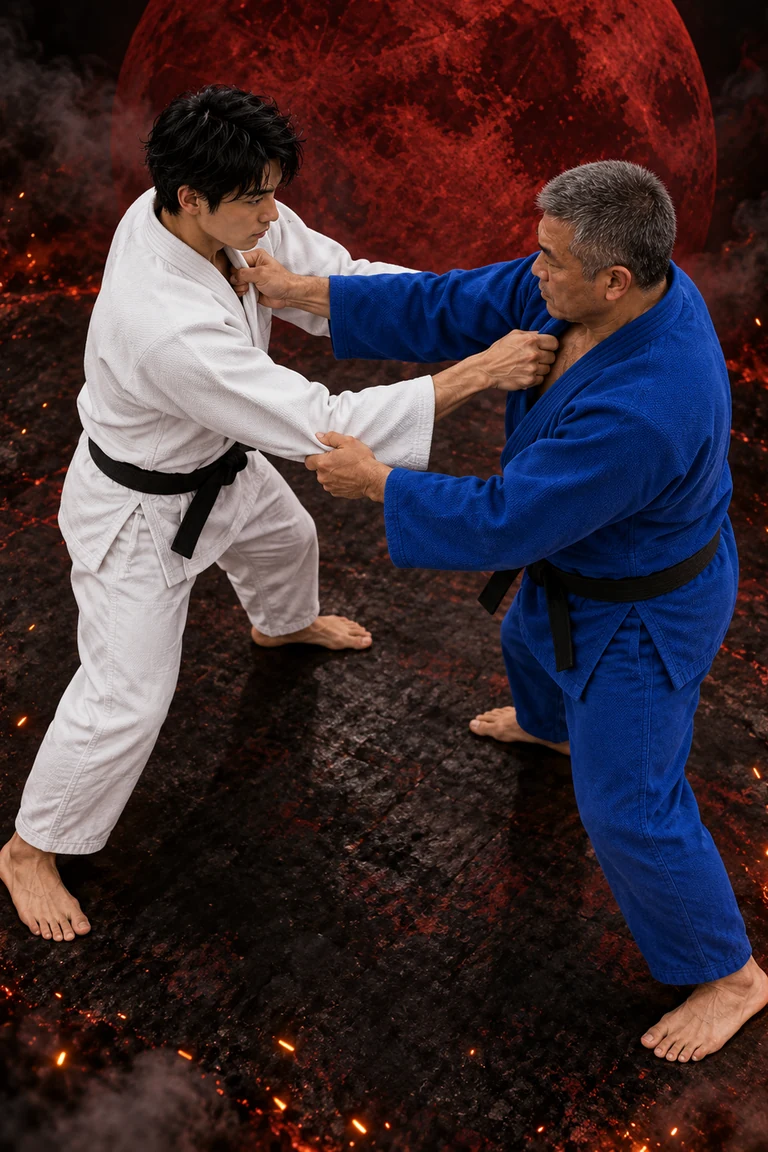
Poucas imagens dizem «judo» tão claramente como um seoi-nage: um entra, baixa-se, e o outro voa por cima do ombro. O nome quer dizer «projeção carregando às costas», e é uma das primeiras projeções que um judoca aprende e uma das últimas que deixa de aperfeiçoar.
Judo: projetar com o mínimo de força, aproveitando o desequilíbrio. Ilustração WABUKAN
De onde vem
Projeções em que o atacante carrega o adversário às costas já existiam nas velhas escolas de jujutsu. Quando Jigorō Kanō fundou o Kodokan em 1882, escolheu e organizou as técnicas segundo uma única ideia: usar o desequilíbrio do adversário para obter o máximo efeito com o mínimo esforço. Em 1895 o Kodokan publicou o primeiro Gokyō, os «cinco grupos» de projeções de ensino, revisto em 1920. O seoi-nage está no primeiro grupo, entre as técnicas básicas que qualquer principiante estuda.
Na classificação do Kodokan é um te-waza, uma técnica de mão, porque os braços e a pega guiam a projeção, embora as pernas e a anca façam boa parte do trabalho.
As variantes principais
Ippon-seoi-nage («um braço»): o braço do atacante entra por baixo da axila do adversário e prende-lhe o braço contra o ombro. Funciona bem contra adversários direitos ou que avançam a mão.
Morote-seoi-nage («duas mãos»): as duas mãos mantêm a pega na manga e na gola; o cotovelo da mão da gola entra por baixo da axila do adversário.
Eri-seoi-nage: versão com pega na gola do mesmo lado, popular em competição.
Seoi-otoshi: técnica aparentada em que o atacante desce muito e o adversário «cai» por cima de uma perna estendida em vez de ser levantado.
Ippon-seoi-nage em competição: o braço passa por baixo da axila do adversário. Autor: MelkiaD · Licença: CC BY 2.0 · Wikimedia Commons
As três fases
Kanō ensinava que cada projeção tem três momentos. São a melhor forma de perceber o seoi-nage.
1. Kuzushi — quebrar o equilíbrio. Nada funciona se o adversário estiver estável. Com a mão da manga, o atacante puxa para a frente e ligeiramente para cima, como quem olha para o relógio; o peso do adversário passa para as pontas dos pés. Muitas vezes o kuzushi nasce de uma reação: empurra-se um pouco, o adversário empurra de volta, e o atacante aproveita esse empurrão.
2. Tsukuri — encaixar. O atacante roda para dentro, normalmente com um pivô, até as costas ficarem em contacto com o peito do adversário, joelhos fletidos e anca abaixo do cinto do outro. É aqui que acontecem quase todos os erros: rodar devagar demais, ficar alto demais ou deixar espaço entre os corpos.
3. Kake — execução. As pernas esticam, o tronco inclina-se e roda, e os braços continuam a puxar na direção da projeção. O adversário passa por cima do ombro e cai de costas. Um seoi-nage bem feito parece leve: são as pernas e a rotação que levantam, não os braços.
Morote-seoi-nage: as duas mãos agarram o judogi. Autor: Michael Hultström · Licença: CC BY-SA 3.0 · Wikimedia Commons
Erros comuns
Puxar só com os braços. Força sem kuzushi torna a projeção lenta e fácil de bloquear.
Anca alta demais. Se a anca do atacante não ficar abaixo do centro de gravidade do adversário, não há nada para levantar.
Olhar para o chão. Baixar a cabeça quebra a linha das costas e trava a rotação; os olhos devem seguir a direção da projeção.
Largar a manga. A mão que puxa protege o parceiro: controla a queda e ajuda-o a cair de costas, e não de cabeça ou de ombro.
Segurança
O seoi-nage é seguro quando o parceiro sabe cair. Antes de aprender a projetar, aprende-se o ukemi, as quedas, e as primeiras projeções fazem-se devagar, de joelhos ou para um colchão de queda. As versões em que o atacante cai sobre os dois joelhos forçam os joelhos e, mal feitas, o pescoço do parceiro; algumas competições de jovens restringem-nas, e os treinadores costumam reservá-las a praticantes experientes. Treine sempre em tatami adequado e com um professor qualificado.
Como se treina
Os judocas constroem a projeção por etapas. No uchikomi repetem a entrada muitas vezes sem projetar, para tornar a rotação rápida e a posição precisa. No nagekomi completam a projeção para um colchão, com um parceiro que colabora. Só depois a tentam no randori, a prática livre, onde o parceiro resiste e é preciso encontrar o momento certo. As combinações também contam: uma finta com uma projeção para a frente leva muitas vezes o adversário a inclinar-se para trás, e aí funciona uma técnica para trás.
Campeões e estilo
Muitos grandes judocas construíram a carreira com o seoi-nage. O japonês Toshihiko Koga, campeão olímpico em Barcelona em 1992, ficou famoso por uma versão explosiva. Tadahiro Nomura ganhou três ouros olímpicos seguidos, em 1996, 2000 e 2004, na categoria mais leve, com o seoi-nage entre as suas armas principais. O judo deles mostra porque é que esta projeção serve atletas mais pequenos e rápidos: entrar por baixo de um adversário mais alto é uma vantagem, não um problema.
Para lá do judo
Projeções de carga semelhantes aparecem no sambo, no trabalho de pé do jiu-jitsu brasileiro e na luta, onde a projeção pelo ombro partilha a mesma mecânica. Em defesa pessoal, o princípio é o mesmo: primeiro desequilibrar, depois encaixar, e só então projetar.
Para perceber como esta técnica passou das velhas escolas para um desporto moderno, leia Do jujutsu ao judo.
Linha do tempo
1882Jigorō Kanō funda o Kodokan em Tóquio.
1895Primeiro Gokyō: seoi-nage no primeiro grupo.
1920Revisão do Gokyō, que ainda hoje é a base.
1964O judo estreia nos Jogos Olímpicos de Tóquio.
1996–2004Tadahiro Nomura ganha três ouros olímpicos com o seoi-nage como arma.
Seoi-nage: the shoulder throw explained step by step
· 4 min read
Few images say "judo" as clearly as a seoi-nage: one person turns in, ducks under, and the other flies over the shoulder. The name means "back-carry throw", and it is one of the first throws a judoka learns and one of the last they stop refining.
Judo: throwing with minimum force by using imbalance. WABUKAN illustration
Where it comes from
Throws where the attacker loads the opponent on the back existed in the old schools of jujutsu. When Jigorō Kanō founded the Kodokan in 1882, he selected and organised techniques according to a single idea: use the opponent's imbalance to obtain the maximum effect with the minimum effort. In 1895 the Kodokan published its first Gokyō, the "five groups" of teaching throws, revised in 1920. Seoi-nage sits in the first group, among the basic techniques every beginner studies.
In the Kodokan classification it is a te-waza, a hand technique, because the arms and the grip guide the throw, even though legs and hips do much of the work.
The main variants
Ippon-seoi-nage ("one-arm"): the attacker's arm slides under the opponent's armpit and clamps the upper arm against the shoulder. It works well against opponents who stand upright or reach forward.
Morote-seoi-nage ("two hands"): both hands keep their grip on the sleeve and lapel; the elbow of the lapel hand goes under the opponent's armpit.
Eri-seoi-nage: a version gripping the lapel on the same side, popular in competition.
Seoi-otoshi: a related technique in which the attacker drops low and the opponent is "dropped" over an extended leg rather than lifted.
Ippon-seoi-nage in competition: the arm goes under the opponent's armpit. Author: MelkiaD · Licence: CC BY 2.0 · Wikimedia Commons
The three phases
Kanō taught that every throw has three moments. They are the best way to understand seoi-nage.
1. Kuzushi — breaking the balance. Nothing works if the opponent is stable. With the sleeve hand, the attacker pulls forward and slightly up, as if looking at a wristwatch; the opponent's weight moves onto the toes. Kuzushi is often created by a reaction: push a little, the opponent pushes back, and the attacker uses that push.
2. Tsukuri — fitting in. The attacker turns in, usually with a pivot, until their back is in contact with the opponent's chest, knees bent, hips lower than the opponent's belt. This is where most mistakes happen: turning too slowly, staying too high, or leaving space between the bodies.
3. Kake — execution. The legs straighten, the upper body bends forward and rotates, and the arms keep pulling in the direction of the throw. The opponent goes over the shoulder and lands on the back. A well-done seoi-nage feels light: the legs and the rotation lift, not the arms.
Morote-seoi-nage: both hands hold the judogi. Author: Michael Hultström · Licence: CC BY-SA 3.0 · Wikimedia Commons
Common mistakes
Pulling only with the arms. Strength without kuzushi makes the throw slow and easy to block.
Hips too high. If the attacker's hips are not below the opponent's centre of gravity, there is nothing to lift.
Looking down. Dropping the head breaks the line of the back and stops the rotation; the eyes should follow the direction of the throw.
Letting go of the sleeve. The pulling hand protects the partner: it controls the fall and helps them land on their back, not on their head or shoulder.
Safety
Seoi-nage is safe when the partner knows how to fall. Before learning to throw, students learn ukemi, the breakfalls, and the first throws are done slowly, from a kneeling position or onto a crash mat. Versions in which the attacker drops onto both knees put stress on the knees and on the partner's neck if done badly; some youth competitions restrict them, and coaches generally keep them for experienced players. Training should always be on proper tatami, with a qualified teacher.
How it is trained
Judoka build the throw in stages. In uchikomi they repeat the entry many times without throwing, to make the turn fast and the position precise. In nagekomi they complete the throw onto a mat, with a cooperative partner. Only then do they try it in randori, free practice, where the partner resists and the timing has to be found. Combinations matter too: a feint with a forward throw often makes the opponent lean back, and then a rear technique works.
Champions and style
Many great judoka built their careers on seoi-nage. The Japanese Toshihiko Koga, Olympic champion in Barcelona in 1992, was famous for an explosive version. Tadahiro Nomura won three consecutive Olympic golds, in 1996, 2000 and 2004, in the lightest category, with seoi-nage among his main weapons. Their judo shows why the throw suits smaller and faster athletes: getting under a taller opponent is an advantage, not a problem.
Beyond judo
Similar loading throws appear in sambo, in Brazilian jiu-jitsu stand-up work and in wrestling, where the "flying mare" or shoulder throw shares the same mechanics. In self-defence contexts, the principle remains the same: break the balance first, then fit in, and only then throw.
To understand how this technique moved from the old schools to a modern sport, read From jujutsu to judo.
Timeline
1882Jigorō Kanō founds the Kodokan in Tokyo.
1895First Gokyō: seoi-nage in the first group.
1920Gokyō revised; still the basis today.
1964Judo debuts at the Tokyo Olympics.
1996–2004Tadahiro Nomura wins three Olympic golds with seoi-nage as a weapon.
Seoi-nage: la proyección por el hombro paso a paso
· 4 min de lectura
Pocas imágenes dicen «judo» tan claramente como un seoi-nage: uno entra, se agacha, y el otro vuela por encima del hombro. El nombre significa «proyección cargando a la espalda», y es una de las primeras proyecciones que aprende un judoca y una de las últimas que deja de pulir.
Judo: proyectar con la mínima fuerza aprovechando el desequilibrio. Ilustración WABUKAN
De dónde viene
Las proyecciones en las que el atacante carga al rival a la espalda ya existían en las viejas escuelas de jujutsu. Cuando Jigorō Kanō fundó el Kodokan en 1882, eligió y ordenó las técnicas según una sola idea: usar el desequilibrio del rival para obtener el máximo efecto con el mínimo esfuerzo. En 1895 el Kodokan publicó su primer Gokyō, los «cinco grupos» de proyecciones de enseñanza, revisado en 1920. El seoi-nage está en el primer grupo, entre las técnicas básicas que estudia cualquier principiante.
En la clasificación del Kodokan es un te-waza, una técnica de mano, porque los brazos y el agarre guían la proyección, aunque piernas y cadera hacen buena parte del trabajo.
Las variantes principales
Ippon-seoi-nage («un brazo»): el brazo del atacante entra bajo la axila del rival y le sujeta el brazo contra el hombro. Funciona bien contra rivales erguidos o que adelantan la mano.
Morote-seoi-nage («dos manos»): las dos manos mantienen el agarre en manga y solapa; el codo de la mano de la solapa entra bajo la axila del rival.
Eri-seoi-nage: versión con agarre de solapa del mismo lado, popular en competición.
Seoi-otoshi: técnica emparentada en la que el atacante baja mucho y el rival «cae» por encima de una pierna extendida en lugar de ser levantado.
Ippon-seoi-nage en competición: el brazo pasa bajo la axila del rival. Autor: MelkiaD · Licencia: CC BY 2.0 · Wikimedia Commons
Las tres fases
Kanō enseñaba que toda proyección tiene tres momentos. Son la mejor manera de entender el seoi-nage.
1. Kuzushi — romper el equilibrio. Nada funciona si el rival está estable. Con la mano de la manga, el atacante tira hacia delante y algo hacia arriba, como quien mira el reloj; el peso del rival pasa a las puntas de los pies. A menudo el kuzushi nace de una reacción: se empuja un poco, el rival empuja de vuelta y el atacante aprovecha ese empuje.
2. Tsukuri — encajar. El atacante gira hacia dentro, normalmente con un pivote, hasta que su espalda toca el pecho del rival, rodillas flexionadas y cadera por debajo del cinturón del otro. Aquí se producen casi todos los errores: girar demasiado despacio, quedarse demasiado alto o dejar espacio entre los cuerpos.
3. Kake — ejecución. Las piernas se estiran, el tronco se inclina y gira, y los brazos siguen tirando en la dirección de la proyección. El rival pasa por encima del hombro y cae de espaldas. Un seoi-nage bien hecho parece ligero: levantan las piernas y el giro, no los brazos.
Morote-seoi-nage: las dos manos agarran el judogi. Autor: Michael Hultström · Licencia: CC BY-SA 3.0 · Wikimedia Commons
Errores comunes
Tirar solo con los brazos. La fuerza sin kuzushi hace la proyección lenta y fácil de bloquear.
Cadera demasiado alta. Si la cadera del atacante no queda por debajo del centro de gravedad del rival, no hay nada que levantar.
Mirar al suelo. Bajar la cabeza rompe la línea de la espalda y frena el giro; la mirada debe seguir la dirección de la proyección.
Soltar la manga. La mano que tira protege al compañero: controla la caída y le ayuda a caer de espaldas, no de cabeza ni de hombro.
Seguridad
El seoi-nage es seguro cuando el compañero sabe caer. Antes de aprender a proyectar se aprende el ukemi, las caídas, y las primeras proyecciones se hacen despacio, de rodillas o sobre una colchoneta de caída. Las versiones en las que el atacante cae sobre las dos rodillas fuerzan las rodillas y, mal hechas, el cuello del compañero; algunas competiciones juveniles las restringen, y los entrenadores suelen reservarlas a practicantes con experiencia. Entrene siempre sobre tatami adecuado y con un profesor cualificado.
Cómo se entrena
Los judocas construyen la proyección por etapas. En el uchikomi repiten la entrada muchas veces sin proyectar, para que el giro sea rápido y la posición precisa. En el nagekomi completan la proyección sobre una colchoneta, con un compañero que colabora. Solo entonces la prueban en el randori, la práctica libre, donde el compañero resiste y hay que encontrar el momento. Las combinaciones también cuentan: una finta con una proyección hacia delante hace a menudo que el rival se incline hacia atrás, y entonces funciona una técnica hacia atrás.
Campeones y estilo
Muchos grandes judocas construyeron su carrera con el seoi-nage. El japonés Toshihiko Koga, campeón olímpico en Barcelona en 1992, se hizo famoso por una versión explosiva. Tadahiro Nomura ganó tres oros olímpicos seguidos, en 1996, 2000 y 2004, en la categoría más ligera, con el seoi-nage entre sus armas principales. Su judo muestra por qué esta proyección conviene a atletas más pequeños y rápidos: entrar por debajo de un rival más alto es una ventaja, no un problema.
Más allá del judo
Proyecciones de carga parecidas aparecen en el sambo, en el trabajo de pie del jiu-jitsu brasileño y en la lucha, donde la proyección por el hombro comparte la misma mecánica. En defensa personal el principio es igual: primero desequilibrar, después encajar y solo entonces proyectar.
Para entender cómo esta técnica pasó de las viejas escuelas a un deporte moderno, lea Del jujutsu al judo.
Cronología
1882Jigorō Kanō funda el Kodokan en Tokio.
1895Primer Gokyō: seoi-nage en el primer grupo.
1920Revisión del Gokyō, base todavía hoy.
1964El judo debuta en los Juegos Olímpicos de Tokio.
1996–2004Tadahiro Nomura gana tres oros olímpicos con el seoi-nage como arma.
Seoi-nage : la projection d’épaule expliquée pas à pas
· 4 min de lecture
Peu d’images disent « judo » aussi clairement qu’un seoi-nage : l’un entre, se baisse, et l’autre passe par-dessus l’épaule. Le nom signifie « projection en chargeant sur le dos » ; c’est l’une des premières projections qu’apprend un judoka et l’une des dernières qu’il cesse de perfectionner.
Judo : projeter avec un minimum de force en exploitant le déséquilibre. Illustration WABUKAN
D’où elle vient
Les projections où l’attaquant charge l’adversaire sur son dos existaient déjà dans les anciennes écoles de jujutsu. Quand Jigorō Kanō fonde le Kodokan en 1882, il choisit et organise les techniques selon une seule idée : utiliser le déséquilibre de l’adversaire pour obtenir le maximum d’effet avec le minimum d’effort. En 1895, le Kodokan publie son premier Gokyō, les « cinq groupes » de projections d’enseignement, révisé en 1920. Le seoi-nage figure dans le premier groupe, parmi les techniques de base que tout débutant étudie.
Dans la classification du Kodokan, c’est un te-waza, une technique de main, car les bras et la saisie guident la projection, même si les jambes et les hanches font une grande partie du travail.
Les principales variantes
Ippon-seoi-nage (« un bras ») : le bras de l’attaquant passe sous l’aisselle de l’adversaire et bloque son bras contre l’épaule. Efficace contre un adversaire droit ou qui avance la main.
Morote-seoi-nage (« deux mains ») : les deux mains gardent la saisie manche et revers ; le coude de la main du revers passe sous l’aisselle de l’adversaire.
Eri-seoi-nage : version avec saisie du revers du même côté, populaire en compétition.
Seoi-otoshi : technique voisine où l’attaquant descend très bas et l’adversaire « tombe » par-dessus une jambe tendue au lieu d’être soulevé.
Ippon-seoi-nage en compétition : le bras passe sous l’aisselle de l’adversaire. Auteur: MelkiaD · Licence: CC BY 2.0 · Wikimedia Commons
Les trois phases
Kanō enseignait que toute projection comporte trois moments. C’est la meilleure façon de comprendre le seoi-nage.
1. Kuzushi — rompre l’équilibre. Rien ne marche si l’adversaire est stable. De la main de la manche, l’attaquant tire vers l’avant et légèrement vers le haut, comme pour regarder sa montre ; le poids de l’adversaire passe sur la pointe des pieds. Souvent le kuzushi naît d’une réaction : on pousse un peu, l’adversaire repousse, et l’attaquant utilise cette poussée.
2. Tsukuri — se placer. L’attaquant pivote vers l’intérieur jusqu’à ce que son dos touche la poitrine de l’adversaire, genoux fléchis, hanches plus basses que la ceinture de l’autre. C’est là que se commettent presque toutes les erreurs : tourner trop lentement, rester trop haut ou laisser de l’espace entre les corps.
3. Kake — exécution. Les jambes se tendent, le buste se penche et tourne, et les bras continuent de tirer dans la direction de la projection. L’adversaire passe par-dessus l’épaule et tombe sur le dos. Un seoi-nage réussi paraît léger : ce sont les jambes et la rotation qui soulèvent, pas les bras.
Morote-seoi-nage : les deux mains tiennent le judogi. Auteur: Michael Hultström · Licence: CC BY-SA 3.0 · Wikimedia Commons
Erreurs fréquentes
Tirer seulement avec les bras. La force sans kuzushi rend la projection lente et facile à bloquer.
Hanches trop hautes. Si les hanches de l’attaquant ne sont pas sous le centre de gravité de l’adversaire, il n’y a rien à soulever.
Regarder le sol. Baisser la tête casse la ligne du dos et freine la rotation ; le regard doit suivre la direction de la projection.
Lâcher la manche. La main qui tire protège le partenaire : elle contrôle la chute et l’aide à tomber sur le dos, pas sur la tête ni l’épaule.
Sécurité
Le seoi-nage est sûr quand le partenaire sait chuter. Avant d’apprendre à projeter, on apprend l’ukemi, les brise-chutes, et les premières projections se font lentement, à genoux ou sur un tapis de chute. Les versions où l’attaquant tombe sur les deux genoux sollicitent les genoux et, mal faites, la nuque du partenaire ; certaines compétitions de jeunes les restreignent, et les entraîneurs les réservent en général aux pratiquants expérimentés. Entraînez-vous toujours sur un tatami adapté et avec un enseignant qualifié.
Comment on l’entraîne
Les judokas construisent la projection par étapes. En uchikomi, ils répètent l’entrée de nombreuses fois sans projeter, pour rendre la rotation rapide et le placement précis. En nagekomi, ils terminent la projection sur un tapis, avec un partenaire coopératif. Ce n’est qu’ensuite qu’ils l’essaient en randori, la pratique libre, où le partenaire résiste et où il faut trouver le bon moment. Les enchaînements comptent aussi : une feinte vers l’avant pousse souvent l’adversaire à se pencher en arrière, et c’est alors une technique arrière qui passe.
Champions et style
Beaucoup de grands judokas ont bâti leur carrière sur le seoi-nage. Le Japonais Toshihiko Koga, champion olympique à Barcelone en 1992, était célèbre pour une version explosive. Tadahiro Nomura a remporté trois titres olympiques consécutifs, en 1996, 2000 et 2004, dans la catégorie la plus légère, avec le seoi-nage parmi ses armes principales. Leur judo montre pourquoi cette projection convient aux athlètes plus petits et rapides : passer sous un adversaire plus grand est un avantage, pas un problème.
Au-delà du judo
Des projections de charge semblables existent en sambo, dans le travail debout du jiu-jitsu brésilien et en lutte, où la projection d’épaule partage la même mécanique. En self-défense, le principe reste le même : d’abord déséquilibrer, puis se placer, et seulement ensuite projeter.
Pour comprendre comment cette technique est passée des anciennes écoles au sport moderne, lisez Du jujutsu au judo.
Chronologie
1882Jigorō Kanō fonde le Kodokan à Tokyo.
1895Premier Gokyō : seoi-nage dans le premier groupe.
1920Révision du Gokyō, toujours la base aujourd’hui.
1964Le judo fait ses débuts aux Jeux olympiques de Tokyo.
1996–2004Tadahiro Nomura remporte trois titres olympiques avec le seoi-nage.