
Historical archive
The roda and the berimbau of capoeira
A circle of people, a one-string bow that gives the orders and a song about the police coming: legends and facts of the capoeira roda.
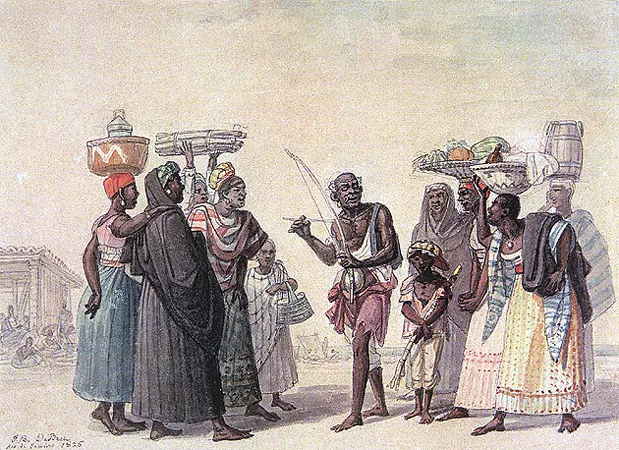
The legend
Legend
What history shows
Evidence
- The berimbau is an African musical bow: its name comes from Kimbundu, and the musicologist Gerhard Kubik found the southwest Angolan mbulumbumba identical in construction, playing technique and tuning.
- The berimbau only appears as capoeira’s instrument in the early 20th century, in Bahia; in the 19th century it accompanied chants and storytelling in Africa and Brazil. The Cavalaria rhythm is linked to the 1920s, when a police cavalry squadron under chief Pedro de Azevedo Gordilho repressed capoeira in Salvador.
- Hidden weapons in instruments are documented: on 16 November 1832 a police inspector in Rio reported capoeiras hiding spears and weapons in marimbas and sugarcane. Mestre Noronha later claimed the berimbau was a very useful weapon for the old masters of the 1920s; no independent record confirms it.
- Capoeira was a crime in Brazil’s 1890 Penal Code. Mestre Bimba opened a formal school in 1932, the state legalised and promoted capoeira from 1937, and Mestre Pastinha founded his Angola school in 1941. In 2014 UNESCO inscribed the roda de capoeira as Intangible Cultural Heritage of Humanity.
In short: The roda’s African roots and its history of police repression are documented; the warning rhythm fits the 1920s repression, while the berimbau-weapon remains oral tradition.
Images: public-domain or CC0 works credited under each picture, or original WABUKAN ink illustrations. Panels: the story told in numbered comic boxes.
Sources
- Berimbau — Wikipedia — en.wikipedia.org
- Capoeira — Wikipedia — en.wikipedia.org
- Roda de capoeira — Wikipedia — en.wikipedia.org
- UNESCO — Capoeira circle (2014) — ich.unesco.org
- Joueur d’urucungo (berimbau) — Wikimedia Commons — commons.wikimedia.org
Cite / use this content
You may quote and share this page with a link to WABUKAN. Suggested citation:
WABUKAN 和武館, «The roda and the berimbau of capoeira», https://wabukan.com/lenda-roda-berimbau (accessed 2026-10-30).