
Technique Manual › Joint locks
Joint locks
Cross armlock (juji-gatame / armbar)
Names by art: Judo: ude-hishigi-juji-gatame 腕挫十字固 · BJJ: chave de braço / armbar · Sambo: armbar (rychag loktya) · MMA: armbar
Juji means “cross”: the bodies of the two partners form a cross. The arm is straightened over the hips, which act as the fulcrum of a lever — a textbook case of τ = F·d. Injury studies show why it must be applied slowly: in Brazilian jiu-jitsu competition the elbow was the joint most often injured, and the arm bar the most common mechanism.
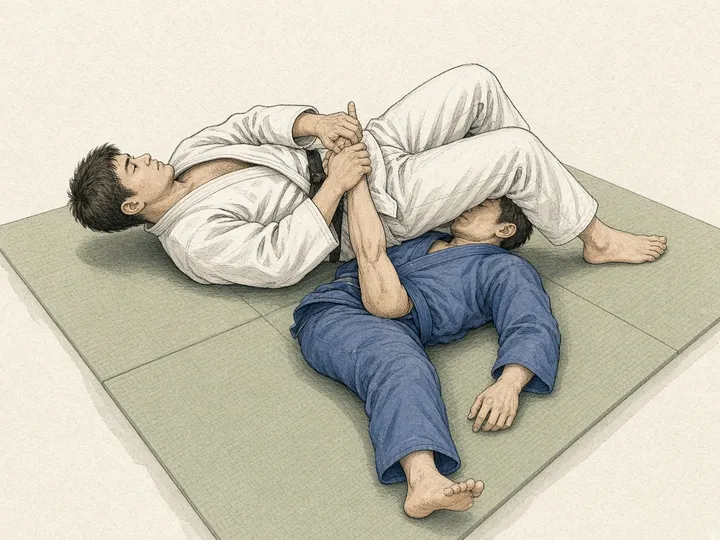
- F
- force of the hands on the wrist
- d
- distance from fulcrum to wrist
- τ
- torque on the elbow
Step by step
- Learn it first from a static position, with an instructor, and agree on the tap.
- From the guard or from the mount, control the partner’s arm with both hands, clamping it to your chest.
- Turn your body perpendicular to the partner’s; one leg crosses over the chest, the other over the face or neck area (without kicking), knees squeezed together.
- Hips close to the partner’s armpit; the elbow joint must be just beyond your hips, with the partner’s thumb pointing up.
- Hold the wrist against your chest and lift your hips slowly. Stop at the first tap — the tap often comes before full extension.
- Release by lowering the hips and letting go of the wrist; do not drop the arm.
Common errors
- Fast, jerking extension: the partner has no time to tap.
- Elbow on the wrong side of the hips (above or below the fulcrum), so there is no lever and you have to force it.
- Thumb pointing sideways: the force goes into a twist of the shoulder and elbow instead of a controlled extension.
- Knees apart: the partner turns and pulls the arm free — or turns into you and the elbow is twisted.
Biomechanics: what the body does
Main muscles
Attacker: gluteus maximus and hamstrings lift the hips (the main force), adductors squeeze the knees, biceps and latissimus dorsi hold the wrist to the chest. On the partner, the elbow flexors (biceps, brachialis) resist.
Joints
The target is the partner’s elbow, a hinge joint, taken into hyperextension. The thumb-up position keeps the forearm aligned so the bend is purely in the elbow’s plane.
Kinetic chain
The force does not come from the arms: hips lifting and the back arching act on the whole forearm, which is held against the chest. The arms only keep the wrist in place — that is why a lighter person can apply it.
Base and balance
The legs are the base: crossed over the partner’s chest and head area, knees squeezed, they pin the shoulder to the mat so it cannot follow the arm.
Physics and maths
What studies measured
- Scoggin et al., 2014: medical records from 8 Brazilian jiu-jitsu tournaments in Hawaii (2005–2011): 46 injuries in 5022 match participations, 9.2 per 1000. The elbow was the joint most often injured and the arm bar the most common mechanism.
- Fares et al., 2026: UFC pay-per-view fights since 2001: of 2859 fights, 523 ended by submission (18.3%) and 97 by an upper-limb submission. Seven serious injuries; return to competition took 10.33 months on average.
- Mańka-Malara & Trzaskowski, 2025: arm and hand submissions, including the armbar, were 27.1% of all submissions in 2488 UFC fights.
- We found no laboratory study that measured the force or torque of juji-gatame on a person; the physics on this page therefore stays as formulas.
Our calculation from cited data
From Fares et al., 2026: 97 ÷ 523 ≈ 18.5%, so roughly one in five or six UFC submissions in that sample attacked the arm. From Scoggin et al., 2014: 46 ÷ 5022 × 1000 ≈ 9.2 injuries per 1000 match participations, as the authors report.
The lever explains the danger: because d is long and the hips are strong, a small, fast hip movement produces a large torque on the elbow. Slow application is the only thing that gives the partner time to tap.
Numbers come from the cited studies, with their sample and conditions. They describe those athletes in that laboratory, not every practitioner.
Comparison across arts
Juji-gatame is shared by almost every grappling art that allows joint locks; the rules decide where and when.
| Art | Typical entry | Rules |
|---|---|---|
| Judo | From a turnover on the ground or directly from a standing grip | In judo competition, joint locks (kansetsu-waza) are allowed only on the elbow |
| BJJ | From the closed guard, the mount or back control | A basic finish at all belt levels; the elbow is the joint most injured in competition (Scoggin et al., 2014) |
| Sambo · MMA | Flying or rolling entries in sambo; from guard or scrambles in MMA | Allowed; in UFC, arm and hand submissions were 27.1% of submissions (Mańka-Malara & Trzaskowski, 2025) |
Safety
- Apply slowly, always. The person applying is responsible for the partner’s elbow.
- Tap early — with the free hand, the foot or your voice — and do not try to “wait it out”.
- Do not practise juji-gatame with beginners who do not yet know how to tap, nor with children outside a supervised club.
- Pain, swelling or instability in the elbow after training: stop and get it checked.
Train with an instructor. Learn and practise this technique only under a qualified instructor, on a suitable surface and with a cooperative partner. This page explains; it does not replace a teacher.
Related
Judo Brazilian Jiu-Jitsu Sambo Jujutsu MMA Luta Livre
Straight punch (reverse punch / cross) Front kick (mae-geri / teep / ap chagi) Roundhouse kick (mawashi-geri / dollyo chagi / Thai kick) Side kick (yoko-geri / yop chagi) Breakfalls (ukemi) Major outer reap (o-soto-gari) Shoulder throw (seoi-nage) Rear naked choke (mata-leão / hadaka-jime)
From history
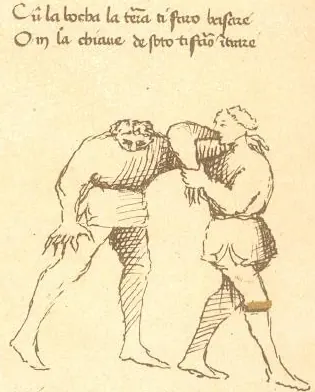
Fiore dei Liberi’s abrazare (c. 1410), unarmed grappling in an Italian fight book: Europe also codified holds and locks.
Image: Abrazar — Fiore di Liberi, 1410. Wikimedia Commons. Licence: Public domain. source
Sources
- J. F. Scoggin III et al. (2014). Assessment of injuries during Brazilian jiu-jitsu competition. Orthopaedic Journal of Sports Medicine 2(2), 2325967114522184. DOI 10.1177/2325967114522184
- M. Y. Fares et al. (2026). Technical and medical trends of upper limb submissions in mixed martial arts. Journal of Sports Medicine and Physical Fitness 66(8), 915–923. DOI 10.23736/S0022-4707.26.17426-X
- K. Mańka-Malara & M. Trzaskowski (2025). The risk of joint and neck injuries in mixed martial arts — grappling and submission techniques in professional fights. Journal of Clinical Medicine 14(21), 7467. DOI 10.3390/jcm14217467
- Jigoro Kano (1986). Kodokan Judo. Kodansha International. ISBN 9780870116810
- Renzo Gracie & John Danaher (2003). Mastering Jujitsu. Human Kinetics. ISBN 9780736044042
Cite / use this content
You may quote short excerpts with a visible link to this page. Suggested citation:
Wabukan (2026). “Cross armlock (juji-gatame / armbar)”. https://wabukan.com/manual/juji-gatame (accessed 2026-10-30).
Full rules, ready-made link code and press kit → · Updated: 2026-10-30