
Technique Manual › Strikes
Strikes
Straight punch (reverse punch / cross)
Names by art: Karate: gyaku-zuki 逆突き · Boxing: cross / rear straight · Taekwondo: bandae jireugi 반대 지르기 · Wing Chun: yat chi kuen 日字衝拳
The straight punch with the rear hand is the most measured strike in sports science. Its force does not come from the arm alone: it starts at the feet and travels up through the hips and trunk. Laboratory studies show the rear hand hits far harder than the lead hand, and experts hit harder than beginners.
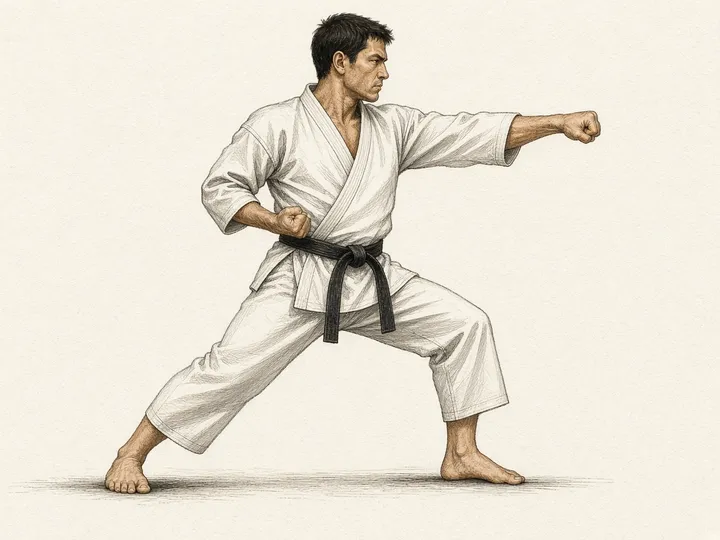
- 1
- feet push the floor
- 2
- hips rotate
- 3
- trunk and shoulder
- 4
- fist at impact
- ω
- angular velocity (rotation)
- v
- linear velocity of the fist
Step by step
- Stand in a fighting stance: feet about shoulder-width apart, one forward, knees slightly bent, weight spread over both feet.
- Push the floor with the ball of the rear foot and let the rear heel turn outwards.
- Rotate the hips and then the shoulders towards the target, keeping the trunk upright.
- Extend the arm in a straight line, turning the fist (palm down) only at the end; the elbow stays behind the fist and does not flare out.
- At contact, align wrist, forearm and shoulder; the knuckles of the index and middle fingers lead.
- Return the hand along the same line to guard; the other hand protects the chin throughout.
Common errors
- Punching with the arm only, feet and hips still — the chain loses its biggest contributors.
- Lifting the rear heel without turning it, so the push goes up instead of forward.
- Leaning the head forward past the front knee: balance is lost and the chin is exposed.
- Bent wrist at impact: the force goes into the joint instead of the target.
- Dropping the other hand.
Biomechanics: what the body does
Main muscles
Calf and quadriceps of the rear leg, gluteus, obliques and other trunk rotators, pectoralis major, anterior deltoid, triceps; serratus anterior pushes the shoulder blade forward.
Joints
Ankle, knee and hip of the rear leg; spine (rotation); shoulder (flexion), elbow (extension) and forearm (pronation). VencesBrito et al., 2011 found that trained karateka used smaller ranges of arm and forearm motion than non-practitioners.
Kinetic chain
Proximal to distal: large, slow segments (legs, hips) start first; small, fast segments (forearm, fist) finish — the typical pattern of fast striking and kicking movements (Sørensen et al., 1996). In the karate choku-zuki, the measured arm and forearm activity all happened within 400 ms (VencesBrito et al., 2011).
Base and balance
The feet form the base. The centre of mass moves forward a little but stays above the base, so the fighter can hit and recover without falling into the punch.
Physics and maths
What studies measured
- Smith et al., 2000: maximum straight-punch force of 4800 ± 227 N (rear hand) and 2847 ± 225 N (lead hand) in elite boxers; 3722 and 2283 N in intermediates; 2381 and 1604 N in novices. Rear hand stronger than lead in every group.
- Walilko et al., 2005: 7 Olympic boxers, straight punches to a dummy face — force 3427 ± 811 N, hand velocity 9.14 ± 2.06 m/s, effective punch mass 2.9 ± 2.0 kg; heavier classes hit harder mainly through higher effective mass.
- Viano et al., 2005: in the same kind of test, the hook gave the largest change in hand velocity (11.0 ± 3.4 m/s) and the largest force (4405 ± 2318 N).
Our calculation from cited data
With the mean values of Walilko et al., 2005: p = 2.9 kg × 9.14 m/s ≈ 26.5 kg·m/s and E = ½ × 2.9 × 9.14² ≈ 121 J. The spread is large (effective mass ± 2.0 kg), so individual punches vary a lot.
Our calculation from cited data
From Smith et al., 2000: the elite rear hand (4800 N) is about 1.7 times the elite lead hand (2847 N) and about 2.0 times the novice rear hand (2381 N).
- A
- elite boxers (n = 7)
- B
- intermediate (n = 8)
- C
- novices (n = 8)
- N
- newtons
- →
- straight punch
- ↪
- hook
Numbers come from the cited studies, with their sample and conditions. They describe those athletes in that laboratory, not every practitioner.
Comparison across arts
The same physical idea — a straight line from the body to the target — is shaped differently by each art’s rules and goals.
| Art | Stance | Fist / rotation | Typical use |
|---|---|---|---|
| Karate (gyaku-zuki) | Long, low front stance (zenkutsu-dachi) in basics; higher and mobile in kumite | Horizontal fist, full rotation at the end; opposite hand pulled to the hip (hikite) | Single decisive strike; controlled contact in sport |
| Boxing (cross) | Narrower, bladed stance on the balls of the feet | Gloved fist, rotation varies; other hand stays at the chin | In combinations (jab–cross), full contact |
| Wing Chun (yat chi kuen) | Upright, often square to the opponent | Vertical fist, little rotation; elbow kept on the centre line | Rapid chains of short punches at close range |
Safety
- Wrap hands and use gloves for bag and pad work; a bent wrist is the most common way to get hurt with this punch.
- Never strike a partner’s head without protective equipment and agreed control.
- Build up volume gradually; shoulders and elbows need time to adapt to fast extensions.
- Walilko et al., 2005 measured head accelerations of 58 ± 13 g from straight punches — head contact carries real injury risk.
Train with an instructor. Learn and practise this technique only under a qualified instructor, on a suitable surface and with a cooperative partner. This page explains; it does not replace a teacher.
Related
Karate Boxing Taekwondo Kickboxing Wing Chun
Front kick (mae-geri / teep / ap chagi) Roundhouse kick (mawashi-geri / dollyo chagi / Thai kick) Side kick (yoko-geri / yop chagi) Breakfalls (ukemi) Major outer reap (o-soto-gari) Shoulder throw (seoi-nage) Rear naked choke (mata-leão / hadaka-jime) Cross armlock (juji-gatame / armbar)
From history
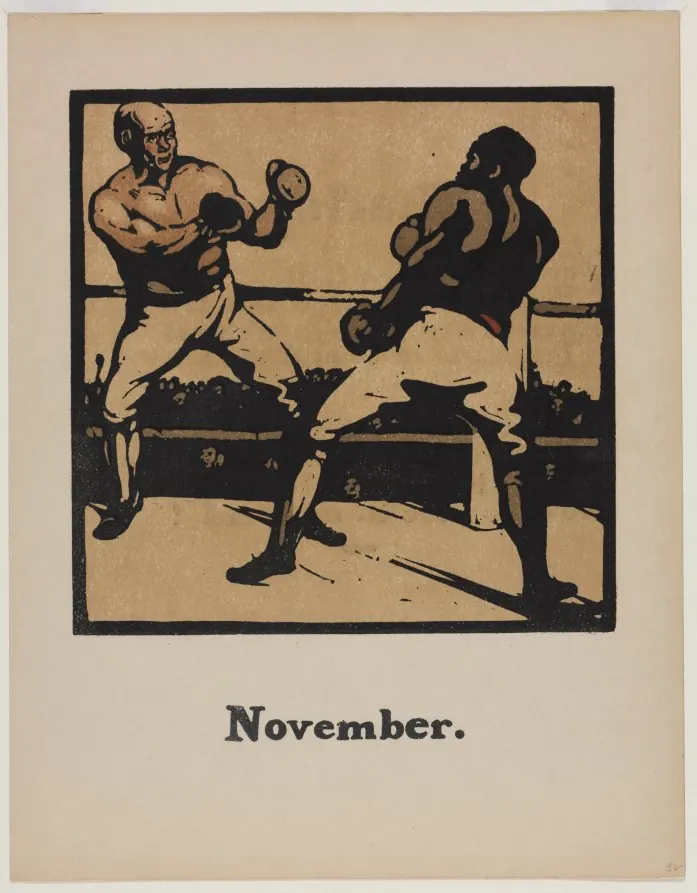
Boxing as one of the “twelve sports” of 1897: the straight punch was already the basic weapon.
Image: An Almanac of Twelve Sports: Boxing — William Nicholson (British, 1872–1949), 1897. Cleveland Museum of Art. Licence: CC0 (public domain). source
Sources
- Marcus S. Smith, R. J. Dyson, T. Hale & L. Janaway (2000). Development of a boxing dynamometer and its punch force discrimination efficacy. Journal of Sports Sciences 18(6), 445–450. DOI 10.1080/02640410050074377
- Timothy J. Walilko, David C. Viano & Cynthia A. Bir (2005). Biomechanics of the head for Olympic boxer punches to the face. British Journal of Sports Medicine 39(10), 710–719. DOI 10.1136/bjsm.2004.014126
- David C. Viano et al. (2005). Concussion in professional football: comparison with boxing head impacts — part 10. Neurosurgery 57(6), 1154–1172. DOI 10.1227/01.neu.0000187541.87937.d9
- António M. VencesBrito et al. (2011). Kinematic and electromyographic analyses of a karate punch. Journal of Electromyography and Kinesiology 21(6), 1023–1029. DOI 10.1016/j.jelekin.2011.09.007
- Henrik Sørensen et al. (1996). Dynamics of the martial arts high front kick. Journal of Sports Sciences 14(6), 483–495. DOI 10.1080/02640419608727735
- Seth Lenetsky, Nigel Harris & Matt Brughelli (2013). Assessment and Contributors of Punching Forces in Combat Sports Athletes. Strength & Conditioning Journal 35(2), 1–7. DOI 10.1519/SSC.0b013e31828b6c12
- Peter M. McGinnis (2013). Biomechanics of Sport and Exercise (3rd ed.). Human Kinetics. ISBN 9780736079662
Cite / use this content
You may quote short excerpts with a visible link to this page. Suggested citation:
Wabukan (2026). “Straight punch (reverse punch / cross)”. https://wabukan.com/manual/murro-direto (accessed 2026-10-30).
Full rules, ready-made link code and press kit → · Updated: 2026-10-30