
Historical archive
Fiore dei Liberi — The Flower of Battle
An Italian master explains the four virtues of the fighter with four animals: five passages, transcribed by us from the manuscript and translated by us.
Fior di Battaglia · Date: c. 1410
The story of the text
Fiore dei Liberi, from Premariacco in Friuli, taught armed and unarmed combat to nobles and condottieri in northern Italy around 1400. His Fior di Battaglia survives in several manuscripts; the one in the J. Paul Getty Museum, made around 1410, is the most complete and beautifully drawn. It covers wrestling, dagger, sword in one and two hands, armoured combat, spear, pollaxe and mounted fighting.
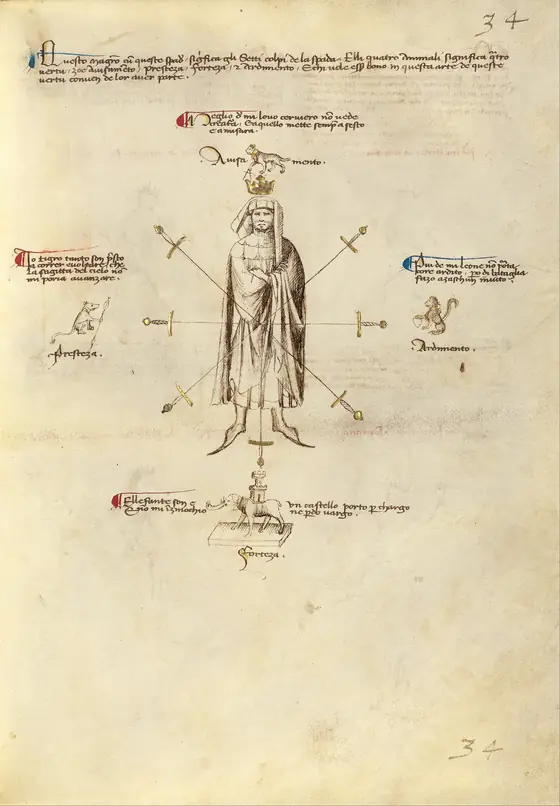
On folio 32r a figure stands among seven swords, the seven cuts, while four animals stand around him. Each animal speaks a rhymed couplet. It is one of the earliest pictures in Europe of the mental and physical qualities a fighter needs.
Source and rights
Original (c. 1410): public domain. The page image is public domain (Getty Open Content). Transcription: WABUKAN, made directly from that image, with abbreviations expanded and light normalisation; reading errors are possible and corrections are welcome. Wiktenauer transcriptions of Fiore are under copyright or non-commercial licences and were NOT used. Translations: WABUKAN.
Passages: original and our translation
Questo magistro cum queste spade significha gli setti colpi de la spada. E lli quatro animali significa quatro vertù, zoè avisamento, presteza, forteza e ardimento. E chi vole esser bono in questa arte, de queste vertù conven de lor aver parte.This master with these swords stands for the seven blows of the sword. And the four animals stand for four virtues: foresight, speed, strength and boldness. Whoever wants to be good in this art must have a share of these virtues.
Avisamento is foresight or judgement: seeing what is coming.
Meglio de mi louo cerviero non vede creatura, e quello mette sempre a sesto e a misura.No creature sees better than I, the lynx, and I always set things to compass and measure.
The lynx holds a pair of compasses: distance and timing.
Io tigro tanto son presto a correr e a voltare che la sagitta del cielo non mi poria avanzare.I, the tiger, am so quick to run and to turn that even the arrow from the sky could not outrun me.
The “arrow from the sky” is the lightning bolt; the tiger holds an arrow.
Più de mi leone non porta core ardito, però di bataglia fazo a zaschuno invito.No one carries a bolder heart than I, the lion; so I invite everyone to battle.
The lion holds a heart.
Elefante son e un castello porto per chargo, e non mi inzenochio né perdo vargo.I am the elephant and I carry a castle as my load, and I neither kneel nor lose my step.
Strength here is stability: staying on your feet under load.
Related
- HEMA
- Olympic Fencing
- Article: fencing and HEMA
- Liechtenauer’s Zettel — the secret verses of the longsword
Sources
- Getty Open Content Program — J. Paul Getty Trust — www.getty.edu
- File: Getty Ms. Ludwig XV 13 32r — Wikimedia Commons — commons.wikimedia.org
- Fiore dei Liberi — Wikipedia — en.wikipedia.org
- Fiore dei Liberi — Wikipedia (it) — it.wikipedia.org
Cite / use this content
You may quote and share this page with a link to WABUKAN. Suggested citation:
WABUKAN 和武館, «Fiore dei Liberi — The Flower of Battle», https://wabukan.com/texto-fiore (accessed 2026-10-30).
Translations on this page are by WABUKAN unless stated otherwise.