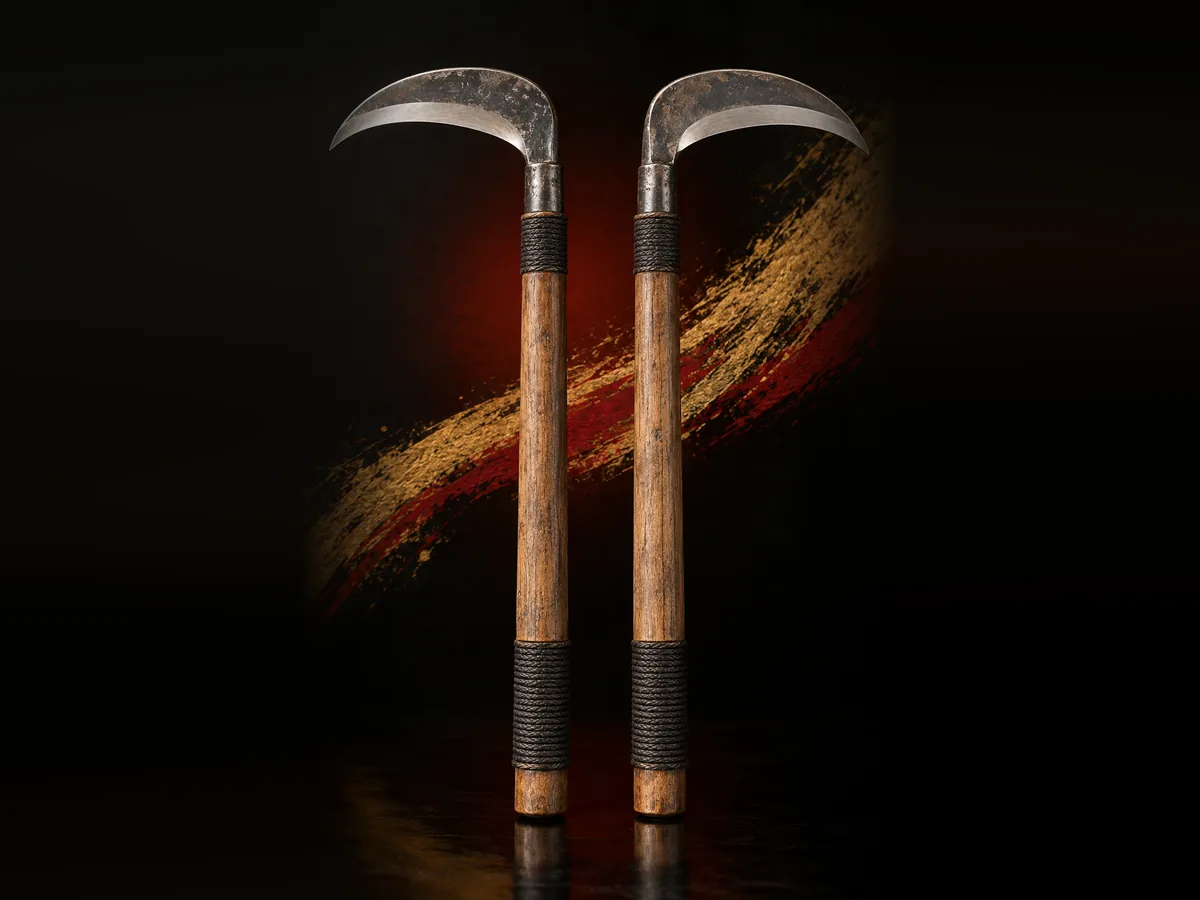
Uma foice de arroz transformada em arma. O kobudo usa-a aos pares, para enganchar, bloquear e cortar.
Kama Ilustração WABUKAN
Outros nomes
鎌 · nichōgama (pair)
Origem e história
A kama é uma foice agrícola usada para cortar arroz e erva; em Okinawa tornou-se arma de kobudō, normalmente treinada aos pares (nichōgama). Aparece também em artes do Sudeste Asiático e da Indonésia como celurit ou arit.
Cabo de madeira de cerca de 40–50 cm com uma lâmina curva em ângulo reto perto do topo; as versões de kobudō têm por vezes um pequeno entalhe para prender um bastão. As kama de treino têm lâminas de madeira ou rombas.
Técnicas básicas
uke
kake (enganchar)
kiri (corte)
kata de kama (Kanegawa no nichōgama)
Treino
O treino de lâmina curta começa com réplicas de madeira, alumínio ou borracha. Treinam-se os ângulos de ataque, as pegas (normal e invertida), o controlo do braço adversário e o trabalho de pés, e depois exercícios de fluxo a pares. Lâminas verdadeiras ficam, quando muito, para formas a solo de praticantes experientes.
Segurança
Use facas de treino em todo o trabalho a pares e proteção para os olhos nos exercícios rápidos. Nunca misture lâminas verdadeiras e de treino na mesma sessão; guarde as lâminas embainhadas e fora do alcance das crianças.
Legalidade (informação geral)
Espadas, facas e outras armas de lâmina são reguladas de forma muito diferente de país para país (e por vezes de região para região): ter uma em casa é muitas vezes permitido, mas trazê-la na via pública, comprá-la abaixo de certa idade ou importá-la pode estar limitado ou proibido. Os praticantes costumam transportá-las em estojo fechado, fora de alcance e diretamente entre casa e dojo. Isto é informação geral, não aconselhamento jurídico: confirme a lei onde vive.
Curiosidades
Os kata de kama estão entre os mais perigosos de praticar, por isso os principiantes usam lâminas de madeira.
A rice sickle turned into a weapon. Kobudo uses it in pairs, to hook, block and cut.
Kama WABUKAN illustration
Also known as
鎌 · nichōgama (pair)
Origin and history
The kama is a farming sickle used to cut rice and grass; in Okinawa it became a kobudō weapon, usually trained in pairs (nichōgama). It also appears in Southeast Asian and Indonesian arts as the celurit or arit.
A wooden handle of about 40–50 cm with a curved blade set at a right angle near the top; kobudō versions sometimes have a small notch to trap a staff. Training kama have wooden or blunt blades.
Basic techniques
uke
kake (hooking)
kiri (cut)
kama kata (Kanegawa no nichōgama)
Training
Short-blade training starts with trainers made of wood, aluminium or rubber. Students drill angles of attack, grips (forward and reverse), checking the opponent’s arm and footwork, then flow drills with a partner. Live blades are kept for solo forms by experienced practitioners, if at all.
Safety
Use training knives for all partner work and eye protection for fast drills. Never mix live and training blades in the same session, store blades sheathed and out of reach of children.
Legality (general information)
Swords, knives and other edged weapons are regulated very differently from country to country (and sometimes from region to region): owning one at home is often allowed, while carrying it in public, buying it under a certain age or importing it may be restricted or banned. Practitioners usually transport them cased, out of reach and straight between home and dojo. This is general information, not legal advice: check the law where you live.
Did you know?
Kama kata are considered among the most dangerous to practise, which is why beginners use wooden blades.
Hoz agrícola convertida en arma del kobudō, usada en pareja.
Kama Ilustración WABUKAN
Otros nombres
鎌 · nichōgama (pair)
Origen e historia
La kama es una hoz agrícola usada para segar arroz y hierba; en Okinawa se convirtió en arma de kobudō, normalmente entrenada por parejas (nichōgama). También aparece en artes del Sudeste Asiático e Indonesia como celurit o arit.
Mango de madera de unos 40–50 cm con una hoja curva en ángulo recto cerca del extremo; las versiones de kobudō tienen a veces una pequeña muesca para atrapar un bastón. Las kama de práctica tienen hojas de madera o romas.
Técnicas básicas
uke
kake (enganchar)
kiri (corte)
kata de kama (Kanegawa no nichōgama)
Entrenamiento
El entrenamiento de hoja corta empieza con réplicas de madera, aluminio o goma. Se practican los ángulos de ataque, los agarres (normal e invertido), el control del brazo contrario y el juego de pies, y después ejercicios de flujo por parejas. Las hojas reales quedan, como mucho, para formas en solitario de practicantes expertos.
Seguridad
Use cuchillos de entrenamiento en todo el trabajo por parejas y protección ocular en los ejercicios rápidos. Nunca mezcle hojas reales y de entrenamiento en la misma sesión; guarde las hojas enfundadas y fuera del alcance de los niños.
Legalidad (información general)
Las espadas, cuchillos y demás armas blancas se regulan de forma muy distinta según el país (y a veces según la región): tener una en casa suele estar permitido, pero llevarla en la vía pública, comprarla por debajo de cierta edad o importarla puede estar limitado o prohibido. Los practicantes suelen transportarlas en funda cerrada, fuera de alcance y directamente entre casa y dojo. Es información general, no asesoramiento jurídico: consulte la ley donde vive.
Curiosidades
Los kata de kama están entre los más peligrosos de practicar, por eso los principiantes usan hojas de madera.
Faucille agricole devenue arme du kobudō, utilisée par paire.
Kama Illustration WABUKAN
Autres noms
鎌 · nichōgama (pair)
Origine et histoire
La kama est une faucille agricole pour couper le riz et l’herbe ; à Okinawa elle devient une arme de kobudō, généralement travaillée par paire (nichōgama). Elle apparaît aussi dans des arts d’Asie du Sud-Est et d’Indonésie sous le nom de celurit ou arit.
Manche en bois d’environ 40–50 cm avec une lame courbe à angle droit près du sommet ; les versions de kobudō ont parfois une petite encoche pour bloquer un bâton. Les kama d’entraînement ont des lames en bois ou émoussées.
Techniques de base
uke
kake (crocheter)
kiri (coupe)
kata de kama (Kanegawa no nichōgama)
Entraînement
L’entraînement à la lame courte commence avec des répliques en bois, aluminium ou caoutchouc. On travaille les angles d’attaque, les prises (normale et inversée), le contrôle du bras adverse et le jeu de jambes, puis des exercices de flux à deux. Les vraies lames sont réservées, au mieux, aux formes solo des pratiquants confirmés.
Sécurité
Utilisez des couteaux d’entraînement pour tout le travail à deux et une protection des yeux pour les exercices rapides. Ne mélangez jamais lames vives et d’entraînement dans une même séance ; rangez les lames dans leur fourreau, hors de portée des enfants.
Légalité (information générale)
Les épées, couteaux et autres armes blanches sont réglementés très différemment d’un pays à l’autre (parfois d’une région à l’autre) : en posséder une chez soi est souvent permis, mais la porter dans la rue, l’acheter avant un certain âge ou l’importer peut être limité ou interdit. Les pratiquants la transportent en général dans un étui fermé, hors de portée et directement entre domicile et dojo. Ceci est une information générale, pas un conseil juridique : vérifiez la loi là où vous vivez.
Le saviez-vous ?
Les kata de kama comptent parmi les plus dangereux à pratiquer ; les débutants utilisent donc des lames en bois.