A história dos cinturões: de onde vêm o cinturão negro e as cores
· 4 min de leitura
Hoje parece natural: começa-se com cinturão branco, muda-se de cor a cada poucos meses ou anos e sonha-se com o cinturão negro. Mas este sistema é relativamente recente. Nasceu em Tóquio nos anos 1880, com Jigoro Kano, e espalhou-se pelo mundo no século XX, com mudanças em cada país e em cada arte.
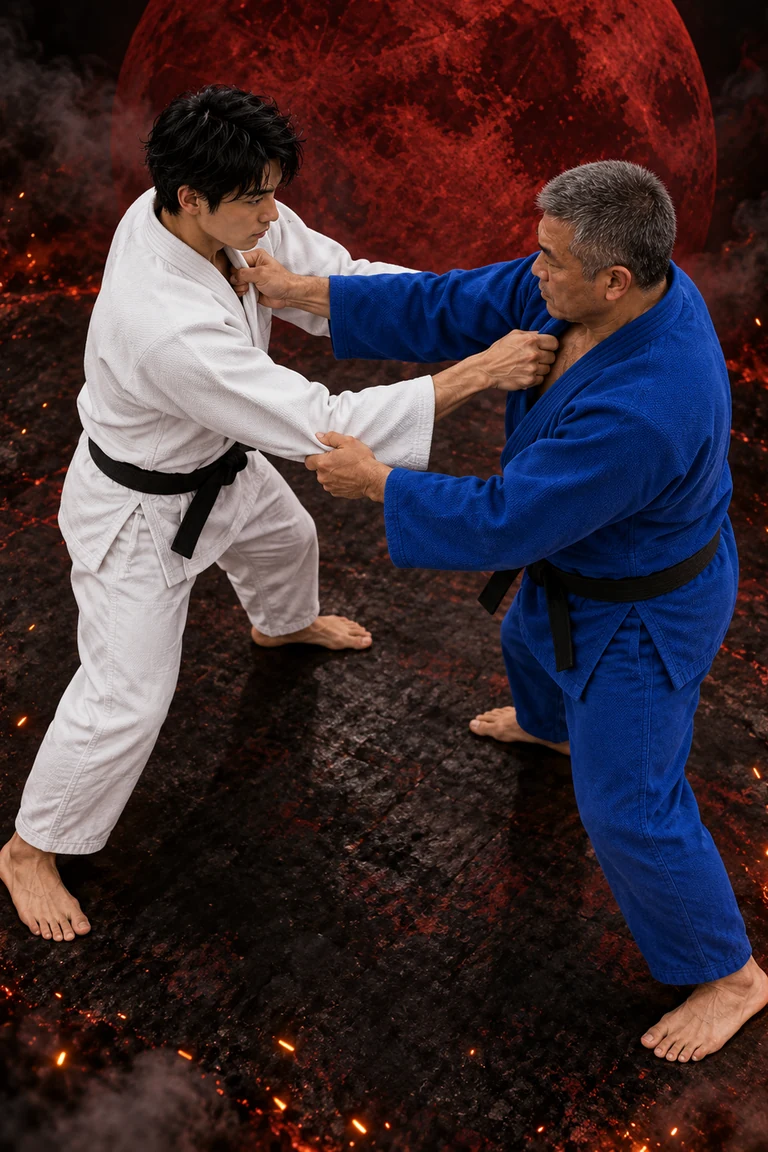
No judo nasceu o sistema kyu/dan e o cinturão negro. Ilustração WABUKAN
Antes dos cinturões
As escolas japonesas antigas (koryū) não tinham cinturões de cor. O progresso do aluno era registado através de licenças e certificados, como o sistema menkyo, que podia levar muitos anos e, no nível mais alto, significava a transmissão completa dos ensinamentos da escola. Estas licenças eram documentos, não algo visível na roupa.
Kano e os primeiros dan
Jigoro Kano fundou o Kodokan em 1882 para ensinar judo, uma versão reformada do jujutsu. Em 1883 atribuiu os primeiros 1.º dan (shodan) a dois alunos, Saigō Shirō e Tomita Tsunejirō. A palavra dan significa «degrau» ou «nível», e Kano terá provavelmente ido buscá-la ao jogo de go, que já a usava para classificar jogadores. Abaixo dos dan criou os graus kyū, para os alunos que ainda não tinham chegado a esse nível.
Jigoro Kano aos 28 anos. Autor: Unknown author · Licença: Domínio público / Public domain · Wikimedia Commons
De início, os graduados dan reconheciam-se por uma faixa negra usada sobre a roupa de treino da época. Por volta de 1907, com a introdução do judogi moderno, de calças compridas e casaco pesado, o cinturão negro de algodão ganhou a forma que conhecemos. Os alunos abaixo de dan usavam cinturão branco. Para os graus mais altos, o Kodokan introduziu mais tarde o cinturão vermelho e branco (6.º a 8.º dan) e o vermelho (9.º e 10.º dan), muito raramente atribuído.
As cores: uma ideia europeia
Os cinturões de cor entre o branco e o negro não vieram do Japão. Costumam ser atribuídos a Mikonosuke Kawaishi, um professor japonês que se instalou em Paris em 1935. Percebeu que os alunos ocidentais precisavam de objetivos visíveis e frequentes para se manterem motivados e criou uma sequência de cores para os graus kyū: branco, amarelo, laranja, verde, azul e castanho. A ideia espalhou-se pela Europa e depois por outras artes e países, cada um com as suas variações.
O karaté adota o sistema
No karaté, o sistema de dan chegou com Gichin Funakoshi, o professor de Okinawa que levou a arte para o Japão continental. Funakoshi era próximo de Kano e, em abril de 1924, atribuiu os primeiros dan de karaté. O karaté adotou também um uniforme inspirado no judogi, mais leve, e o cinturão negro. Hoje cada estilo e federação de karaté tem a sua própria sequência de cores.
O karaté adotou os graus dan em 1924. Ilustração WABUKAN
Jiu-jitsu brasileiro: poucas faixas, muitos anos
No jiu-jitsu brasileiro o sistema é diferente. Para adultos há apenas cinco faixas: branca, azul, roxa, castanha e preta, com «graus» (riscas) pelo meio. A sequência foi formalizada no Rio de Janeiro em 1967 pela Federação de Jiu-Jitsu da Guanabara. Chegar à faixa preta costuma levar dez anos ou mais, e a IBJJF define idades e tempos mínimos em cada faixa. Depois de muitos anos de faixa preta vêm a vermelha e preta, a vermelha e branca e, por fim, a vermelha, ligada a pioneiros como Hélio Gracie.
Taekwondo e outras artes
No taekwondo, o Kukkiwon atribui graus dan aos adultos e graus poom aos menores de 15 anos, com um cinturão vermelho e preto; aos 15 anos o poom passa a dan. Em artes como o kendo e o kyudo há graus dan, mas não cinturões de cor: o grau está escrito no certificado, não à volta da cintura.
Como se conquistam os graus
Cada arte e federação tem as suas regras, mas a maioria dos exames tem elementos semelhantes. O candidato mostra técnicas de base, formas (kata, poomsae), aplicações com parceiro e, em muitos casos, prática livre ou combate. Quase sempre se exige um tempo mínimo em cada grau e uma idade mínima, e os graus mais altos têm também em conta o ensino, a arbitragem e o serviço à arte. No judo, os resultados em competição podem contar para os dan. No BJJ, as promoções são normalmente decididas pelo professor, que acompanha o aluno ao longo de meses de treino e não num único exame.
Mitos e significado
Uma história popular diz que os cinturões escureciam porque nunca eram lavados, até ficarem negros. É uma boa história, mas não há provas históricas: o cinturão negro foi uma escolha deliberada de Kano. Outra ideia comum é que o cinturão negro significa «mestre». No judo e no karaté, shodan quer dizer «primeiro degrau»: marca o fim da formação básica e o início de um estudo mais profundo.
The history of belts: where the black belt and the colours come from
· 4 min read
Today it seems natural: you start with a white belt, change colour every few months or years and dream of the black belt. But this system is relatively recent. It was born in Tokyo in the 1880s, with Jigoro Kano, and spread around the world in the 20th century, with changes in each country and in each art.
Judo is where the kyu/dan system and the black belt were born. WABUKAN illustration
Before belts
The old Japanese schools (koryū) did not have belts of colour. A student's progress was recorded through licences and certificates, such as the menkyo system, which could take many years and, at the highest level, meant full transmission of the school's teachings. These licences were documents, not something visible on the clothing. Many koryū still use this system today, instead of or alongside modern dan grades.
Kano and the first dan grades
Jigoro Kano founded the Kodokan in 1882 to teach judo, a reformed version of jujutsu. In 1883 he gave the first 1st dan (shodan) grades to two of his students, Saigō Shirō and Tomita Tsunejirō. The word dan means "step" or "level", and Kano probably took it from the game of go, which already used it to rank players. Below the dan grades he created the kyū grades, for students who had not yet reached that level.
At first, those with dan grades were recognised by a black sash worn over the training clothes of the time. Around 1907, with the introduction of the modern judogi, with long trousers and a heavy jacket, the black cotton belt took the form we know. Students below dan wore white belts. For the highest grades, the Kodokan later introduced the red and white belt (6th to 8th dan) and the red belt (9th and 10th dan), very rarely awarded.
The colours: a European idea
The colour belts between white and black did not come from Japan. They are generally attributed to Mikonosuke Kawaishi, a Japanese teacher who settled in Paris in 1935. He saw that Western students needed visible, frequent goals to stay motivated, and created a sequence of colours for the kyū grades: white, yellow, orange, green, blue and brown. The idea spread throughout Europe and later to other arts and countries, each with its own variations.
Karate adopts the system
In karate, the dan system arrived with Gichin Funakoshi, the Okinawan teacher who brought the art to mainland Japan. Funakoshi was close to Kano and, in April 1924, he awarded the first karate dan grades. Karate also adopted a uniform inspired by the judogi, lighter, and the black belt. Today each karate style and federation has its own sequence of colours.
Karate adopted dan grades in 1924. WABUKAN illustration
Brazilian jiu-jitsu: few belts, many years
In Brazilian jiu-jitsu the system is different. For adults there are only five belts: white, blue, purple, brown and black, with "stripes" in between. The sequence was formalised in Rio de Janeiro in 1967 by the Guanabara Jiu-Jitsu Federation. Getting a black belt usually takes ten years or more, and the IBJJF sets minimum ages and times at each belt. After many years as a black belt come the red and black, red and white and, finally, the red belt, linked to pioneers such as Hélio Gracie.
Taekwondo and other arts
In taekwondo, the Kukkiwon awards dan grades to adults and poom grades to those under 15, with a red and black belt; when they turn 15, the poom becomes a dan. In arts such as kendo and kyudo there are dan grades, but no coloured belts: the grade is written on the certificate, not around the waist.
How grades are earned
Each art and federation sets its own rules, but most gradings have similar elements. The candidate shows basic techniques, forms (kata, poomsae), applications with a partner and, in many cases, free practice or sparring. A minimum time in each grade and a minimum age are almost always required, and higher grades also take into account teaching, refereeing and service to the art. In judo, competition results can count towards dan grades. In BJJ, promotions are usually decided by the teacher, who follows the student over months of training rather than in a single exam.
Myths and meaning
A popular story says that belts became darker because they were never washed, until they turned black. It is a good story, but there is no historical evidence for it: the black belt was a deliberate choice by Kano. Another common idea is that the black belt means "master". In judo and karate, shodan means "first step": it marks the end of the basic training and the beginning of a deeper study.
La historia de los cinturones: de dónde vienen el cinturón negro y los colores
· 4 min de lectura
Hoy parece natural: se empieza con cinturón blanco, se cambia de color cada pocos meses o años y se sueña con el cinturón negro. Pero este sistema es relativamente reciente. Nació en Tokio en la década de 1880, con Jigoro Kano, y se extendió por el mundo en el siglo XX, con cambios en cada país y en cada arte.
En el judo nació el sistema kyu/dan y el cinturón negro. Ilustración WABUKAN
Antes de los cinturones
Las escuelas japonesas antiguas (koryū) no tenían cinturones de colores. El progreso del alumno se registraba mediante licencias y certificados, como el sistema menkyo, que podía llevar muchos años y, en su nivel más alto, suponía la transmisión completa de las enseñanzas de la escuela. Estas licencias eran documentos, no algo visible en la ropa.
Kano y los primeros dan
Jigoro Kano fundó el Kodokan en 1882 para enseñar judo, una versión reformada del jujutsu. En 1883 concedió los primeros 1.er dan (shodan) a dos alumnos, Saigō Shirō y Tomita Tsunejirō. La palabra dan significa «escalón» o «nivel», y probablemente Kano la tomó del juego de go, que ya la usaba para clasificar a los jugadores. Por debajo de los dan creó los grados kyū, para los alumnos que aún no habían llegado a ese nivel.
Jigoro Kano a los 28 años. Autor: Unknown author · Licencia: Domínio público / Public domain · Wikimedia Commons
Al principio, los graduados dan se reconocían por una faja negra llevada sobre la ropa de entrenamiento de la época. Hacia 1907, con la introducción del judogi moderno, de pantalón largo y chaqueta gruesa, el cinturón negro de algodón adquirió la forma que conocemos. Los alumnos por debajo de dan llevaban cinturón blanco. Para los grados más altos, el Kodokan introdujo después el cinturón rojo y blanco (6.º a 8.º dan) y el rojo (9.º y 10.º dan), concedido muy raras veces.
Los colores: una idea europea
Los cinturones de colores entre el blanco y el negro no vienen de Japón. Suelen atribuirse a Mikonosuke Kawaishi, un profesor japonés que se instaló en París en 1935. Vio que los alumnos occidentales necesitaban objetivos visibles y frecuentes para mantenerse motivados y creó una secuencia de colores para los grados kyū: blanco, amarillo, naranja, verde, azul y marrón. La idea se extendió por Europa y después a otras artes y países, cada uno con sus variantes.
El karate adopta el sistema
En el karate, el sistema de dan llegó con Gichin Funakoshi, el maestro de Okinawa que llevó el arte al Japón continental. Funakoshi era cercano a Kano y, en abril de 1924, concedió los primeros dan de karate. El karate adoptó también un uniforme inspirado en el judogi, más ligero, y el cinturón negro. Hoy cada estilo y federación de karate tiene su propia secuencia de colores.
El karate adoptó los grados dan en 1924. Ilustración WABUKAN
Jiu-jitsu brasileño: pocos cinturones, muchos años
En el jiu-jitsu brasileño el sistema es distinto. Para adultos solo hay cinco cinturones: blanco, azul, morado, marrón y negro, con «grados» (franjas) intermedios. La secuencia se formalizó en Río de Janeiro en 1967 por la Federación de Jiu-Jitsu de Guanabara. Llegar al cinturón negro suele llevar diez años o más, y la IBJJF fija edades y tiempos mínimos en cada cinturón. Tras muchos años de negro llegan el rojo y negro, el rojo y blanco y, por último, el rojo, asociado a pioneros como Hélio Gracie.
Taekwondo y otras artes
En el taekwondo, el Kukkiwon concede grados dan a los adultos y grados poom a los menores de 15 años, con un cinturón rojo y negro; al cumplir 15, el poom pasa a dan. En artes como el kendo y el kyudo hay grados dan, pero no cinturones de colores: el grado figura en el certificado, no en la cintura.
Cómo se consiguen los grados
Cada arte y federación tiene sus reglas, pero la mayoría de los exámenes comparten elementos. El candidato muestra técnicas básicas, formas (kata, poomsae), aplicaciones con compañero y, en muchos casos, práctica libre o combate. Casi siempre se exige un tiempo mínimo en cada grado y una edad mínima, y los grados altos tienen también en cuenta la enseñanza, el arbitraje y el servicio al arte. En judo, los resultados en competición pueden contar para los dan. En BJJ, las promociones suelen decidirlas el profesor, que sigue al alumno durante meses de entrenamiento y no en un único examen.
Mitos y significado
Una historia popular dice que los cinturones se oscurecían porque nunca se lavaban, hasta volverse negros. Es una buena historia, pero no hay pruebas históricas: el cinturón negro fue una elección deliberada de Kano. Otra idea común es que el cinturón negro significa «maestro». En judo y karate, shodan significa «primer escalón»: marca el fin de la formación básica y el comienzo de un estudio más profundo.
L’histoire des ceintures : d’où viennent la ceinture noire et les couleurs
· 4 min de lecture
Aujourd’hui cela paraît naturel : on commence ceinture blanche, on change de couleur tous les quelques mois ou années et l’on rêve de la ceinture noire. Pourtant, ce système est assez récent. Il est né à Tokyo dans les années 1880, avec Jigoro Kano, et s’est répandu dans le monde au XXe siècle, avec des variantes selon les pays et les arts.
Le système kyu/dan et la ceinture noire sont nés au judo. Illustration WABUKAN
Avant les ceintures
Les anciennes écoles japonaises (koryū) n’avaient pas de ceintures de couleur. Les progrès de l’élève étaient consignés par des licences et des certificats, comme le système menkyo, qui pouvait demander de longues années et signifiait, au plus haut niveau, la transmission complète de l’enseignement de l’école. Ces licences étaient des documents, rien de visible sur la tenue.
Kano et les premiers dan
Jigoro Kano fonde le Kodokan en 1882 pour enseigner le judo, une version réformée du jujutsu. En 1883, il décerne les premiers 1er dan (shodan) à deux élèves, Saigō Shirō et Tomita Tsunejirō. Le mot dan signifie « marche » ou « niveau », et Kano l’a probablement emprunté au jeu de go, qui l’utilisait déjà pour classer les joueurs. Sous les dan, il crée les grades kyū, pour les élèves qui n’ont pas encore atteint ce niveau.
Jigoro Kano à 28 ans. Auteur: Unknown author · Licence: Domínio público / Public domain · Wikimedia Commons
Au début, les gradés dan se reconnaissaient à une large ceinture noire portée sur la tenue d’entraînement de l’époque. Vers 1907, avec l’apparition du judogi moderne, à pantalon long et veste épaisse, la ceinture noire en coton prend la forme que l’on connaît. Les élèves non gradés dan portaient une ceinture blanche. Pour les plus hauts grades, le Kodokan a introduit plus tard la ceinture rouge et blanche (6e à 8e dan) et la ceinture rouge (9e et 10e dan), très rarement décernée.
Les couleurs : une idée européenne
Les ceintures de couleur entre la blanche et la noire ne viennent pas du Japon. On les attribue généralement à Mikonosuke Kawaishi, un professeur japonais installé à Paris en 1935. Constatant que les élèves occidentaux avaient besoin d’objectifs visibles et rapprochés pour rester motivés, il crée une suite de couleurs pour les grades kyū : blanc, jaune, orange, vert, bleu et marron. L’idée gagne toute l’Europe, puis d’autres arts et d’autres pays, chacun avec ses variantes.
Le karaté adopte le système
En karaté, le système des dan arrive avec Gichin Funakoshi, le maître d’Okinawa qui a introduit l’art au Japon continental. Proche de Kano, Funakoshi décerne en avril 1924 les premiers dan de karaté. Le karaté adopte aussi une tenue inspirée du judogi, plus légère, et la ceinture noire. Aujourd’hui, chaque style et chaque fédération de karaté a sa propre suite de couleurs.
Le karaté a adopté les grades dan en 1924. Illustration WABUKAN
Jiu-jitsu brésilien : peu de ceintures, beaucoup d’années
En jiu-jitsu brésilien, le système est différent. Pour les adultes, il n’y a que cinq ceintures : blanche, bleue, violette, marron et noire, avec des « degrés » (barrettes) entre elles. La séquence a été formalisée à Rio de Janeiro en 1967 par la Fédération de jiu-jitsu de Guanabara. Obtenir la ceinture noire prend en général dix ans ou plus, et l’IBJJF fixe des âges et des durées minimales pour chaque ceinture. Après de longues années de noire viennent la rouge et noire, la rouge et blanche et enfin la rouge, associée à des pionniers comme Hélio Gracie.
Taekwondo et autres arts
En taekwondo, le Kukkiwon décerne des grades dan aux adultes et des grades poom aux moins de 15 ans, avec une ceinture rouge et noire ; à 15 ans, le poom devient dan. Dans des arts comme le kendo et le kyudo, il existe des grades dan mais pas de ceintures de couleur : le grade figure sur le diplôme, pas autour de la taille.
Comment on obtient les grades
Chaque art et chaque fédération ont leurs règles, mais la plupart des passages de grade ont des points communs. Le candidat présente des techniques de base, des formes (kata, poomsae), des applications avec partenaire et souvent du travail libre ou du combat. Un temps minimal dans chaque grade et un âge minimal sont presque toujours exigés, et les hauts grades tiennent aussi compte de l’enseignement, de l’arbitrage et du service rendu à l’art. En judo, les résultats en compétition peuvent compter pour les dan. En BJJ, les promotions sont généralement décidées par le professeur, qui suit l’élève pendant des mois d’entraînement plutôt que lors d’un examen unique.
Mythes et signification
Selon une histoire populaire, les ceintures fonçaient parce qu’on ne les lavait jamais, jusqu’à devenir noires. C’est une belle histoire, mais aucune preuve historique ne l’appuie : la ceinture noire est un choix délibéré de Kano. Autre idée répandue : la ceinture noire signifierait « maître ». En judo et en karaté, shodan veut dire « premier degré » : il marque la fin de la formation de base et le début d’une étude plus approfondie.