Sambo: a luta soviética nascida do judo e das lutas tradicionais
· 4 min de leitura
Sambo é um acrónimo do russo SAMooborona Bez Oruzhiya, «defesa pessoal sem armas». Nascido na União Soviética nas décadas de 1920 e 1930, mistura o judo japonês com as lutas tradicionais dos povos da URSS. Hoje pratica-se em todos os continentes e deu ao MMA alguns dos lutadores mais conhecidos.
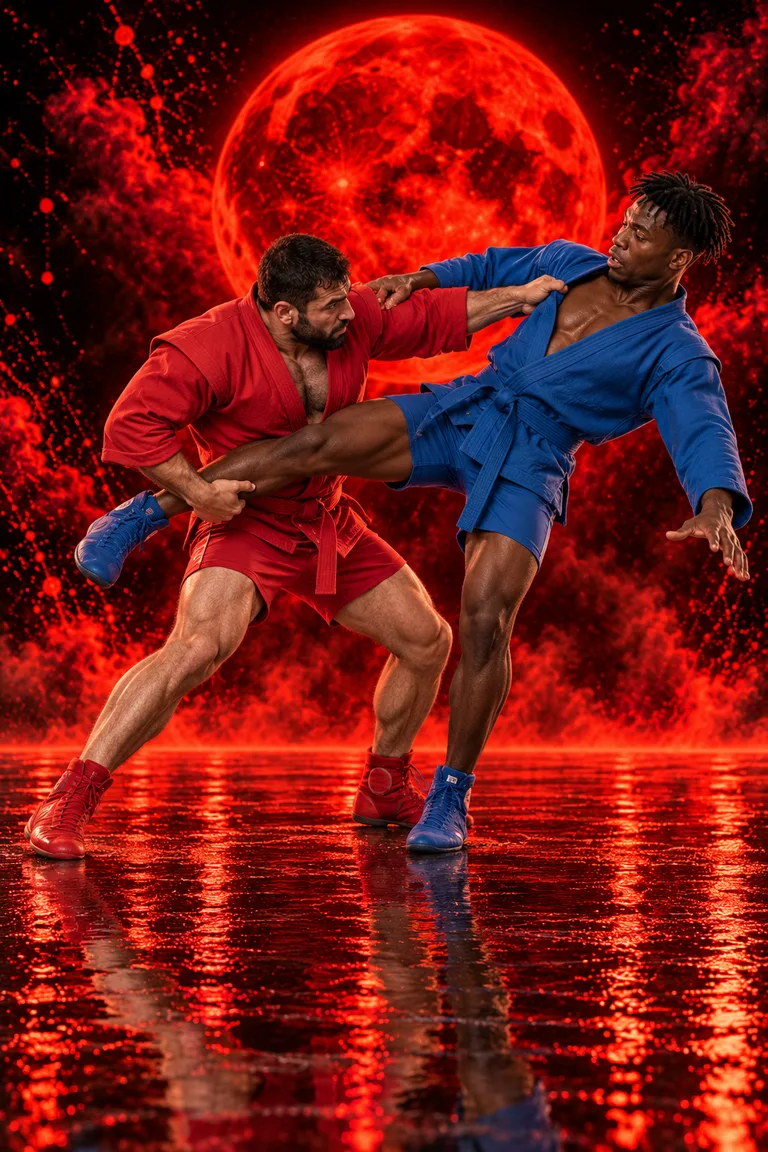
Sambo: casaco (kurtka) vermelho ou azul, calções e sapatilhas de luta. Ilustração WABUKAN
As origens: um judoca em Vladivostok
A história do sambo começa com Vasili Oshchepkov. Nascido na ilha de Sacalina em 1892, estudou num seminário ortodoxo no Japão e treinou no Kodokan, a escola fundada por Jigoro Kano. Em 1913 recebeu o 1.º dan, tornando-se um dos primeiros europeus com cinturão negro de judo, e mais tarde chegou ao 2.º dan.
Vasili Oshchepkov, c. 1912, na época em que estudava judo no Japão. Autor: Unknown author · Licença: Domínio público / Public domain · Wikimedia Commons
De volta à Rússia, Oshchepkov ensinou judo em Vladivostok e, a partir do fim dos anos 1920, em Moscovo, no Instituto Central de Cultura Física e em clubes ligados ao Exército Vermelho. Ao mesmo tempo, Viktor Spiridonov, veterano da Primeira Guerra Mundial, desenvolvia no clube Dínamo um sistema de defesa pessoal para a polícia e os serviços de segurança, com influências do jujutsu e de outros métodos.
Uma síntese soviética
As autoridades soviéticas queriam um sistema de combate próprio, e não apenas uma arte japonesa. A ideia era reunir as técnicas mais eficazes das muitas lutas tradicionais da URSS, como a chidaoba georgiana, o kurash tártaro, o kokh arménio e as lutas da Mongólia e da Ásia Central, e combiná-las com o judo. Os alunos de Oshchepkov, entre eles Anatoly Kharlampiev, viajaram e registaram estas tradições.
Em 1937, durante as purgas estalinistas, Oshchepkov foi preso, acusado de espionagem a favor do Japão, e morreu na prisão poucos dias depois. O seu nome foi apagado da história oficial durante décadas. A 16 de novembro de 1938, o Comité de Toda a União para a Cultura Física e o Desporto reconheceu oficialmente a nova disciplina, então chamada «luta livre»; o nome sambo passou a ser usado nos anos seguintes. Kharlampiev, que escreveu os primeiros livros sobre o tema, foi durante muito tempo apresentado como o seu único criador; hoje os historiadores reconhecem o papel dos três.
Sambo desportivo e sambo de combate
O sambo tem duas formas principais. O sambo desportivo é uma luta próxima do judo: projeções, imobilizações e finalizações. O sambo de combate acrescenta golpes com punhos, pés, joelhos e cotovelos, e foi desenvolvido para militares e forças de segurança; é a forma mais próxima do MMA moderno.
Algumas regras dão ao sambo desportivo um carácter próprio:
As chaves de perna são permitidas, ao contrário do judo, e por isso os sambistas são conhecidos pelos ataques a joelhos e tornozelos.
Os estrangulamentos não são permitidos no sambo desportivo; existem no sambo de combate.
Uma projeção limpa que deixa o adversário de costas, ficando quem projeta de pé, dá a vitória total, tal como uma finalização.
As imobilizações no chão dão pontos, mas não acabam o combate por si só.
O equipamento também é característico: um casaco (kurtka) com «asas» nos ombros para segurar o cinto, calções e sapatilhas de luta, sempre em vermelho ou azul, uma cor para cada atleta.
Como se treina
Uma sessão típica de sambo parece uma aula de luta ou de judo. Começa com um aquecimento exigente e quedas, seguem-se pegas e projeções a pares, trabalho de chão com imobilizações e chaves de perna e, por fim, combate livre. Como as chaves de perna são permitidas, os principiantes aprendem cedo a desistir a tempo e a aplicar estas técnicas devagar e com controlo, porque os ligamentos do joelho e do tornozelo lesionam-se com facilidade. O sambo de combate acrescenta trabalho de manápulas, proteções, luvas e capacete para o combate com golpes.
Da URSS para o mundo
Durante muito tempo, o sambo praticou-se sobretudo na União Soviética e nos países aliados. Os sambistas soviéticos também competiam em judo, e as suas pegas pouco ortodoxas e ataques às pernas surpreenderam os japoneses nos Jogos Olímpicos de Tóquio de 1964, onde os judocas soviéticos ganharam quatro medalhas de bronze. O primeiro torneio internacional realizou-se em Riga em 1967 e o primeiro campeonato do mundo em Teerão em 1973. Em 1984 foi fundada a Federação Internacional de Sambo (FIAS), que em 2021 recebeu o reconhecimento provisório do Comité Olímpico Internacional.
O sambo e o MMA
O grande público conheceu o sambo através das artes marciais mistas. Fedor Emelianenko, considerado um dos melhores pesos-pesados da história do MMA, foi várias vezes campeão do mundo de sambo de combate; Khabib Nurmagomedov, campeão invicto do UFC, também ganhou títulos mundiais de sambo de combate antes da carreira profissional. O sucesso de ambos mostrou o valor de um treino que junta projeções, controlo no chão e finalizações com uma procura constante da eficácia prática.
Quer saber mais?
O sambo tem uma relação próxima com o judo: muitas projeções são as mesmas, como o seoi-nage. Para perceber onde tudo começou, leia o nosso artigo do jujutsu ao judo e veja a página do sambo, com a sua história, técnicas e mestres.
Linha do tempo
1913Oshchepkov recebe o 1.º dan no Kodokan.
1920s–30sOshchepkov e Spiridonov desenvolvem sistemas de luta e defesa pessoal na URSS.
1937Oshchepkov é preso e morre na prisão.
16/11/1938Reconhecimento oficial como desporto na URSS.
Sambo: the Soviet fighting art born from judo and folk wrestling
· 4 min read
Sambo is an acronym of the Russian SAMooborona Bez Oruzhiya, "self-defence without weapons". Born in the Soviet Union in the 1920s and 1930s, it mixes Japanese judo with the folk wrestling styles of the peoples of the USSR. Today it is practised on every continent and has produced some of the best-known fighters in mixed martial arts.
Sambo: red or blue jacket (kurtka), shorts and wrestling shoes. WABUKAN illustration
Origins: a judoka in Vladivostok
The story of sambo begins with Vasili Oshchepkov. Born on the island of Sakhalin in 1892, he studied at an Orthodox seminary in Japan and trained at the Kodokan, the school founded by Jigoro Kano. In 1913 he received the 1st dan, becoming one of the first Europeans to earn a black belt in judo, and later reached the 2nd dan.
Vasili Oshchepkov, c. 1912, when he was studying judo in Japan. Author: Unknown author · Licence: Domínio público / Public domain · Wikimedia Commons
Back in Russia, Oshchepkov taught judo in Vladivostok and, from the late 1920s, in Moscow, at the Central Institute of Physical Culture and in clubs linked to the Red Army. At the same time, Viktor Spiridonov, a veteran of the First World War, developed in the Dynamo club a self-defence system for the police and security services, with influences from jujutsu and other methods.
A Soviet synthesis
The Soviet authorities wanted a combat system of their own, not simply a Japanese art. The idea was to gather the most effective techniques of the many wrestling styles of the USSR, such as Georgian chidaoba, Tatar kurash, Armenian kokh and Mongolian and Central Asian wrestling, and combine them with judo. Oshchepkov's students, among them Anatoly Kharlampiev, travelled and recorded these traditions.
In 1937, during the Stalinist purges, Oshchepkov was arrested, accused of spying for Japan, and died in prison a few days later. His name was erased from the official history for decades. On 16 November 1938 the All-Union Committee for Physical Culture and Sport officially recognised the new discipline, then called "freestyle wrestling"; the name sambo came into use in the following years. Kharlampiev, who wrote the first books on the subject, was long presented as its sole creator; today historians recognise the role of all three men.
Sport sambo and combat sambo
Sambo has two main forms. Sport sambo is a wrestling sport, close to judo: throws, pins and submissions. Combat sambo adds strikes with fists, feet, knees and elbows, and was developed for the military and security forces; it is the form closest to modern MMA.
Some rules give sport sambo its own character:
Leg locks are allowed, unlike in judo, which is why sambo players are known for knee and ankle attacks.
Chokes are not allowed in sport sambo; they exist in combat sambo.
A clean throw that lands the opponent on his back while the thrower stays on his feet gives a total victory, as does a submission.
Holds on the ground score points but do not end the match on their own.
The uniform is also distinctive: a jacket (kurtka) with "wings" on the shoulders to hold the belt in place, shorts and wrestling shoes, always in red or blue, one colour for each athlete.
How it is trained
A typical sambo session looks like a wrestling or judo class. It starts with a demanding warm-up and breakfalls, followed by grips and throws in pairs, ground work with pins and leg locks, and finally sparring. Because leg locks are allowed, beginners learn early to tap in time and to apply these techniques slowly and under control, since the knee and ankle ligaments are easily injured. Combat sambo adds pad work, protective gear, gloves and helmets for sparring with strikes.
From the USSR to the world
For a long time sambo was practised mainly in the Soviet Union and allied countries. Soviet sambo players also competed in judo, and their unorthodox grips and leg attacks surprised the Japanese at the 1964 Tokyo Olympics, where Soviet judokas won four bronze medals. The first international tournament was held in Riga in 1967 and the first world championship in Tehran in 1973. In 1984 the International Sambo Federation (FIAS) was founded, and in 2021 it received provisional recognition from the International Olympic Committee.
Sambo and MMA
Sambo became known to the general public through mixed martial arts. Fedor Emelianenko, considered one of the best heavyweights in MMA history, was a multiple world champion in combat sambo; Khabib Nurmagomedov, undefeated UFC champion, also won world titles in combat sambo before his professional career. Their success showed the value of a training that combines throws, ground control and submissions with a constant search for practical efficiency.
Want to learn more?
Sambo has a close relationship with judo: many throws are the same, such as seoi-nage. To understand where it all began, read our article from jujutsu to judo and see the sambo page, with its history, techniques and masters.
Timeline
1913Oshchepkov receives 1st dan at the Kodokan.
1920s–30sOshchepkov and Spiridonov develop wrestling and self-defence systems in the USSR.
1937Oshchepkov is arrested and dies in prison.
16/11/1938Official recognition as a sport in the USSR.
Sambo: la lucha soviética nacida del judo y las luchas tradicionales
· 4 min de lectura
Sambo es un acrónimo del ruso SAMooborona Bez Oruzhiya, «defensa personal sin armas». Nacido en la Unión Soviética en las décadas de 1920 y 1930, mezcla el judo japonés con las luchas tradicionales de los pueblos de la URSS. Hoy se practica en todos los continentes y ha dado a las MMA algunos de sus luchadores más conocidos.
Sambo: chaqueta (kurtka) roja o azul, pantalón corto y zapatillas de lucha. Ilustración WABUKAN
Los orígenes: un judoka en Vladivostok
La historia del sambo empieza con Vasili Oshchepkov. Nacido en la isla de Sajalín en 1892, estudió en un seminario ortodoxo en Japón y entrenó en el Kodokan, la escuela fundada por Jigoro Kano. En 1913 recibió el 1.er dan, convirtiéndose en uno de los primeros europeos con cinturón negro de judo, y más tarde alcanzó el 2.º dan.
Vasili Oshchepkov, c. 1912, cuando estudiaba judo en Japón. Autor: Unknown author · Licencia: Domínio público / Public domain · Wikimedia Commons
De vuelta en Rusia, Oshchepkov enseñó judo en Vladivostok y, desde finales de los años veinte, en Moscú, en el Instituto Central de Cultura Física y en clubes vinculados al Ejército Rojo. Al mismo tiempo, Víktor Spiridónov, veterano de la Primera Guerra Mundial, desarrollaba en el club Dinamo un sistema de defensa personal para la policía y los servicios de seguridad, con influencias del jujutsu y de otros métodos.
Una síntesis soviética
Las autoridades soviéticas querían un sistema de combate propio y no solo un arte japonés. La idea era reunir las técnicas más eficaces de las muchas luchas tradicionales de la URSS, como la chidaoba georgiana, el kurash tártaro, el kokh armenio y las luchas de Mongolia y Asia Central, y combinarlas con el judo. Los alumnos de Oshchepkov, entre ellos Anatoli Jarlampiev, viajaron y documentaron estas tradiciones.
En 1937, durante las purgas estalinistas, Oshchepkov fue detenido, acusado de espiar para Japón, y murió en prisión pocos días después. Su nombre fue borrado de la historia oficial durante décadas. El 16 de noviembre de 1938, el Comité de toda la Unión para la Cultura Física y el Deporte reconoció oficialmente la nueva disciplina, llamada entonces «lucha libre»; el nombre sambo empezó a usarse en los años siguientes. Jarlampiev, autor de los primeros libros sobre el tema, fue presentado durante mucho tiempo como su único creador; hoy los historiadores reconocen el papel de los tres.
Sambo deportivo y sambo de combate
El sambo tiene dos formas principales. El sambo deportivo es una lucha cercana al judo: proyecciones, inmovilizaciones y sumisiones. El sambo de combate añade golpes con puños, pies, rodillas y codos, y se desarrolló para militares y fuerzas de seguridad; es la forma más cercana a las MMA modernas.
Algunas reglas dan al sambo deportivo un carácter propio:
Las llaves de pierna están permitidas, a diferencia del judo, por lo que los sambistas son conocidos por sus ataques a rodillas y tobillos.
Las estrangulaciones no están permitidas en el sambo deportivo; existen en el sambo de combate.
Una proyección limpia que deja al rival de espaldas, mientras quien proyecta sigue de pie, da la victoria total, igual que una sumisión.
Las inmovilizaciones en el suelo dan puntos, pero no terminan el combate por sí solas.
El uniforme también es característico: una chaqueta (kurtka) con «alas» en los hombros para sujetar el cinturón, pantalón corto y zapatillas de lucha, siempre en rojo o azul, un color para cada atleta.
Cómo se entrena
Una sesión típica de sambo se parece a una clase de lucha o de judo. Empieza con un calentamiento exigente y caídas; siguen agarres y proyecciones por parejas, trabajo de suelo con inmovilizaciones y llaves de pierna y, al final, combate libre. Como las llaves de pierna están permitidas, los principiantes aprenden pronto a rendirse a tiempo y a aplicar estas técnicas despacio y con control, porque los ligamentos de rodilla y tobillo se lesionan con facilidad. El sambo de combate añade trabajo con manoplas, protecciones, guantes y casco para el combate con golpes.
De la URSS al mundo
Durante mucho tiempo el sambo se practicó sobre todo en la Unión Soviética y en los países aliados. Los sambistas soviéticos también competían en judo, y sus agarres poco ortodoxos y ataques a las piernas sorprendieron a los japoneses en los Juegos Olímpicos de Tokio 1964, donde los judokas soviéticos ganaron cuatro medallas de bronce. El primer torneo internacional se celebró en Riga en 1967 y el primer campeonato del mundo en Teherán en 1973. En 1984 se fundó la Federación Internacional de Sambo (FIAS), que en 2021 obtuvo el reconocimiento provisional del Comité Olímpico Internacional.
El sambo y las MMA
El gran público conoció el sambo a través de las artes marciales mixtas. Fedor Emelianenko, considerado uno de los mejores pesos pesados de la historia de las MMA, fue varias veces campeón del mundo de sambo de combate; Khabib Nurmagomedov, campeón invicto de la UFC, también ganó títulos mundiales de sambo de combate antes de su carrera profesional. Su éxito mostró el valor de un entrenamiento que une proyecciones, control en el suelo y sumisiones con una búsqueda constante de la eficacia práctica.
¿Quiere saber más?
El sambo tiene una relación estrecha con el judo: muchas proyecciones son las mismas, como el seoi-nage. Para entender dónde empezó todo, lea nuestro artículo del jujutsu al judo y visite la página del sambo, con su historia, técnicas y maestros.
Cronología
1913Oshchepkov recibe el 1.er dan en el Kodokan.
1920s–30sOshchepkov y Spiridonov desarrollan sistemas de lucha y defensa personal en la URSS.
1937Oshchepkov es detenido y muere en prisión.
16/11/1938Reconocimiento oficial como deporte en la URSS.
Sambo : l’art de combat soviétique né du judo et des luttes traditionnelles
· 4 min de lecture
Sambo est l’acronyme du russe SAMooborona Bez Oroujia, « autodéfense sans armes ». Né en Union soviétique dans les années 1920 et 1930, il mêle le judo japonais aux luttes traditionnelles des peuples de l’URSS. Il est aujourd’hui pratiqué sur tous les continents et a donné au MMA certains de ses combattants les plus connus.
Sambo : veste (kurtka) rouge ou bleue, short et chaussures de lutte. Illustration WABUKAN
Les origines : un judoka à Vladivostok
L’histoire du sambo commence avec Vassili Ochtchepkov. Né sur l’île de Sakhaline en 1892, il étudie dans un séminaire orthodoxe au Japon et s’entraîne au Kodokan, l’école fondée par Jigoro Kano. En 1913, il reçoit le 1er dan, devenant l’un des premiers Européens ceinture noire de judo, puis atteint le 2e dan.
Vassili Ochtchepkov, vers 1912, à l’époque où il étudiait le judo au Japon. Auteur: Unknown author · Licence: Domínio público / Public domain · Wikimedia Commons
De retour en Russie, Ochtchepkov enseigne le judo à Vladivostok puis, à partir de la fin des années 1920, à Moscou, à l’Institut central de culture physique et dans des clubs liés à l’Armée rouge. Au même moment, Viktor Spiridonov, vétéran de la Première Guerre mondiale, développe au club Dynamo un système d’autodéfense pour la police et les services de sécurité, influencé par le jujutsu et d’autres méthodes.
Une synthèse soviétique
Les autorités soviétiques voulaient leur propre système de combat, et pas seulement un art japonais. L’idée était de réunir les techniques les plus efficaces des nombreuses luttes traditionnelles de l’URSS, comme la tchidaoba géorgienne, le kourach tatar, le kokh arménien et les luttes de Mongolie et d’Asie centrale, et de les combiner avec le judo. Les élèves d’Ochtchepkov, dont Anatoli Kharlampiev, ont voyagé pour étudier et consigner ces traditions.
En 1937, pendant les purges staliniennes, Ochtchepkov est arrêté, accusé d’espionnage au profit du Japon, et meurt en prison quelques jours plus tard. Son nom disparaît de l’histoire officielle pendant des décennies. Le 16 novembre 1938, le Comité de l’Union pour la culture physique et le sport reconnaît officiellement la nouvelle discipline, appelée alors « lutte libre » ; le nom sambo s’impose dans les années suivantes. Kharlampiev, auteur des premiers livres sur le sujet, a longtemps été présenté comme son unique créateur ; les historiens reconnaissent aujourd’hui le rôle des trois hommes.
Sambo sportif et sambo de combat
Le sambo existe sous deux formes principales. Le sambo sportif est une lutte proche du judo : projections, immobilisations et soumissions. Le sambo de combat ajoute les frappes des poings, des pieds, des genoux et des coudes ; développé pour les militaires et les forces de sécurité, c’est la forme la plus proche du MMA moderne.
Quelques règles donnent au sambo sportif son caractère :
Les clés de jambe sont autorisées, contrairement au judo ; les samboïstes sont donc réputés pour leurs attaques sur les genoux et les chevilles.
Les étranglements sont interdits en sambo sportif ; ils existent en sambo de combat.
Une projection nette qui met l’adversaire sur le dos, le projeteur restant debout, donne la victoire totale, tout comme une soumission.
Les immobilisations au sol rapportent des points mais ne terminent pas le combat à elles seules.
La tenue est aussi caractéristique : une veste (kourtka) munie d’« ailes » aux épaules pour tenir la ceinture, un short et des chaussures de lutte, toujours en rouge ou en bleu, une couleur par athlète.
Comment on s’entraîne
Une séance type ressemble à un cours de lutte ou de judo. Elle commence par un échauffement exigeant et des chutes, puis viennent les saisies et projections à deux, le travail au sol avec immobilisations et clés de jambe, et enfin le combat libre. Comme les clés de jambe sont autorisées, les débutants apprennent tôt à abandonner à temps et à appliquer ces techniques lentement et avec contrôle, car les ligaments du genou et de la cheville se blessent facilement. Le sambo de combat ajoute le travail aux pattes d’ours, les protections, les gants et le casque pour les assauts avec frappes.
De l’URSS au monde
Longtemps, le sambo s’est surtout pratiqué en Union soviétique et dans les pays alliés. Les samboïstes soviétiques combattaient aussi en judo, et leurs saisies peu orthodoxes et attaques aux jambes ont surpris les Japonais aux Jeux olympiques de Tokyo en 1964, où les judokas soviétiques ont remporté quatre médailles de bronze. Le premier tournoi international a eu lieu à Riga en 1967 et le premier championnat du monde à Téhéran en 1973. En 1984 est fondée la Fédération internationale de sambo (FIAS), qui a obtenu en 2021 la reconnaissance provisoire du Comité international olympique.
Le sambo et le MMA
Le grand public a découvert le sambo grâce aux arts martiaux mixtes. Fedor Emelianenko, considéré comme l’un des meilleurs poids lourds de l’histoire du MMA, a été plusieurs fois champion du monde de sambo de combat ; Khabib Nurmagomedov, champion invaincu de l’UFC, a lui aussi remporté des titres mondiaux de sambo de combat avant sa carrière professionnelle. Leur réussite a montré la valeur d’un entraînement qui associe projections, contrôle au sol et soumissions à une recherche constante d’efficacité.
Envie d’en savoir plus ?
Le sambo est très proche du judo : beaucoup de projections sont les mêmes, comme le seoi-nage. Pour comprendre où tout a commencé, lisez notre article du jujutsu au judo et consultez la page du sambo, avec son histoire, ses techniques et ses maîtres.
Chronologie
1913Ochtchepkov reçoit le 1er dan au Kodokan.
1920s–30sOchtchepkov et Spiridonov développent des systèmes de lutte et d’autodéfense en URSS.
1937Ochtchepkov est arrêté et meurt en prison.
16/11/1938Reconnaissance officielle comme sport en URSS.