
Historical archive
← All beliefs and philosophies
Confucianism: the teacher, the student and the bow
Why East Asian martial arts are built on lineage, respect and ritual, and where that comes from.
The story
What the tradition holds
- Respect for the teacher and for seniors is part of the training.
- Skill should be joined to virtue: a strong person must also be a good one.
- Ritual, such as the bow, trains the mind and keeps contest civil.
What history and science show
- The Analects and the six arts are well documented; the archery passage is genuine (Analects 3.7).
- Many dojo customs (grades, uniforms, recited codes) are modern, from the late nineteenth and twentieth centuries, even when they use Confucian language.
- Strong hierarchy has a downside: it can hide abuse. Modern safeguarding rules in sport exist partly for this reason.
Myth and fact
Confucius was a martial arts master.
There is no evidence for this. He valued archery and charioteering as part of a gentleman’s education, but he taught ethics and ritual, not fighting.
A note of respect
Confucian values still shape family and school life for hundreds of millions of people. Explaining their history is not a judgement on them.
Related
- Kung Fu
- Taekwondo
- Karate
- Judo
- The bow: rituals of the dojo
- Article: taekwondo
- Article: kyudo
- Code of honour
Images: public-domain or CC0 works credited under each picture, or original WABUKAN ink illustrations. Panels: the story told in numbered comic boxes.
Sources
- Confucianism — Wikipedia — en.wikipedia.org
- Analects — Wikipedia — en.wikipedia.org
- Analects 3 (Ba Yi), Chinese Text Project — ctext.org
- Six Arts — Wikipedia — en.wikipedia.org
- Senpai and kōhai — Wikipedia — en.wikipedia.org
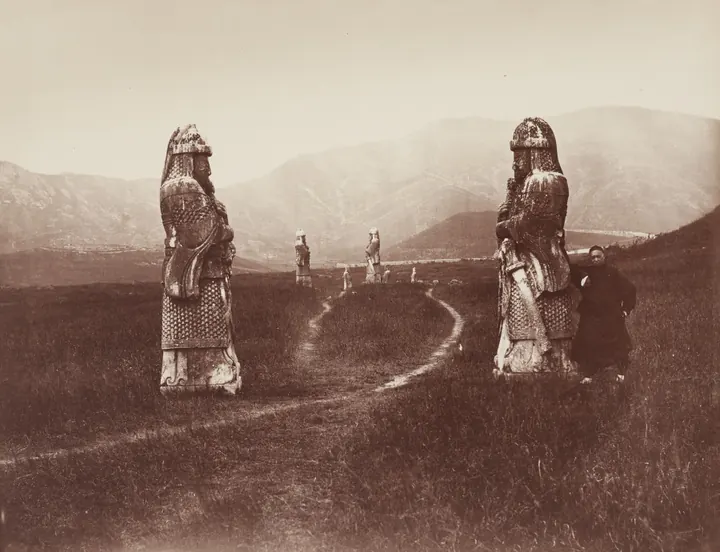
- Portrait of a Man at Nanking Tombs / Stone Warriors — Cleveland Museum of Art — clevelandart.org
Cite / use this content
You may quote and share this page with a link to WABUKAN. Suggested citation:
WABUKAN 和武館, «Confucianism: the teacher, the student and the bow», https://wabukan.com/crenca-confucionismo (accessed 2026-10-30).