
Historical archive
← All beliefs and philosophies
Taoism and the internal arts: softness that overcomes hardness
How tai chi, xingyi and bagua came to be called “internal”, and what the link to Taoism really is.
The story
What the tradition holds
- Softness, relaxation and timing can overcome brute strength.
- Training cultivates qi and health as well as fighting skill.
- Tai chi was created by the Taoist Zhang Sanfeng on Mount Wudang.
What history and science show
- Zhang Sanfeng is a figure of legend; no document from his supposed lifetime links him to boxing. In the 1930s the historian Tang Hao attacked this attribution as a myth.
- The internal/external split is a later classification, not a sharp technical boundary: all good martial arts train both relaxation and power.
- Clinical trials show that tai chi improves balance and reduces falls in older adults, including people with Parkinson’s disease. That is a measurable benefit, whatever one believes about qi.
Myth and fact
Internal arts need no strength or physical conditioning.
Historical internal boxers trained hard, with standing postures, repetition and partner work. Their stories praise skill over strength, not the absence of training.
A note of respect
Taoism is a living religion, and many practitioners find real meaning in its ideas. Tracing the history does not take that away.
Related
- Tai Chi
- Baguazhang
- Xingyiquan
- Kung Fu
- Article: the internal arts
- Article: Shaolin
- Sun Tzu — The Art of War
- Ki and chi
Images: public-domain or CC0 works credited under each picture, or original WABUKAN ink illustrations. Panels: the story told in numbered comic boxes.
Sources
- Taoism — Wikipedia — en.wikipedia.org
- Neijia — Wikipedia — en.wikipedia.org
- Zhang Sanfeng — Wikipedia — en.wikipedia.org
- Tai chi — Wikipedia — en.wikipedia.org
- Sun Lutang — Wikipedia — en.wikipedia.org
- Tang Hao — Wikipedia — en.wikipedia.org
- Daodejing (Chinese Text Project) — ctext.org
- Li F. et al., Tai chi and postural stability in Parkinson’s disease, NEJM 2012 — pubmed.ncbi.nlm.nih.gov
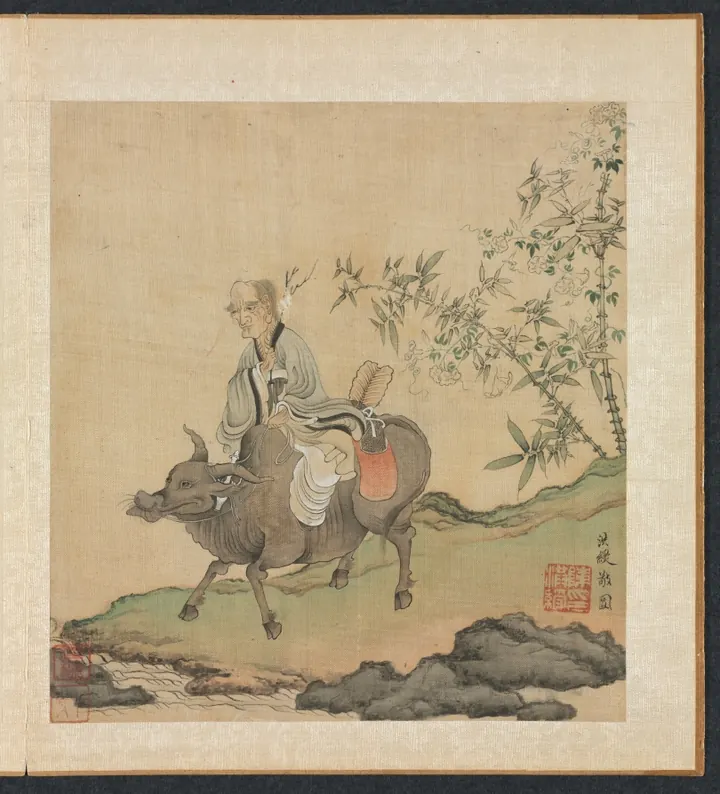
- Paintings after Ancient Masters: Laozi Riding an Ox — Cleveland Museum of Art — clevelandart.org
Cite / use this content
You may quote and share this page with a link to WABUKAN. Suggested citation:
WABUKAN 和武館, «Taoism and the internal arts: softness that overcomes hardness», https://wabukan.com/crenca-taoismo-neijia (accessed 2026-10-30).