
Historical archive
← All beliefs and philosophies
Ki and chi: belief, experience and science
What qi means in Chinese thought, what practitioners feel, and what tests have actually shown.
The story
What the tradition holds
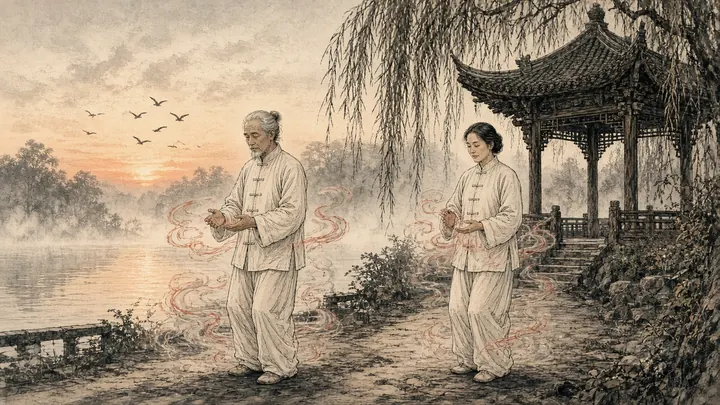
- Qi is a vital force that flows through channels (meridians) in the body.
- Breathing and calm intention lead the qi, and the qi moves the body.
- A master’s qi can be felt, and in some stories used at a distance.
What history and science show
- No anatomical structure matching the meridians has been found, and no instrument detects qi as a distinct form of energy.
- What qi training produces (relaxed power, balance, breath control, whole-body movement) is real and can be explained by biomechanics and physiology.
- No-touch “knockouts” work only on students who expect them. When the no-touch teacher Yanagi Ryūken accepted a real fight against an outside fighter, he was quickly beaten.
Myth and fact
A real master can throw you without touching you.
Every public test with a non-cooperating partner has failed. The effect is suggestion and compliance inside a group, not a force.
A note of respect
Many people use the language of qi as a way to describe and teach bodily experience. That use is valuable; it is only the claim of a measurable external energy that the evidence does not support.
Related
- Tai Chi
- Baguazhang
- Xingyiquan
- Kung Fu
- Taoism and the internal arts
- Article: aiki arts
- Article: the internal arts
- Technique manual
Images: public-domain or CC0 works credited under each picture, or original WABUKAN ink illustrations. Panels: the story told in numbered comic boxes.
Sources
- Qi — Wikipedia — en.wikipedia.org
- Kiai — Wikipedia — en.wikipedia.org
- Rosa L. et al., A close look at therapeutic touch, JAMA 1998 — pubmed.ncbi.nlm.nih.gov
- Emily Rosa — Wikipedia — en.wikipedia.org
- Touchless knockout — Wikipedia — en.wikipedia.org
- Meridian (Chinese medicine) — Wikipedia — en.wikipedia.org
Cite / use this content
You may quote and share this page with a link to WABUKAN. Suggested citation:
WABUKAN 和武館, «Ki and chi: belief, experience and science», https://wabukan.com/crenca-ki-chi (accessed 2026-10-30).