
Historical archive
← All beliefs and philosophies
Zen and bushido: the mind of the warrior, and the myth of a code
What Zen really gave the Japanese sword arts, and why “bushido” as we know it is largely a modern idea.
The story
What the tradition holds
- Training can become a way of shaping the mind, not only the body.
- A calm, unattached mind (mushin, fudōchi) acts faster and better than a mind full of fear or plans.
- Loyalty, courage, honesty and self-control are virtues of the warrior.
What history and science show
- Takuan’s letter and later sword treatises are real historical documents and do link Zen ideas to swordsmanship.
- Most samurai were not Zen practitioners; many followed Pure Land, Nichiren or esoteric Buddhism, Shintō and Confucian teaching.
- Historians such as Oleg Benesch show that modern bushido was built in the late nineteenth and early twentieth centuries; scholars such as Brian Victoria have documented how Zen institutions supported Japanese militarism.
Myth and fact
Every samurai lived by bushido, a strict code of honour and loyalty unto death.
Medieval warriors changed sides often when it paid. At Sekigahara in 1600, the defection of Kobayakawa Hideaki helped decide the battle. Ideals of loyalty existed, but they were many, local and often ignored.
The Hagakure was the samurai’s bible.
The Hagakure was dictated around 1716 by one retainer of the Saga domain and stayed little known for about two centuries. It became famous in the twentieth century.
A note of respect
Zen is a living religion with millions of followers. Separating it from wartime propaganda respects it rather than diminishes it.
Related
- Kendo
- Kenjutsu
- Iaido
- Takuan Sōhō — The Mysterious Record of Immovable Wisdom
- Hagakure — Hidden by the Leaves
- Miyamoto Musashi — The Book of Five Rings
- Meiji Japan
- Article: the old sword schools
- Philosophy
Images: public-domain or CC0 works credited under each picture, or original WABUKAN ink illustrations. Panels: the story told in numbered comic boxes.
Sources
- Zen — Wikipedia — en.wikipedia.org
- Takuan Sōhō — Wikipedia — en.wikipedia.org
- Bushido — Wikipedia — en.wikipedia.org
- Nitobe Inazō — Wikipedia — en.wikipedia.org
- Zen at War (B. Victoria) — Wikipedia — en.wikipedia.org
- Battle of Sekigahara — Wikipedia — en.wikipedia.org
- Hagakure — Wikipedia — en.wikipedia.org
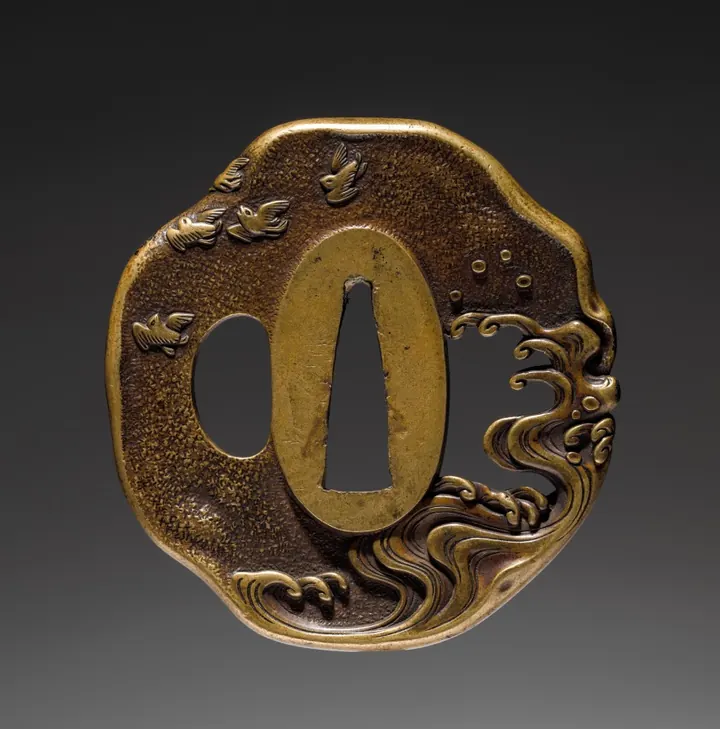
- Sword Guard (Tsuba) with Plovers in Waves — Cleveland Museum of Art — clevelandart.org
Cite / use this content
You may quote and share this page with a link to WABUKAN. Suggested citation:
WABUKAN 和武館, «Zen and bushido: the mind of the warrior, and the myth of a code», https://wabukan.com/crenca-zen-bushido (accessed 2026-10-30).