
Historical archive
The Five Elders of Shaolin
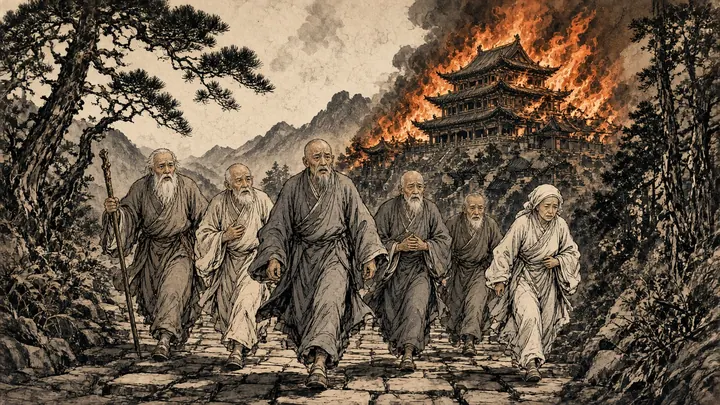
A burning temple, a traitor and five survivors who scattered kung fu across southern China: the legend behind dozens of styles.
The legend
Legend
What history shows
Evidence
- The story of a Shaolin temple burnt by the Qing comes from the founding myth of the Heaven and Earth Society (Tiandihui), a secret brotherhood of the 18th century; its own documents give different dates (1647 or 1732 are both cited).
- It is not known whether a “Southern Shaolin” temple ever existed: several places in Fujian claim it, and none is proven.
- The five heroes became famous through late Qing novels and, in the 20th century, through Hong Kong kung fu cinema, which turned them into characters such as the villain Bak Mei.
- Southern styles such as Hung Gar and Wing Chun can be traced reliably only from the 19th century onwards, through named teachers.
In short: A powerful brotherhood myth, not a documented event. It tells us a lot about rebel identity in Qing China and almost nothing about the real origin of the styles.
Images: public-domain or CC0 works credited under each picture, or original WABUKAN ink illustrations. Panels: the story told in numbered comic boxes.
Sources
- Five Elders — Wikipedia — en.wikipedia.org
- Tiandihui — Wikipedia — en.wikipedia.org
- Southern Shaolin Monastery — Wikipedia — en.wikipedia.org
Cite / use this content
You may quote and share this page with a link to WABUKAN. Suggested citation:
WABUKAN 和武館, «The Five Elders of Shaolin», https://wabukan.com/lenda-cinco-anciaos-shaolin (accessed 2026-10-30).