
Technique Manual › Kicks
Kicks
Front kick (mae-geri / teep / ap chagi)
Names by art: Karate: mae-geri 前蹴り · Taekwondo: ap chagi 앞차기 · Muay Thai: teep ถีบ · Savate: chassé frontal
The front kick travels straight forward from the hip. It is usually the first kick taught, because it shows the core mechanism of almost every kick: the thigh moves first, then stops, and the lower leg whips out. Studies of the high front kick and the karate mae-geri explain what really drives that whip.
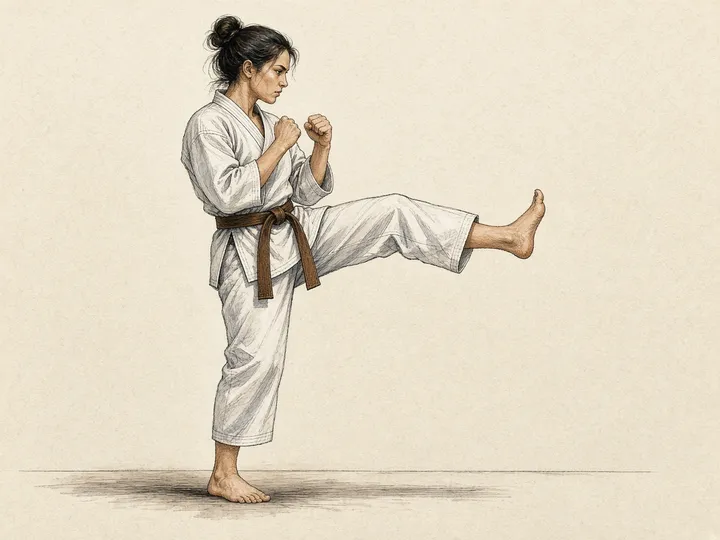
- 1
- hip flexes: the knee rises (chamber)
- 2
- knee extends: the lower leg whips out
- 3
- foot at impact
- ω
- angular velocity
- v
- foot velocity
Step by step
- From guard, shift your weight onto the supporting leg without leaning back.
- Raise the knee of the kicking leg towards the target, foot pulled up (chamber).
- Extend the knee quickly, pushing the hips slightly forward; strike with the ball of the foot (toes pulled back) or with the sole/heel for a push.
- Keep the supporting knee slightly bent and the heel on the floor or lightly raised.
- Pull the lower leg back to the chamber at once, then put the foot down in a stable stance.
Common errors
- Kicking with a straight leg from the floor (a swing), without chamber: slow and easy to see.
- Leaning the trunk far back to reach higher; balance and power go backwards.
- Toes not pulled back on a ball-of-foot kick: the toes take the impact.
- Locking the knee hard at full extension against air, which stresses the joint.
- Dropping the hands while kicking.
Biomechanics: what the body does
Main muscles
Hip flexors (iliopsoas, rectus femoris) lift the knee; quadriceps extend the knee; gluteus medius and the supporting-leg muscles keep balance; abdominals stabilise the pelvis.
Joints
Hip (flexion), knee (extension), ankle (plantar flexion for the ball of the foot, or neutral for the heel), and the whole supporting leg.
Kinetic chain
Sørensen et al., 1996 filmed 17 taekwon-do practitioners: the thigh slowed down not because opposing muscles braked it, but as a passive result of the lower leg’s motion. The lower leg was accelerated partly by the knee extensors and partly by the thigh’s own angular velocity.
Base and balance
The whole body stands on one foot during the kick. The centre of mass must stay over that small base; pushing the hips forward adds reach without tipping over.
Physics and maths
What studies measured
- Sørensen et al., 1996: 17 skilled taekwon-do practitioners, high-speed film and EMG of five leg muscles. Thigh deceleration was passive; the knee extensors and the thigh’s angular velocity both drove the lower leg.
- Pozo et al., 2011: 17 black-belt karate competitors (9 national, 8 international), 6 mae-geri each. International athletes kicked in significantly less time, but the maximum impact force was not different between groups. Their knee angle and velocity peaks came earlier, and their kicks were more repeatable.
What the numbers mean in practice: at the top level, the front kick is better described as faster and more consistent, not harder (Pozo et al., 2011). We did not find a peer-reviewed laboratory study specific to the Muay Thai teep, so its row in the table below is descriptive only.
Numbers come from the cited studies, with their sample and conditions. They describe those athletes in that laboratory, not every practitioner.
Comparison across arts
Same direction, different intentions: a snapping strike, a scoring kick or a push that breaks the opponent’s rhythm.
| Art | Contact surface | Action | Typical use |
|---|---|---|---|
| Karate (mae-geri) | Ball of the foot (koshi) | Snap (keage) or thrust (kekomi) | Midsection, often as a counter |
| Taekwondo (ap chagi) | Ball of the foot or instep | Fast snap, often rising | Body or head, combinations |
| Muay Thai (teep) | Sole or heel | Push with the hips forward | Keep distance, stop an attack, unbalance |
Safety
- Warm up the hip flexors and hamstrings before kicking high.
- Practise on pads or a bag before kicking a partner; partners wear body protection.
- Pull the toes back or use the heel — never kick a hard target with the toes.
- Children and beginners: kick low and slow first; height comes with control.
Train with an instructor. Learn and practise this technique only under a qualified instructor, on a suitable surface and with a cooperative partner. This page explains; it does not replace a teacher.
Related
Karate Taekwondo Muay Thai Savate Kickboxing
Straight punch (reverse punch / cross) Roundhouse kick (mawashi-geri / dollyo chagi / Thai kick) Side kick (yoko-geri / yop chagi) Breakfalls (ukemi) Major outer reap (o-soto-gari) Shoulder throw (seoi-nage) Rear naked choke (mata-leão / hadaka-jime) Cross armlock (juji-gatame / armbar)
From history
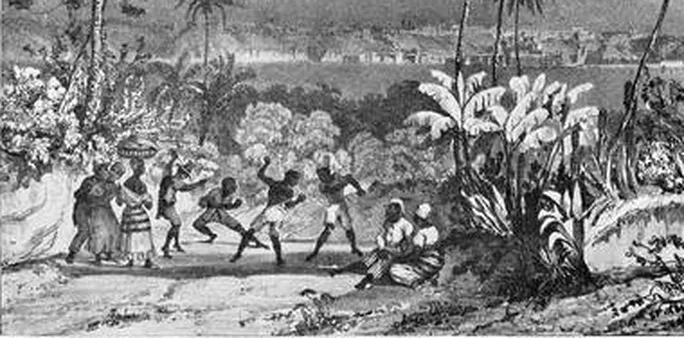
Capoeira on a road outside Salvador da Bahia, drawn by Rugendas (1835, detail): the game of kicks and evasions was already played in the open air.
Image: Capoeira in Bahia 1835 — Johann Moritz Rugendas, 1835. Wikimedia Commons. Licence: Public domain. source
Sources
- Henrik Sørensen et al. (1996). Dynamics of the martial arts high front kick. Journal of Sports Sciences 14(6), 483–495. DOI 10.1080/02640419608727735
- Julien Pozo, Guillaume Bastien & Frédéric Dierick (2011). Execution time, kinetics, and kinematics of the mae-geri kick: comparison of national and international standard karate athletes. Journal of Sports Sciences 29(14), 1553–1561. DOI 10.1080/02640414.2011.605164
- Joseph Hamill, Kathleen M. Knutzen & Timothy R. Derrick (2015). Biomechanical Basis of Human Movement (4th ed.). Wolters Kluwer. ISBN 9781451177305
Cite / use this content
You may quote short excerpts with a visible link to this page. Suggested citation:
Wabukan (2026). “Front kick (mae-geri / teep / ap chagi)”. https://wabukan.com/manual/pontape-frontal (accessed 2026-10-30).
Full rules, ready-made link code and press kit → · Updated: 2026-10-30