
Historical archive
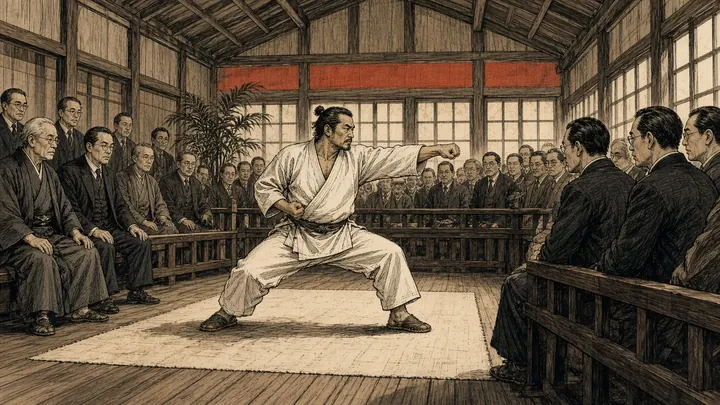
1922: karate leaves Okinawa for Tokyo
How a local Okinawan art became a Japanese budō, changed its name and went global.
1922–1936
The story
Key dates
- c. 1901–1905
Karate enters Okinawan school physical education.
- 1922
Demonstration at the Ministry of Education exhibition in Tokyo, then at the Kōdōkan.
- 1924
First university karate club, at Keiō University.
- 1936
25 October: Okinawan masters adopt the writing 空手, “empty hand”.
- 2021
Karate makes its Olympic debut at Tokyo 2020 (held in 2021).
Myth and fact
Karate is an ancient Japanese art of the samurai.
Karate grew up in the Ryūkyū Kingdom (Okinawa), with strong Chinese influence, and only reached mainland Japan in the 1920s.
Why it matters
The 1922 journey explains why karate has two faces: the Okinawan styles close to their Chinese roots, and the Japanese styles shaped by budō and university clubs that later spread across the world.
Related
Images: public-domain or CC0 works credited under each picture, or original WABUKAN ink illustrations. Panels: the story told in numbered comic boxes.
Sources
- Karate — Wikipedia — en.wikipedia.org
- Okinawan martial arts — Wikipedia — en.wikipedia.org
- 空手道 — Wikipedia (ja) — ja.wikipedia.org
Cite / use this content
You may quote and share this page with a link to WABUKAN. Suggested citation:
WABUKAN 和武館, «1922: karate leaves Okinawa for Tokyo», https://wabukan.com/marco-karate-japao (accessed 2026-10-30).