
Technique Manual › Chokes
Chokes
Rear naked choke (mata-leão / hadaka-jime)
Names by art: BJJ: mata-leão · Judo: hadaka-jime 裸絞 · MMA: rear-naked choke (RNC) · Jujutsu: hadaka-jime
“Mata-leão” means “lion killer” in Portuguese. In professional MMA it is by far the most common submission. Done correctly it is a blood choke: the arms press on the sides of the neck, where the carotid arteries run, and not on the windpipe. A study with police officers measured what happens in the brain — and why the partner must release the moment the other taps or goes limp.
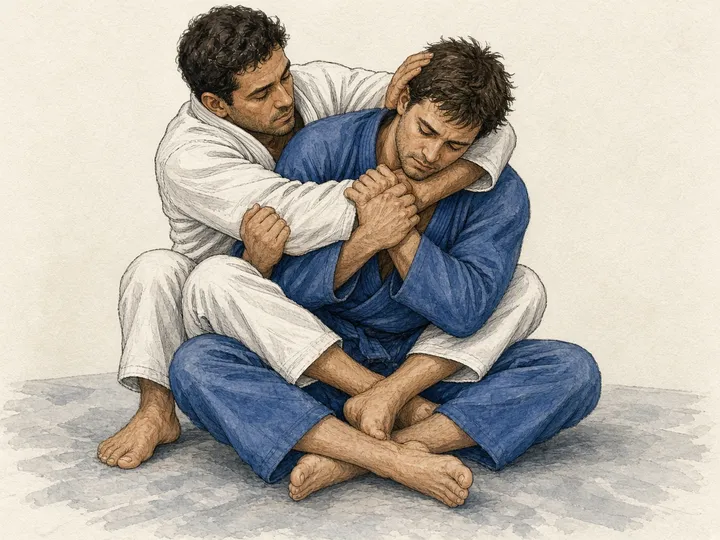
Step by step
- Only in supervised sparring, with a partner who knows the tap. Agree beforehand: tap with the hand, tap with the foot or say “tap” — any of them means release at once.
- From the back, pass the choking arm around the neck so the elbow is directly under the partner’s chin.
- Bring the hand of the choking arm to your other biceps; place the other hand behind the partner’s head (or on their shoulder in a safer training variant).
- Close the angle by squeezing the elbows together and expanding the chest — the pressure is on the sides of the neck, not on the front.
- Apply pressure slowly and progressively in training. Release immediately at the tap, at any sound of distress, or if the partner stops responding.
- Control: legs (hooks) or body position keep the partner from turning; this is what makes the choke possible without force on the neck.
Common errors
- Pressing the forearm across the front of the throat: that is a crushing air choke — painful and dangerous for the windpipe and larynx.
- Squeezing with the arms only, without closing the elbows and expanding the chest.
- Holding on after the tap “to make sure”: in Sasaki et al., 2022, holding for 4 s or more after unconsciousness was linked to post-choke symptoms.
- Jerking or twisting the neck while choking.
Biomechanics: what the body does
Main muscles
Biceps brachii and brachialis flex the elbow; pectoralis major and latissimus dorsi pull the elbows together; the shoulder retractors and the chest expansion close the last centimetres.
Joints
Elbow of the choking arm in deep flexion, forming a “V”; shoulders adducted. On the partner, the neck is in neutral — any added twist puts the cervical spine at risk.
Kinetic chain
Inside the partner’s body: Mitchell et al., 2012 concluded that the main mechanism of unconsciousness is reduced blood flow to the brain caused by compression of the carotid arteries. Stellpflug et al., 2020 argues that two more factors probably add to it: compression of the jugular veins (blood cannot leave the skull, pressure inside rises) and a reflex from the carotid body that slows the heart.
Base and balance
The choke depends on position, not strength: the attacker’s chest against the partner’s back and the legs controlling the hips stop the escape by turning towards the arm.
Physics and maths
What studies measured
- Mitchell et al., 2012: 24 healthy police officers (35 ± 4 years) in a laboratory, released 1–2 s after their eyes stopped tracking a moving pen. That happened in 16 of them after 9.5 ± 0.4 s (SE). Pressure over the carotids: 257 ± 22 mmHg (right) and 146 ± 18 mmHg (left). Middle cerebral artery flow velocity fell from 45 ± 3 to 8 ± 4 cm/s (right) and from 53 ± 2 to 10 ± 3 cm/s (left). Mean arterial pressure and heart rate did not change significantly.
- Sasaki et al., 2022: 7426 bouts at Judo World Championships 2015–2021; 307 (4.1%) ended by shime-waza — 6.0% of cadet, 4.4% of junior and 3.0% of senior bouts. Of 39 cases of unconsciousness, 24 (61.5%) showed convulsions or staggering after waking. Time from unconsciousness to release: 5.0 ± 3.5 s with symptoms vs 2.4 ± 2.0 s without; the cut-off for symptoms was 4 s or more (odds ratio 6.7).
- Mańka-Malara & Trzaskowski, 2025: 2488 UFC fights (2000–2021); submissions ended 18.7% of fights, and the rear-naked choke was 68.6% of all submissions.
Our calculation from cited data
From Mitchell et al., 2012: flow velocity fell by about 82% on the right ((45 − 8) ÷ 45) and 81% on the left ((53 − 10) ÷ 53). In other words, during the restraint the brain received roughly a fifth of its normal arterial flow velocity — and the eyes stopped tracking after under ten seconds.
These are laboratory and competition data, not a guide to “how long is safe”. There is no safe duration of unconsciousness; in training the goal is the tap, long before it.
Numbers come from the cited studies, with their sample and conditions. They describe those athletes in that laboratory, not every practitioner.
Comparison across arts
The same choke has different names and different rules depending on the art.
| Art | Name | Rules |
|---|---|---|
| Judo | Hadaka-jime (“naked choke”, no gi grip) | Allowed in shime-waza; the referee stops the bout at the tap or at loss of consciousness (Sasaki et al., 2022) |
| BJJ | Mata-leão | One of the central finishes, from back control with hooks |
| MMA | Rear-naked choke | Most common submission: 68.6% of submissions in UFC (Mańka-Malara & Trzaskowski, 2025) |
| Wrestling · sport sambo | — | Chokes are not allowed |
Safety
- Never practise chokes alone, without supervision, or as a “game” — and never on children outside a properly run club.
- Tap early, release instantly. Apply slowly; the partner must be able to tap at every moment.
- Release at once if the partner goes limp; keep them lying down, watch breathing and call the instructor. Any convulsion, confusion or headache: medical assessment.
- People with heart, vascular or neck problems, or who are pregnant, should ask a doctor before training chokes.
Train with an instructor. Learn and practise this technique only under a qualified instructor, on a suitable surface and with a cooperative partner. This page explains; it does not replace a teacher.
Related
Brazilian Jiu-Jitsu Judo Jujutsu MMA Luta Livre Catch Wrestling
Straight punch (reverse punch / cross) Front kick (mae-geri / teep / ap chagi) Roundhouse kick (mawashi-geri / dollyo chagi / Thai kick) Side kick (yoko-geri / yop chagi) Breakfalls (ukemi) Major outer reap (o-soto-gari) Shoulder throw (seoi-nage) Cross armlock (juji-gatame / armbar)
From history
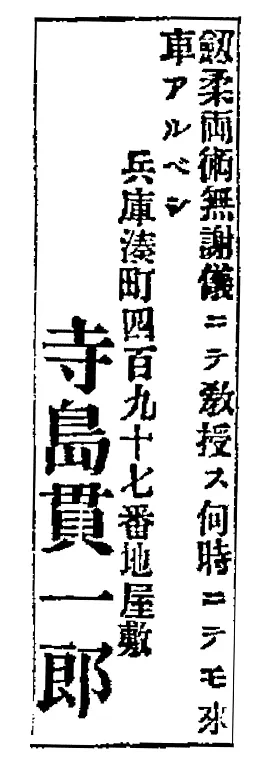
A Japanese notice of 1884 by Terashima Kan’ichirō, offering to teach “both arts, sword and jū” free of charge: jujutsu, where the BJJ chokes come from, was still taught as a combat art.
Image: 剣柔両術教授 寺島貫一郎 — 寺島貫一郎, 1884. Wikimedia Commons. Licence: Public domain. source
Sources
- J. R. Mitchell, D. E. Roach, J. V. Tyberg, I. Belenkie & R. S. Sheldon (2012). Mechanism of loss of consciousness during vascular neck restraint. Journal of Applied Physiology 112(3), 396–402. DOI 10.1152/japplphysiol.00592.2011
- Samuel J. Stellpflug, T. Menton, J. Corry & A. Schneir (2020). There is more to the mechanism of unconsciousness from vascular neck restraint than simply carotid compression. International Journal of Neuroscience 130(1), 103–106. DOI 10.1080/00207454.2019.1664520
- E. Sasaki, A. Ikumi, N. Sakuyama, N. Malliaropoulos, Y. Mikami & S. Nagahiro (2022). High-rate settlement and unconsciousness with shime-waza in young judo athletes from a video analytic study in Judo World Championships. Journal of Science and Medicine in Sport 25(11), 942–947. DOI 10.1016/j.jsams.2022.09.001
- K. Mańka-Malara & M. Trzaskowski (2025). The risk of joint and neck injuries in mixed martial arts — grappling and submission techniques in professional fights. Journal of Clinical Medicine 14(21), 7467. DOI 10.3390/jcm14217467
- Renzo Gracie & John Danaher (2003). Mastering Jujitsu. Human Kinetics. ISBN 9780736044042
Cite / use this content
You may quote short excerpts with a visible link to this page. Suggested citation:
Wabukan (2026). “Rear naked choke (mata-leão / hadaka-jime)”. https://wabukan.com/manual/mata-leao (accessed 2026-10-30).
Full rules, ready-made link code and press kit → · Updated: 2026-10-30