
Technique Manual › Throws
Throws
Shoulder throw (seoi-nage)
Names by art: Judo: seoi-nage 背負投 · ippon-seoi-nage · morote-seoi-nage · Sambo: throw over the back · Wrestling: shoulder throw / fireman’s-carry family · Jujutsu: seoi-nage
Seoi-nage means “back-carry throw”: tori turns, gets under uke and lifts uke over the shoulder. Coaches often say it is done with the arms. Measurements say otherwise: in a 3D study of French national-level judoka, most of the driving moments came from the legs and trunk, and in Japanese studies what separated elite athletes was how fast they moved forwards into the throw.
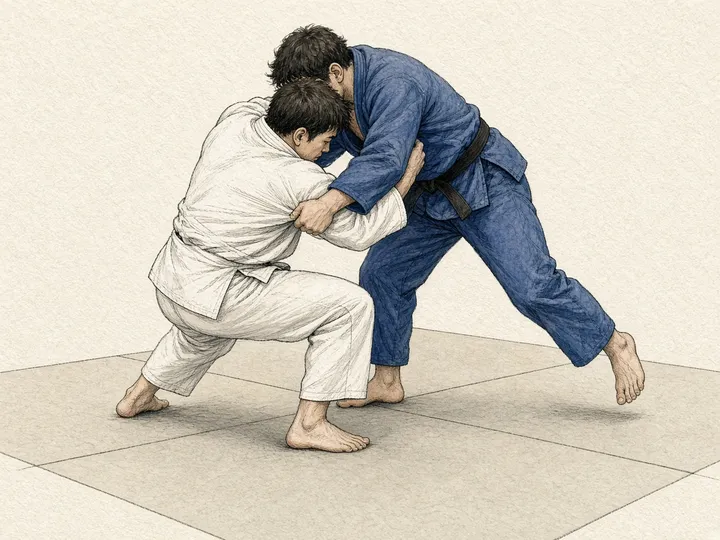
- v
- forward speed of tori’s centre of mass
- ω
- rotation that carries uke over
Step by step
- Kuzushi: pull uke forwards and up onto the toes with the sleeve hand, as if looking at your watch.
- Step in with the front foot to the inside of uke’s front foot, then pivot on it and bring the other foot back so both feet are inside uke’s feet, close together.
- Bend the knees so your hips are clearly lower than uke’s hips; your back touches uke’s front.
- Ippon-seoi-nage: the second arm hooks under uke’s armpit, the elbow tight. Morote-seoi-nage: keep the lapel grip and place the forearm or elbow under uke’s armpit.
- Extend the legs, bend forwards and rotate the trunk towards your front foot — the throw comes from legs and trunk, the arms keep uke attached.
- Keep the sleeve as uke lands so the fall is controlled.
Common errors
- Pulling with the arms while standing straight: the legs, the biggest contributors (Blais et al., 2007), do nothing.
- Hips not lower than uke’s hips, so there is no lever to lift over.
- Turning on the spot without forward drive; elite judoka move forwards much faster during the turn (Ishii et al., 2018).
- Dropping onto both knees on a hard surface, or throwing a partner onto the head by bending too far without the sleeve.
Biomechanics: what the body does
Main muscles
Quadriceps and gluteus maximus extend knees and hips; spinal erectors and abdominals control the trunk bend and rotation; latissimus dorsi, biceps and forearm flexors hold the grips.
Joints
Knees and hips go from flexion to extension; the trunk flexes and rotates; the shoulder of the gripping arm is under uke’s armpit (ippon) or the elbow is under it (morote).
Kinetic chain
Blais et al., 2007 found the main driving moments at the knees, hips and trunk, “contrary to the teaching of some judo coaches”. Most of the energy (about 880 J) was spent in tsukuri, the phase of getting under uke — the entry is the hard work. Ishii & Koshida, 2026 adds that higher-performing elite throwers had more forward linear momentum and angular momentum, and passed it to uke rather than to the ground.
Base and balance
Tori’s base is small (feet close together inside uke’s feet) but very low, with the centre of mass under uke’s. Uke is pulled forwards onto the toes, so the centre of mass is already in front of the base when the lift starts.
Physics and maths
What studies measured
- Blais et al., 2007: 16 French national-level judoka, 10 morote-seoi-nage each on an ergometer loaded with 20 kg, force sensors and six cameras. Share of total driving moments: knees 24% (SD 4), hips 29% (SD 3), trunk 28% (SD 3). Energy spent: mean 880 J (SD 160), mostly in tsukuri.
- Ishii et al., 2018: 3 elite and 7 college judoka, 18-camera system at 250 Hz. Maximum forward velocity of the centre of mass relative to the opponent during the turn: 2.74 ± 0.33 m/s (elite) vs 1.62 ± 0.47 m/s (college), p = 0.023. The time of the turning phase did not differ.
- Ishii & Koshida, 2026: 19 elite judoka including world medallists; higher-performing throwers showed greater vertical centre-of-mass displacement, forward linear momentum and angular momentum than lower-performing ones (reported differences: 115–132%, 62–142% and 62–169%).
Our calculation from cited data
From Blais et al., 2007: knees + hips + trunk = 24% + 29% + 28% = 81% of the total driving moments. From Ishii et al., 2018: 2.74 ÷ 1.62 ≈ 1.69, so the elite group moved forwards about 69% faster during the turn, in the same turning time.
The ergometer in Blais et al., 2007 replaced a human partner with a 20 kg load, so the absolute numbers do not describe a real 80 kg opponent; the distribution between joints is the useful lesson.
Numbers come from the cited studies, with their sample and conditions. They describe those athletes in that laboratory, not every practitioner.
Comparison across arts
Throws over the back are found in judo, sambo, jujutsu, Chinese shuai jiao and wrestling; the grips and the way of landing differ.
| Art | Grip | Typical detail |
|---|---|---|
| Judo | Sleeve + lapel or armpit | Standing or dropping to the knees (drop seoi-nage); uke lands on the back |
| Sambo | Jacket (kurtka) and belt grips | Often followed directly by a leg lock on the ground |
| Wrestling | No jacket: arm drag, underhook, head and arm | The shoulder throw (and the related fireman’s carry) lands the opponent for a pin |
Safety
- Learn mae-mawari and ushiro ukemi before being thrown with seoi-nage.
- Keep uke’s sleeve to the end; never throw “over the head” onto the partner’s neck.
- Drop seoi-nage onto the knees puts load on the knees — learn it on mats and only with an instructor.
- Warm up legs and lower back: they do most of the work (Blais et al., 2007).
Train with an instructor. Learn and practise this technique only under a qualified instructor, on a suitable surface and with a cooperative partner. This page explains; it does not replace a teacher.
Related
Judo Jujutsu Sambo Wrestling Aikijujutsu Shuai Jiao
Straight punch (reverse punch / cross) Front kick (mae-geri / teep / ap chagi) Roundhouse kick (mawashi-geri / dollyo chagi / Thai kick) Side kick (yoko-geri / yop chagi) Breakfalls (ukemi) Major outer reap (o-soto-gari) Rear naked choke (mata-leão / hadaka-jime) Cross armlock (juji-gatame / armbar)
From history
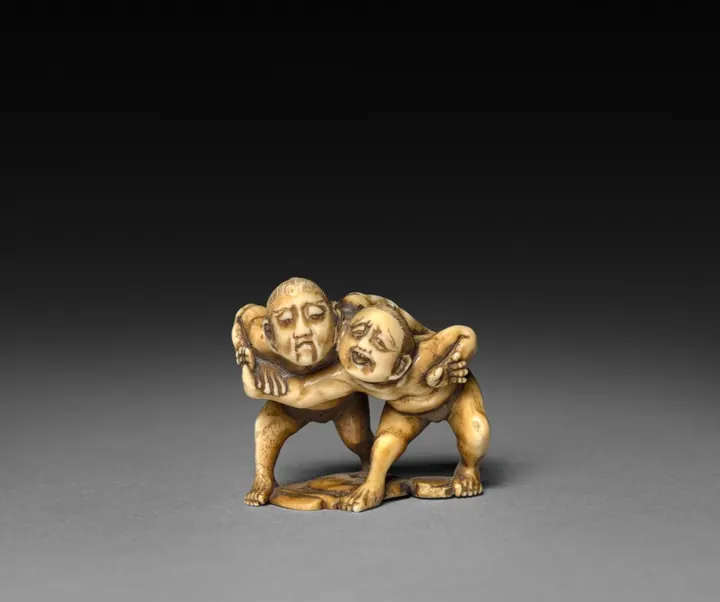
Two wrestlers locked chest to chest, a small carving from the early to mid 1800s: grappling for the throw is far older than judo (1882).
Image: Two Wrestlers — Unknown artist, early to mid-1800s. Cleveland Museum of Art. Licence: CC0 (public domain). source
Sources
- Laurent Blais, François Trilles & Paul Lacouture (2007). Three-dimensional joint dynamics and energy expenditure during the execution of a judo throwing technique (Morote Seoi Nage). Journal of Sports Sciences 25(11), 1211–1220. DOI 10.1080/02640410600982204
- Takanori Ishii, Michiyoshi Ae, Yuta Suzuki & Yasuto Kobayashi (2018). Kinematic comparison of the seoi-nage judo technique between elite and college athletes. Sports Biomechanics 17(2), 238–250. DOI 10.1080/14763141.2017.1284256
- Takanori Ishii & Shinji Koshida (2026). Elite seoi-nage biomechanics: integration of centre-of-mass control, propulsion and rotation. Sports Biomechanics (online ahead of print), 1–17. DOI 10.1080/14763141.2026.2723212
- Jigoro Kano (1986). Kodokan Judo. Kodansha International. ISBN 9780870116810
- Toshiro Daigo (2005). Kodokan Judo Throwing Techniques. Kodansha International. ISBN 9784770023308
Cite / use this content
You may quote short excerpts with a visible link to this page. Suggested citation:
Wabukan (2026). “Shoulder throw (seoi-nage)”. https://wabukan.com/manual/seoi-nage (accessed 2026-10-30).
Full rules, ready-made link code and press kit → · Updated: 2026-10-30