
Technique Manual › Throws
Throws
Inner thigh throw (uchi-mata)
Names by art: Judo: uchi-mata 内股 · Jujutsu: uchi-mata · BJJ: uchi-mata (stand-up) · Sambo: inner-thigh throw
Uchi-mata means “inner thigh”. Tori turns in, bows the trunk forward and swings one leg high between uke’s legs, so the two bodies move like a seesaw: tori’s head goes down, uke’s legs go up. A 2025 study filmed 40 national-team black belts in 3D. What set the uchi-mata specialists apart was not raw speed but shape: the reaping knee and foot ended higher, and the hip lower.
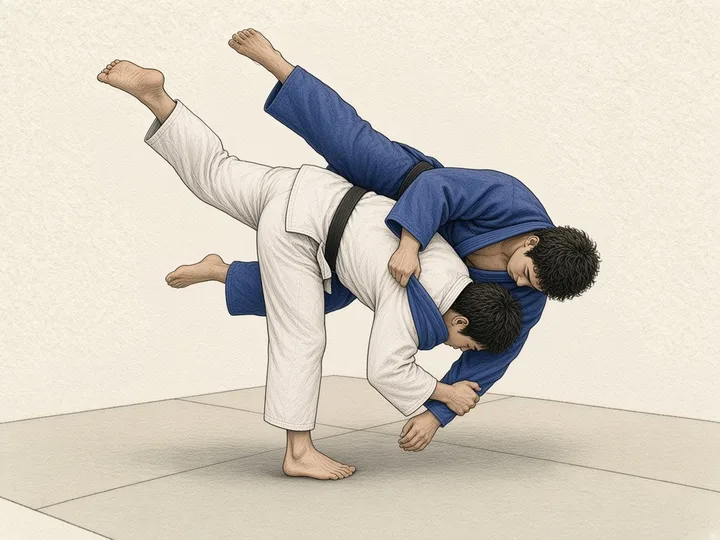
- ω
- rotation that carries uke over tori
Step by step
- Kuzushi: with the sleeve and lapel, pull uke forward and up onto the toes, towards the corner of their front foot.
- Step in with the first foot between uke’s feet, then pivot so your back faces uke; your supporting foot ends near the middle, toes pointing the same way as uke’s.
- Keep the supporting leg slightly bent at first, then straighten it as you lift — it carries your weight and uke’s.
- Swing the reaping leg backwards and up between uke’s legs: the back of your thigh meets uke’s inner thigh and keeps rising, heel towards the ceiling.
- At the same time bow the trunk forward and turn the head towards your supporting side; the hands keep pulling uke around you, as on a seesaw.
- Keep the sleeve as uke lands, and stay on your feet — do not dive after uke.
Common errors
- Lifting the leg only to hip height: specialists finished with the reaping foot about 17 cm higher and the knee about 12 cm higher (Brito et al., 2025).
- Standing upright: without the trunk bowing forward there is no seesaw, and the hip stays high.
- Turning on the spot with no forward drive; skilled judoka moved their centre of mass faster (Hamaguchi et al., 2025).
- Diving head-first into the mat after uke — dangerous for the neck and penalised in competition.
Biomechanics: what the body does
Main muscles
Gluteus maximus and hamstrings drive the reaping leg backwards and up; quadriceps and calf of the supporting leg hold and straighten it; abdominals and spinal erectors control the forward bow; latissimus dorsi and forearm flexors keep the grips.
Joints
Reaping leg: hip extension with the knee moving from bent to straighter as it rises. Supporting leg: knee and ankle from slight flexion to extension. Trunk: flexion and rotation towards the supporting side.
Kinetic chain
Hamaguchi et al., 2025 compared 10 highly skilled and 10 less skilled judoka: the skilled group had higher peak centre-of-mass velocity (forwards and upwards), faster hip, shoulder and arm rotation, and gave uke more angular momentum — the forward drive during the turn matters. Brito et al., 2025 adds the shape: in national-team specialists the knee travelled through a larger range, and the reaping foot and knee ended higher.
Base and balance
The whole throw stands on one foot. That base is tiny, so tori keeps the centre of mass over the supporting foot by bowing the trunk forward exactly as much as the leg rises behind — the seesaw. Uke, pulled onto the toes and lifted off one leg, has almost no base at all.
Physics and maths
What studies measured
- Brito et al., 2025: 40 national-team black belts (12 women, 28 men, 24.5 ± 5.9 years), Vicon system at 200 Hz, uchi-mata specialists vs non-specialists. Final height of the reaping leg: foot 121.0 vs 104.4 cm, knee 98.5 vs 86.3 cm, hip 61.9 vs 75.6 cm. Knee displacement was the clearest difference between the groups; peak hip angular velocity during the throw (179.3 vs 149.2 °/s) and the accelerations did not differ significantly.
- Hamaguchi et al., 2025: 10 highly skilled vs 10 less skilled judoka, motion capture at 250 Hz. Skilled throwers showed greater peak centre-of-mass velocity forwards and upwards, greater hip, shoulder and arm angular velocity, and greater angular momentum of uke.
Our calculation from cited data
From Brito et al., 2025: foot 121.0 − 104.4 = 16.6 cm higher (121.0 ÷ 104.4 ≈ 1.16, about 16%); knee 98.5 − 86.3 = 12.2 cm higher; hip 75.6 − 61.9 = 13.7 cm lower. Specialists open a bigger seesaw: the leg goes up while the hip stays down.
Both studies are small and filmed throws in the laboratory against a cooperating partner; they describe what good uchi-mata looks like, not how a contest is won.
Numbers come from the cited studies, with their sample and conditions. They describe those athletes in that laboratory, not every practitioner.
Comparison across arts
Uchi-mata has close relatives in the Kodokan list of throws (Kano, 1986); what changes is where the leg makes contact.
| Throw | Leg contact | Typical detail |
|---|---|---|
| Uchi-mata | Back of the thigh against uke’s inner thigh | Leg goes high between uke’s legs; trunk bows forward like a seesaw |
| Harai-goshi | Back of the thigh sweeps the outside of uke’s legs | Hip contact first, then the sweep |
| Hane-goshi | Bent leg springs up against uke’s inner leg | Hip and leg act together, close to a hip throw |
| Ken-ken uchi-mata | As uchi-mata | Tori hops on the supporting leg to follow uke before finishing |
Safety
- Learn mae-mawari ukemi (rolling breakfall) and yoko ukemi before being thrown with uchi-mata.
- Keep uke’s sleeve to the end so uke lands on the back and side, not on the head or shoulder.
- Never dive head-first into the mat after uke: it loads the neck and is penalised in competition.
- The reaping leg rises into the groin area — in training, aim the thigh at the inner thigh and go slowly with a new partner.
Train with an instructor. Learn and practise this technique only under a qualified instructor, on a suitable surface and with a cooperative partner. This page explains; it does not replace a teacher.
Related
Judo Jujutsu Brazilian Jiu-Jitsu Sambo
Straight punch (reverse punch / cross) Front kick (mae-geri / teep / ap chagi) Roundhouse kick (mawashi-geri / dollyo chagi / Thai kick) Side kick (yoko-geri / yop chagi) Breakfalls (ukemi) Major outer reap (o-soto-gari) Shoulder throw (seoi-nage) Rear naked choke (mata-leão / hadaka-jime) Cross armlock (juji-gatame / armbar)
Sources
- Ciro José Brito, Nicolas Ribeiro Almeida, Ignacio Roa-Gamboa et al. (2025). Kinematic Analysis of the Lower Limb in Uchi-Mata: Comparison Between Elite Athletes Specializing and Non-Specializing. Journal of Functional Morphology and Kinesiology 10(4), 378. DOI 10.3390/jfmk10040378
- Kei Hamaguchi, Lixin Liu, Masaki Shiokawa & Tomonori Deguchi (2025). A biomechanical study of judo uchimata: a comparison of judokas with different skill levels. Sports Biomechanics 24(9), 2540–2555. DOI 10.1080/14763141.2025.2474515
- Jigoro Kano (1986). Kodokan Judo. Kodansha International. ISBN 9780870116810
- Toshiro Daigo (2005). Kodokan Judo Throwing Techniques. Kodansha International. ISBN 9784770023308
Cite / use this content
You may quote short excerpts with a visible link to this page. Suggested citation:
Wabukan (2026). “Inner thigh throw (uchi-mata)”. https://wabukan.com/manual/uchi-mata (accessed 2026-10-30).
Full rules, ready-made link code and press kit → · Updated: 2026-10-30