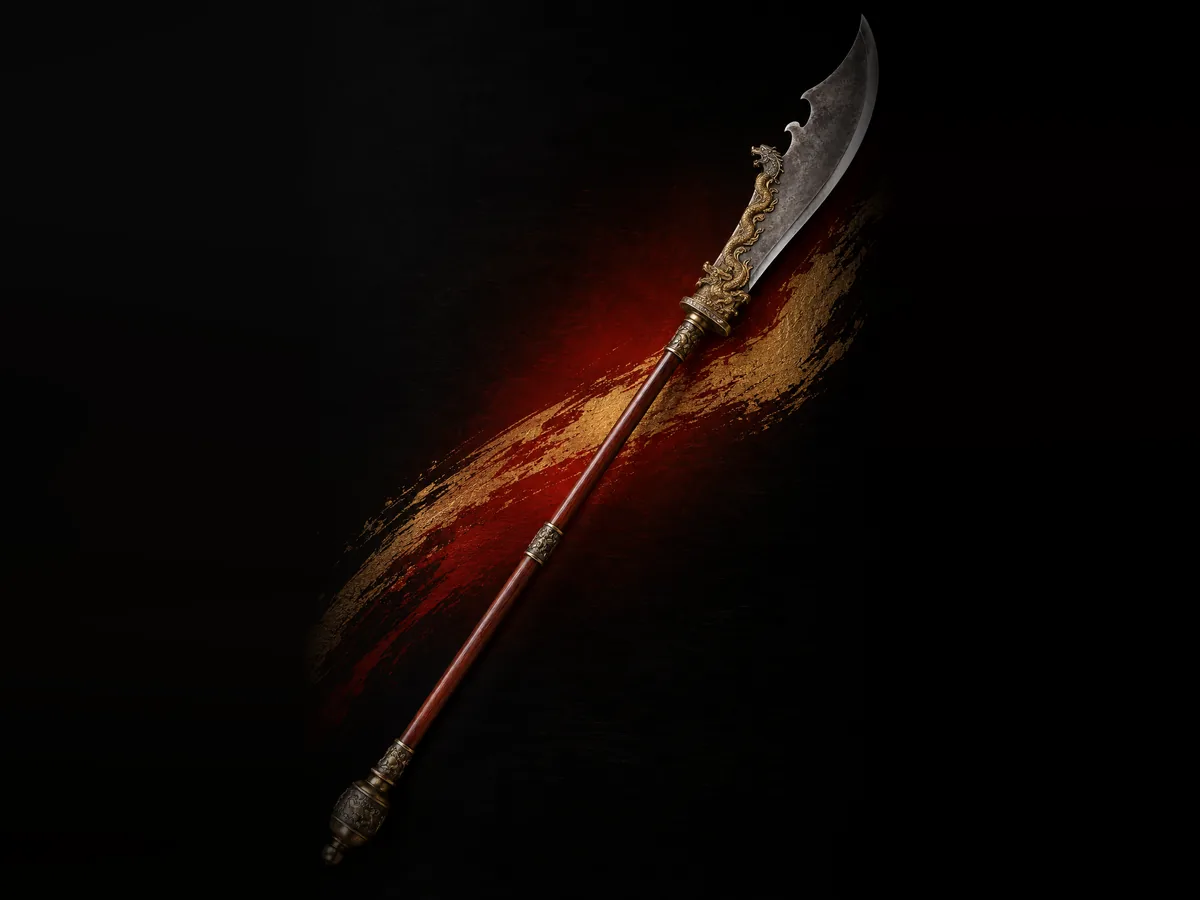
Uma lâmina pesada num cabo comprido, com o nome do general Guan Yu. Os historiadores acham que surgiu séculos depois dele; também servia para testar a força dos soldados.
Guandao Ilustração WABUKAN
Outros nomes
關刀 · guān dāo; yanyue dao (crescent-moon blade)
Origem e história
O guandao deve o nome ao general Guan Yu (séc. III), cuja arma no romance Romance dos Três Reinos é uma glaive de lâmina em crescente. Historicamente, guandao pesados usaram-se desde a dinastia Song e, no período Qing, também em provas de força nos exames militares.
Lâmina pesada e curva num cabo comprido (cerca de 1,8–2,2 m), muitas vezes com um espigão nas costas e um contrapeso na base. As versões de treino para formas são mais leves.
Técnicas básicas
pi (corte descendente)
sao (varrimento)
tiao (levantar)
forma de guandao (Chun Qiu Da Dao)
Treino
O treino de armas de haste começa pelo manejo: deslizar as mãos ao longo do cabo, virar a arma de ponta a ponta e manter a distância. Estocadas, varrimentos e bloqueios treinam-se a solo e depois em formas combinadas a pares, com versões de madeira de ponta almofadada ou romba.
Segurança
As armas longas precisam de espaço: verifique o teto e o espaço atrás de si e avise os parceiros antes de virar a arma. Inspecione os cabos de madeira à procura de fissuras e lascas e substitua-os em vez de os reparar.
Legalidade (informação geral)
Espadas, facas e outras armas de lâmina são reguladas de forma muito diferente de país para país (e por vezes de região para região): ter uma em casa é muitas vezes permitido, mas trazê-la na via pública, comprá-la abaixo de certa idade ou importá-la pode estar limitado ou proibido. Os praticantes costumam transportá-las em estojo fechado, fora de alcance e diretamente entre casa e dojo. Isto é informação geral, não aconselhamento jurídico: confirme a lei onde vive.
Curiosidades
Guan Yu é venerado como deus da lealdade e da guerra, e a sua estátua com o guandao encontra-se em templos, esquadras e restaurantes.
A heavy blade on a long pole, named after the general Guan Yu. Historians think it appeared centuries after him; it was also used to test soldiers' strength.
Guandao WABUKAN illustration
Also known as
關刀 · guān dāo; yanyue dao (crescent-moon blade)
Origin and history
The guandao is named after the general Guan Yu (3rd c.), whose weapon in the novel Romance of the Three Kingdoms is a crescent-blade glaive. Historically, heavy guandao were used from the Song dynasty and, in the Qing period, also for strength tests in the military examinations.
A heavy, curved blade on a long shaft (about 1.8–2.2 m), often with a back spike and a counterweight at the butt. Training versions for forms are lighter.
Basic techniques
pi (chop)
sao (sweep)
tiao (lift)
guandao form (Chun Qiu Da Dao)
Training
Polearm training begins with handling: sliding the hands along the shaft, turning the weapon end to end and keeping distance. Thrusts, sweeps and blocks are drilled solo, then in prearranged forms with a partner using wooden versions with padded or blunt tips.
Safety
Long weapons need room: check the ceiling and the space behind you, and warn partners before turning the weapon. Inspect wooden shafts for cracks and splinters and replace them rather than repair them.
Legality (general information)
Swords, knives and other edged weapons are regulated very differently from country to country (and sometimes from region to region): owning one at home is often allowed, while carrying it in public, buying it under a certain age or importing it may be restricted or banned. Practitioners usually transport them cased, out of reach and straight between home and dojo. This is general information, not legal advice: check the law where you live.
Did you know?
Guan Yu is honoured as a god of loyalty and war, and his statue with the guandao is found in temples, police stations and restaurants.
Alabarda china de hoja curva, asociada al general Guan Yu.
Guandao Ilustración WABUKAN
Otros nombres
關刀 · guān dāo; yanyue dao (crescent-moon blade)
Origen e historia
El guandao debe su nombre al general Guan Yu (s. III), cuya arma en la novela Romance de los Tres Reinos es una guja de hoja en creciente. Históricamente, guandao pesados se usaron desde la dinastía Song y, en el periodo Qing, también en pruebas de fuerza de los exámenes militares.
Hoja pesada y curva en un asta larga (unos 1,8–2,2 m), a menudo con un pincho trasero y un contrapeso en la base. Las versiones para formas son más ligeras.
Técnicas básicas
pi (tajo descendente)
sao (barrido)
tiao (levantar)
forma de guandao (Chun Qiu Da Dao)
Entrenamiento
El entrenamiento con armas de asta empieza por el manejo: deslizar las manos por el mango, girar el arma de punta a punta y mantener la distancia. Estocadas, barridos y bloqueos se practican en solitario y después en formas pactadas por parejas, con versiones de madera de punta acolchada o roma.
Seguridad
Las armas largas necesitan espacio: compruebe el techo y el espacio a su espalda y avise a los compañeros antes de girar el arma. Revise los mangos de madera en busca de grietas y astillas y sustitúyalos en lugar de repararlos.
Legalidad (información general)
Las espadas, cuchillos y demás armas blancas se regulan de forma muy distinta según el país (y a veces según la región): tener una en casa suele estar permitido, pero llevarla en la vía pública, comprarla por debajo de cierta edad o importarla puede estar limitado o prohibido. Los practicantes suelen transportarlas en funda cerrada, fuera de alcance y directamente entre casa y dojo. Es información general, no asesoramiento jurídico: consulte la ley donde vive.
Curiosidades
Guan Yu es venerado como dios de la lealtad y de la guerra, y su estatua con el guandao se encuentra en templos, comisarías y restaurantes.
Arme d’hast chinoise à lame courbe, associée au général Guan Yu.
Guandao Illustration WABUKAN
Autres noms
關刀 · guān dāo; yanyue dao (crescent-moon blade)
Origine et histoire
Le guandao porte le nom du général Guan Yu (IIIe s.), dont l’arme dans le roman Les Trois Royaumes est un vouge à lame en croissant. Historiquement, de lourds guandao sont utilisés depuis les Song et, sous les Qing, pour des épreuves de force aux examens militaires.
Lourde lame courbe sur une longue hampe (environ 1,8–2,2 m), souvent avec une pointe au dos et un contrepoids au talon. Les versions pour les formes sont plus légères.
Techniques de base
pi (taille descendante)
sao (balayage)
tiao (soulever)
forme de guandao (Chun Qiu Da Dao)
Entraînement
L’entraînement aux armes d’hast commence par le maniement : faire glisser les mains le long de la hampe, retourner l’arme d’un bout à l’autre et garder la distance. Estocs, balayages et parades se travaillent seuls, puis en formes convenues à deux, avec des versions en bois à pointe rembourrée ou émoussée.
Sécurité
Les armes longues demandent de la place : vérifiez le plafond et l’espace derrière vous, et prévenez vos partenaires avant de retourner l’arme. Inspectez les hampes en bois (fissures, échardes) et remplacez-les plutôt que de les réparer.
Légalité (information générale)
Les épées, couteaux et autres armes blanches sont réglementés très différemment d’un pays à l’autre (parfois d’une région à l’autre) : en posséder une chez soi est souvent permis, mais la porter dans la rue, l’acheter avant un certain âge ou l’importer peut être limité ou interdit. Les pratiquants la transportent en général dans un étui fermé, hors de portée et directement entre domicile et dojo. Ceci est une information générale, pas un conseil juridique : vérifiez la loi là où vous vivez.
Le saviez-vous ?
Guan Yu est vénéré comme dieu de la loyauté et de la guerre ; sa statue avec le guandao se trouve dans les temples, les commissariats et les restaurants.